French ocean racer Pierre-Louis Attwell has completed a solo Atlantic crossing that combined a demanding sporting result with a carefully described experiment in remote health monitoring. Sailing the IMOCA RESILIENT, he finished 12th in the class in the 2026 Route du Rhum–Destination Guadeloupe, crossing the line on 14 November after 12 days, 21 hours and 52 minutes at sea. The official IMOCA association account, published 19 November, reports that the skipper also carried out two medical examinations during the race as part of work with Nantes University Hospital and IMAD. This story has two distinct aspects: an offshore performance achieved despite technical setbacks, and a research-oriented demonstration of what remote monitoring might make possible when conventional medical services are distant. Neither should be exaggerated into a claim of a completed clinical validation.
Twelfth across the line after almost thirteen days
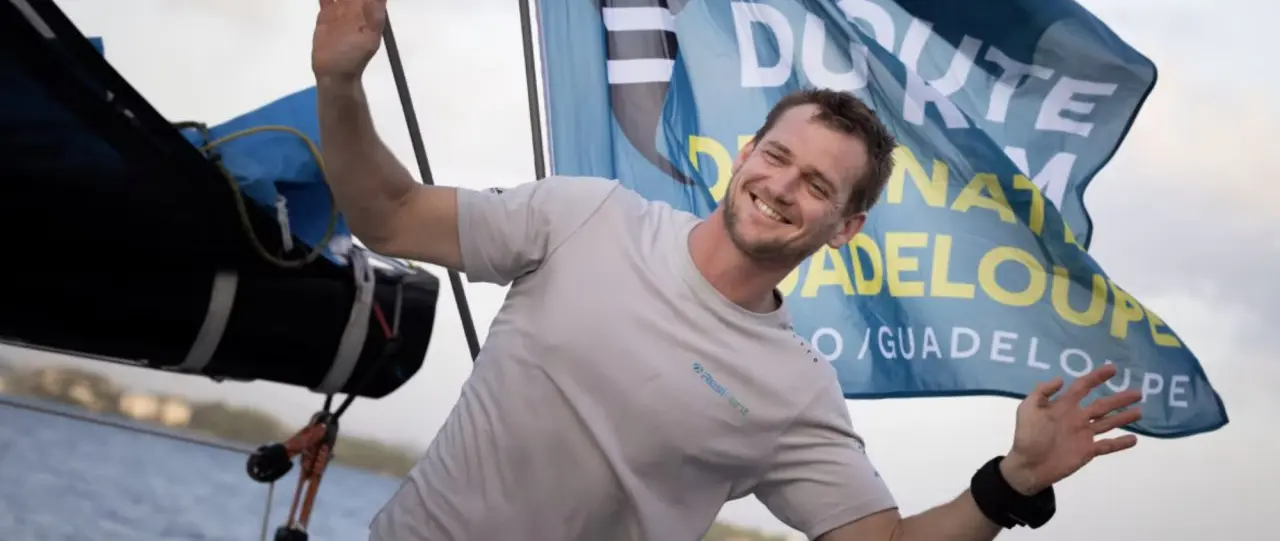
Attwell departed Saint-Malo on 1 November and finished at Pointe-à-Pitre, Guadeloupe, at 05:54:06 local time on 14 November. IMOCA identifies him as 12th overall among the class and third among daggerboard-equipped IMOCA boats. That second comparison matters because a straight-appendage yacht operates in a competitive category increasingly associated with newer foiling designs, but it is not a separate overall race victory. The reported elapsed time, finishing position and equipment distinction provide a measurable sporting outcome. They should be read alongside the conditions and incidents described by his team rather than translated into a universal judgment about the comparative speeds of different generations of IMOCA.
A first Route du Rhum in this boat
The race was Attwell's first Route du Rhum aboard RESILIENT, adding to the challenge of racing a high-performance vessel alone through changing Atlantic conditions. The official report describes intervals of light air, strong winds and moving low-pressure systems, without providing a complete weather data set for independent performance analysis. In solo competition, each course change, sail decision and technical intervention competes with the need to sleep, eat and maintain situational awareness. The ability to keep the boat moving efficiently while managing uncertainty is therefore as relevant as the headline result. For readers interested in ocean-going 12–23.99m yachts, that combination of navigational and mechanical judgment is a familiar, if less extreme, passage-making problem.
A halyard malfunction demanded a mast climb
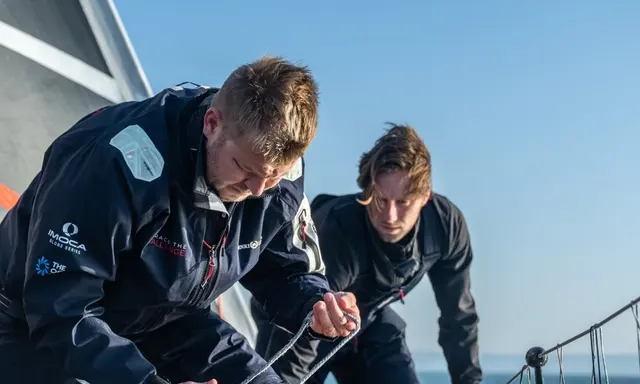
The team reports a halyard jammed in a furler that required Attwell to climb the mast during the crossing. Going aloft offshore is a serious undertaking even with support, and especially demanding on a racing boat operated by one person. The incident is noteworthy not because it offers a procedure to copy, but because it shows how a small equipment malfunction can escalate into a substantial operational risk. The official record does not publish a complete rigging failure analysis, and it would be inappropriate to infer one from a short account. The broader lesson is the importance of accessible inspection points, sound rigging maintenance and contingency thinking before departure rather than assuming every fault can be repaired safely while underway.
Another obstacle near the finishing line
The report also describes a knot in the J2 sheet close to Guadeloupe that forced the skipper to turn back and clear the problem before completing the approach. By that stage he was still trying to close the gap to Sébastien Marsset aboard FOUSSIER. The late incident illustrates the difference between a finish that appears straightforward on a tracker and the complex last miles actually experienced on deck. Inshore approaches can demand changes of pace and sail plan after the exhaustion of an ocean passage. The official account supports the existence of this last setback; it does not quantify the time lost or provide enough evidence to claim it changed the final classification.
Crohn's disease and the RESILIENT project
Attwell has publicly discussed living with Crohn's disease, a chronic inflammatory bowel condition. His RESILIENT initiative uses sailing to raise awareness of chronic illness and invisible disability while exploring support for people who operate far from conventional healthcare services. This is a first-person, voluntarily disclosed part of his own sporting programme, not a diagnosis inferred from photographs or performance. The key editorial distinction is that a skipper with a chronic condition completed a demanding sporting challenge and participated in an experimental monitoring effort. A race result cannot show that similar participation would be appropriate for everyone with a comparable diagnosis; individual medical circumstances and clinical advice remain important.
Two different examinations aboard the yacht
IMOCA identifies an ultrasound examination using a portable device and a video capsule endoscopy using a swallowable camera as the two tests undertaken during the crossing. These are markedly different technologies. Ultrasound depends on obtaining interpretable images with suitable equipment and expertise; capsule endoscopy involves recording images from within the digestive tract. Performing either aboard a moving yacht introduces questions about equipment handling, image quality, data access and clinical interpretation. The announcement demonstrates that the examinations were carried out during the passage, but it does not disclose diagnostic findings or independently assessed accuracy. Presenting them as a complete medical service or a substitute for land-based care would exceed the evidence.
Clinical partners and the limits of the published evidence
The programme involves CHU de Nantes, Nantes University Hospital, and IMAD. Those partners are identified by the official class report, which describes work to explore remote monitoring in isolated environments. The nature of this publication is a sporting and project announcement, not a peer-reviewed study detailing patient selection, comparison groups, accuracy, safety outcomes or regulatory authorisations. Consequently, the responsible conclusion is narrow: the voyage gave the partners a demanding setting in which to explore remote examinations. Any future broader clinical application would require assessment by qualified researchers and authorities. For a yachting audience, understanding that distinction is more useful than repeating ambitious technology claims without supporting evidence.
The remote-care question for long voyages
People sailing long distances can be hours or days from hospital-based assessment even when navigation and communication systems are working normally. That challenge is not limited to competitive sailors; it can arise on cruising yachts, expedition voyages and remote maritime projects. Better communications and portable examination devices may help clinical teams acquire information sooner, but the practical issues are substantial. Equipment must function in humidity and motion, batteries require reliable power, private health information needs secure handling and a qualified clinician still needs to interpret results. This account offers a case study in the difficulties and potential of remote assessment, not a recommendation for an owner to purchase particular diagnostic equipment.
An essential boundary between resilience and risk
Attwell's achievement will naturally be discussed as an example of resilience, but admiration should not turn into simplistic messages about overcoming medical limits. Offshore racing is a chosen high-risk pursuit requiring an appropriate support structure, self-knowledge and professional evaluation. A person managing a chronic illness may require a carefully adapted approach, and what is safe for one sailor may not be safe for another. The team itself frames the project around better understanding and support rather than an expectation that everyone must attempt extreme endurance events. That framing makes the story relevant beyond racing: inclusive access works best when risk is acknowledged and managed, not denied in pursuit of an inspirational narrative.
Technical lessons for yachts with small crews
RESILIENT provides a demanding example of how an offshore vessel can become a temporary working environment for tasks usually performed ashore. A 12–23.99m bluewater cruising yacht has more accommodation than an IMOCA but may still lack stable surfaces, clean working space and dependable data connectivity. These characteristics affect equipment servicing, communications and emergency planning as well as any attempt at remote medical consultation. Owners considering prolonged passages should distinguish routine first-aid capability from specialist diagnostic or treatment claims. Training, communications protocols and an appropriate medical plan established before departure are more credible safeguards than assuming that the presence of one sophisticated device solves access-to-care problems.
Why racing can provide a demanding test environment
Professional offshore sailing produces unusual combinations of motion, isolation, physical workload and time pressure. That makes it a potentially informative environment in which engineering and research partners can observe equipment operating outside the laboratory. It also creates limits: a single athlete and one voyage cannot represent every maritime user or clinical circumstance. The value of the RESILIENT work will depend on what can be learned from the observations, what measurements can be validated and whether future applications are tested appropriately. The reported two onboard examinations are therefore newsworthy as a practical research step, while their long-term significance remains for the partners to establish and publish.
What the result means within IMOCA
The Route du Rhum result placed Attwell among the finishers in a field that included sophisticated newer yachts and highly experienced sailors. His third position among daggerboard boats contributes an important comparison without changing the overall 12th-place classification. The sporting dimension should be allowed to stand on its own, independent of the health project: completing the route after a mast-climb incident and a late sheet problem required considerable seamanship. At the same time, the health work adds a distinctive public-interest component without justifying assumptions about how the examinations affected his racing performance. The two accounts can coexist precisely because the facts supporting them are separable.
What to watch next
The immediate confirmed outcome is a finished ocean race and two examinations conducted at sea as part of the project. The class association has not released a detailed scientific report or announced a commercial maritime healthcare product on the strength of this voyage. Future follow-up should therefore focus on any published assessment from the named medical partners and on Attwell's further sporting programme, rather than forecasting diagnostic breakthroughs. The race demonstrates the demands placed on an offshore sailor and the creativity of a project exploring remote support. Responsible coverage credits both achievements, records the limits of the evidence and avoids treating an inspiring result as medical advice.
Related Luxury Yacht Guide reporting
- Malizia 4 Takes Second in Route du Rhum IMOCA Class
- Malizia 4 Faces First Solo Atlantic Test as Boris Herrmann Races 18.23m IMOCA
- Francesca Clapcich Keeps Racing After 11th Hour Racing Loses Its Bowsprit
- ARC Fleet Sets Course for Saint Lucia as 700 Sailors Depart Gran Canaria
Primary reporting and image credit
Primary manufacturer and organiser source(s): https://www.imoca.org/en/news/news/pierre-louis-attwell-finishes-12th-a-sporting-achievement-and-a-step-forward-for-the-remote-medical-monitoring-of-chronic-illness. © IMOCA / RESILIENT official 2026 team release; first-party article photograph supplied by the class association. Image is used only for correctly attributed factual editorial coverage and never represented as open-licence stock photography.