An overnight setback in the Atlantic
Francesca Clapcich has continued the 2026 Route du Rhum–Destination Guadeloupe after a major structural setback aboard the IMOCA yacht 11th Hour Racing. During her fifth night at sea, the Italian-American solo skipper encountered problems with a headsail and then lost the boat's bowsprit, the forward projection used to support some of its powerful reaching sails. The incident happened while the yacht was sailing west of the Azores in difficult conditions. A team report issued on 6 November says Clapcich was exhausted but uninjured and determined to continue towards Guadeloupe at reduced performance. It is a stark illustration of how quickly an offshore race can change when sail-handling problems meet heavily loaded equipment.
A demanding first Route du Rhum
This edition of the Route du Rhum started from Saint-Malo on 1 November 2026 and sends a large mixed fleet across the Atlantic to Guadeloupe. Clapcich is competing in an IMOCA monohull, a class of approximately 18-metre ocean-racing yachts that sits within Luxury Yacht Guide's performance-sailing size range. The boats are extraordinarily specialised, but the underlying seamanship remains recognisable to anyone who has managed an offshore passage with a small crew. The skipper must make tactical decisions, trim the sails, maintain the equipment, monitor the weather and preserve enough energy to handle unexpected problems. In a solo event, there is no second person to take over the watch while damage is assessed.
The sail sequence before the failure
According to the skipper's team and the official race account, the trouble began as Clapcich was deploying a J0 reaching sail. The sail did not set as intended, fell into the water and wrapped around the J2 forestay. Recovering the sail in darkness and at sea became a difficult operation. Afterwards, while she was preparing a fractional Code Zero, the bowsprit broke. The public accounts establish this sequence but do not constitute a complete engineering investigation into the precise cause of the structural failure. It would be premature to identify one component, manufacturing issue or handling decision as the definitive cause. The immediate news is the loss of an important part of the yacht's sail-carrying capability.
Why a bowsprit matters on an IMOCA
A bowsprit is far more than a convenient fitting extending beyond the bow. On a high-performance offshore racer it forms part of a system that allows particular reaching and downwind sails to be projected forward and flown efficiently. Those sails can be crucial to achieving high speeds at particular angles to the wind. Losing the structure may leave a skipper with a narrower choice of safe and effective sail configurations. The impact depends on the conditions, the remaining rig and what the boat can still carry; it should not automatically be described as making the yacht unable to sail. The team report confirms that Clapcich continued with a reduced sail plan after the damage.
What the team knew on 6 November
The team’s 6 November account placed 11th Hour Racing about 450 nautical miles west of Horta, in the Azores, when the bowsprit broke. It said the yacht had been near the front of the IMOCA competition before the incident and had dropped from third to fourth during the difficult period. The team also reported approximately 1,780 nautical miles remaining to the finish at the time of its update. Those were contemporaneous figures, not a claim about her live position on 7 November or her eventual result. Rankings, distances and boat speeds can change continuously in an ocean race, particularly when a skipper is forced to adapt after equipment damage.
Continuing under a different sail plan
In the team update, 11th Hour Racing was moving under its J3 and mainsail. That detail is important because it shows the skipper was still sailing and managing the boat rather than waiting for a tow or declaring an immediate retirement. A reduced sail inventory can alter speed and tactical options, but it may also help keep the remaining equipment within manageable limits. Every decision after such a failure involves trade-offs: whether to press on, which heading gives the best combination of progress and control, and what further inspection can be undertaken safely. There is no universal answer; the skipper has to assess the actual condition of her yacht and the weather ahead.
The human cost of a long night
Clapcich's own comments, relayed by the team, convey the physical and mental pressure of sorting a sail problem alone after hours of racing. Recovering a large sail from the water can demand concentrated effort, and working around a jammed halyard or forestay in darkness adds difficulty. A later structural failure can feel especially punishing after an earlier problem appears to have been contained. Fatigue itself becomes a seamanship issue. An exhausted skipper must still decide whether to investigate damage immediately, reduce sail further or conserve energy for work that can be completed more safely later. The team emphasised that Clapcich had not been injured, a critical fact amid the speculation that often follows dramatic incident photographs.
A contest shaped by reliability
Ocean racing rewards exceptional boat speed, but it is also a test of keeping a complicated machine functioning through changing conditions. The fastest sail combination on paper has little value if the boat cannot continue carrying it. Every foil, spar, fitting and line belongs to an interconnected system, and the failure of one element can reshape an entire tactical plan. The Route du Rhum brings this reality into sharp focus because skippers are separated by long distances and must operate without the immediate assistance that a coastal race team might have. The best-performing campaigns often combine speed with disciplined checks, conservative decisions at the right moments and an ability to improvise when circumstances change.
The race organisers confirm the incident
The Route du Rhum's official website published a short report on the loss of the bowsprit aboard 11th Hour Racing, corroborating the central sequence described by the team. That independent event confirmation is useful because initial messages from offshore yachts can be fragmentary or published while a crew is still managing an emergency. In this case the core facts are consistent: difficulties with the J0, work to recover the sail, a subsequent attempt to set another reaching sail and the loss of the bowsprit. At the time of the reports, the skipper was proceeding with the race. Later updates may refine the technical understanding or alter the competitive picture, but they should not be anticipated in the absence of published evidence.
A reminder for owner-operated sailing yachts
The mechanical loads on an IMOCA racer are very different from those aboard most private 12- to 24-metre sailing yachts. Nevertheless, the episode highlights principles relevant to offshore owners. Reaching sails and bowsprits introduce concentrated forces; safe handling depends on understanding the manufacturer's limits and the rigging geometry. Owners should make sure the regular crew knows the correct sequence for hoisting and furling sails, how to recognise a developing problem and when to stop an operation rather than force it. A written plan for reducing sail and dealing with jammed lines can be more useful on a difficult night than any amount of confidence gained in fair-weather sailing.
What makes solo racing exceptional
A professional solo ocean racer is trained to operate in circumstances that would be unacceptable for many cruising crews. The skipper has to sleep strategically, monitor systems and manage complex manoeuvres without hands to spare. That reality should not lead recreational sailors to copy the tactics of the race fleet. The sensible lesson is the importance of redundancy and self-sufficiency adapted to the intended voyage. Carrying a suitable alternative sail, checking emergency communications, understanding how the boat behaves with a reduced sail plan and maintaining clear priorities after a failure all contribute to safer passage-making. The situation aboard 11th Hour Racing demonstrates how quickly the original plan may become irrelevant.
The race remains wider than one incident
Clapcich's setback unfolded in the context of a hard-fought IMOCA fleet, where other skippers were also dealing with demanding conditions. The organisers and class association have issued their own updates about separate incidents, underscoring the seriousness of the Atlantic section. It would be misleading to reduce the whole race to a single dramatic breakage or to imply that all competitors face identical risks. Weather systems, yacht configuration and tactical choices can expose skippers to very different conditions even within the same event. The technical performance of each boat is ultimately tested against the sea and against the discipline of the person managing it.
Why the details of the failure matter
The bowsprit is a visible part of an ocean-racing yacht, so its loss produces an immediate and striking image. The more informative questions concern which functions have been lost, whether the hull and remaining rig are sound and what sail combinations remain possible. The available reports establish that the forward projection had failed and that Clapcich carried on, but they do not provide a complete structural assessment. A responsible news report should distinguish those confirmed facts from assumptions about the severity of internal damage. The priority is to understand the skipper's stated situation and not to invent details about hidden systems that have not been inspected publicly.
A competitive decision becomes a seamanship decision
In the opening days of a solo transatlantic race, competitors make choices that may affect position hundreds of miles later. Equipment damage changes the calculation. A damaged yacht may still have enough speed to continue, yet the quickest theoretical route may no longer be the most prudent. Clapcich's team said she was determined to finish as competitively as possible. That ambition is compatible with adjusting the plan to the boat's current capabilities. Offshore racing is compelling because performance and judgement cannot be separated: the skipper is responsible not just for extracting speed but also for deciding what level of load and risk is acceptable while reaching the destination.
The next reliable update
At the time of the 6 November reports, Clapcich was still progressing towards Pointe-à-Pitre, and her immediate situation was confirmed by both her team and the official race organisation. Her eventual finishing position, repair decisions and the full engineering explanation of the broken bowsprit are not established by those reports. The next authoritative information will come from the skipper, the team and the race organisers as the transatlantic passage continues. For the wider sailing community, the episode is a compelling reminder that the most advanced 18-metre yacht is still governed by physical loads, uncertain seas and the skill of the person aboard. In ocean racing, resilience can become as important as raw speed.
Primary sources: Francesca Clapcich official Route du Rhum campaign, 6 November 2026 report; Route du Rhum race organiser's incident account; IMOCA class official updates.
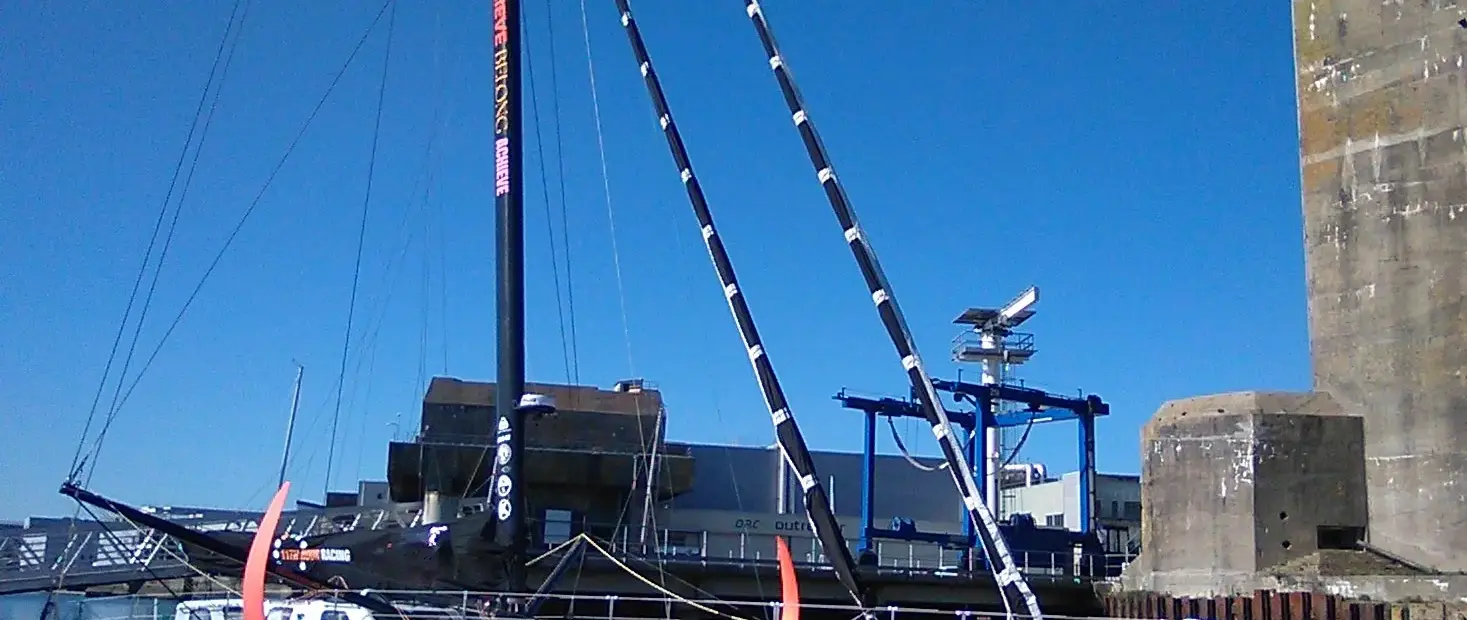
Lead photograph: Clapcich’s IMOCA 11th Hour Racing photographed at Lorient in April 2026 by Jug81, CC BY-SA 4.0 via Wikimedia Commons. The photograph predates the November race and does not depict the broken bowsprit incident.