Incremental change with a measurable purpose
The newest development in performance sailing may be almost impossible to recognise from the dock. Sailmaker Quantum Sails has described a programme in which the most significant advances lie in laminate chemistry, fibre placement, shape analysis and the quality of feedback from customers. In an industry interview published on 7 November 2026, the company's specialists outlined how they seek to turn information from racing fleets and cruising owners into better products. The story is of particular interest to owners of performance sailing yachts between 12 and 24 metres: this is the size range where sail decisions can strongly affect both the handling of a yacht with a small crew and its competitiveness on the racecourse.
Every sailing day offers observations
Quantum's vice president of design, Doug Stewart, describes an approach that begins with on-water experience rather than a marketing drawing. Photographs of sail shape, accounts of handling and reports about durability all enter the development process. A sail that looks effective in a controlled setting may behave differently after hours of use in changing wind and sea states. Conversely, a complaint about difficult trimming can point designers towards a better balance of shape retention and manoeuvrability. The important feature of this process is repetition: a single favourable race result does not prove a product is superior, but consistent feedback from many different sailors can indicate where further testing should be directed.
Why one-design racing is a useful laboratory
The interview cites the J/70 one-design fleet as an example of unusually clear performance feedback. When boats are broadly comparable, differences in sail development may be easier to isolate than in mixed fleets where hull, keel, rig and crew factors vary substantially. Quantum points to refinements used on successful J/70 programmes during the 2026 season. The smaller J/70 itself is not a 12- to 24-metre luxury yacht, and its race results should not be presented as direct evidence of how a larger cruiser will perform. The transferable lesson concerns the testing method: repeated comparison under similar conditions, with careful attention to what changed and what stayed constant.
Materials as a design variable
One of the company's more consequential decisions has been to develop greater control over material formulations. Traditional sailmaking involves buying films, fibres and adhesives from specialist suppliers, then assembling them into finished structures. Quantum says its expanded internal technology team can formulate proprietary components and examine how those components interact. That could allow a designer to address weaknesses at the boundary between materials, rather than treating each purchased layer as fixed. The attraction is obvious, but so is the difficulty: chemical changes must be evaluated for long-term consistency, manufacturing repeatability and performance in real conditions. An elegant theoretical improvement is not enough if the finished sail cannot survive a season.
The issue of laminate bonding
Quantum's VX Surfaces platform focuses on the bond between a polyester surface film and the internal structural layers of a membrane sail. That interface is critical because a sail is repeatedly flexed, loaded, unloaded and exposed to water, heat and movement. The company says its QTec bonding system is designed to reduce defects and create a more stable connection across the laminate. This is a manufacturer account of its own technology, not an independently verified lifetime-performance comparison against every alternative on the market. Nevertheless, it identifies a problem that yacht owners know well: a sail may lose its useful shape or structural integrity before every individual fibre has worn out.
What long-term shape retention means on board
A sail is not judged solely by how quickly it makes a boat move on its first outing. Owners also care whether it continues to set properly after a long passage, repeated reefing and months of storage. A laminate that better holds its designed shape can, in principle, preserve predictable handling and a more repeatable trim response. The actual outcome will depend on the design, cloth, loads, rig tune and care of a particular yacht. Some 16- or 18-metre cruisers prioritise forgiving handling and longevity; others are optimised for short-handed racing. There is no single construction that must suit every brief. Quantum's materials programme is notable precisely because it seeks more control over the choices available to designers.
A different approach to tri-radial construction
The company also describes Electra, a tri-radial racing sail platform that applies advanced aerodynamic modelling and load-path analysis to a panelled format. A common assumption is that membrane construction is always the premium answer and that panelled sails are inevitably compromised. The reality is more nuanced because materials, panel orientation and design intent matter. According to Quantum, Electra combines high-strength aramid or carbon warp fibres with a low-stretch UPE cross-ply to manage loads in different directions. The platform seeks to offer some benefits associated with membrane-derived shapes while keeping the advantages of a different construction and manufacturing route.
The importance of the complete sail plan
In one project cited by Quantum, an older X-382 named Yabadaba Too had its sail inventory and geometry rethought, moving away from a traditional arrangement with a larger overlapping genoa towards a bigger square-top mainsail and a single furling headsail. It is a useful illustration of a design principle, although that particular boat is not presented here as a new luxury yacht launch or as proof that every owner should copy its setup. The best sail programme considers how the entire arrangement works together: rig geometry, crew workload, sail changes, balance and the expected conditions. A new sail used with the wrong overall configuration may never reveal its intended advantage.
The role of digital modelling
Quantum's iQ Technology predates the present announcement and provides an established framework for modelling aerodynamic behaviour, structural loads and sail shape. The company's own technical literature describes the use of three-dimensional design, computational fluid dynamics, finite-element analysis and validation on the water. Such software can make it less expensive to explore alternatives before cutting and assembling material. It cannot fully replace sailing experience because real yachts operate in changing conditions and because the behaviour of a crew is difficult to represent in a clean numerical model. The strongest process joins the calculations to a controlled test programme and remains willing to change a design when the water produces inconvenient evidence.
Designing for a 12- to 24-metre performance cruiser
A larger performance cruiser must reconcile objectives that a small one-design racer can often treat separately. It may carry several guests, need a manageable watch system and undertake long passages in addition to racing. Owners can benefit from modern sail construction, but the right technical specification starts with questions about frequency of use, average wind conditions, crew experience and the trade-off between peak speed and everyday tolerance. The designer should also know whether the boat is routinely reefed, whether power winches are installed and whether the main challenge is light-air performance, durability or ease of short-handed manoeuvring. Better materials make more options possible; they do not remove the need for an honest owner brief.
Why sail photographs are useful data
Sailmakers commonly ask for images of a sail when it is loaded and trimmed in particular conditions. The exercise can feel surprisingly ordinary in an era of advanced simulation, yet the photographs record practical information that cannot be extracted from a theoretical drawing alone. Draft position, leech behaviour, wrinkles and the interaction with the rig help tell a story about the sail's current state. The most useful photographs are taken consistently and accompanied by information about wind, apparent angle and trim. For the cruising owner, preserving that record over time can be a sensible way to spot changes in shape and communicate with a sailmaker before the next season.
A supply-chain change with competitive implications
Taking more material science in-house potentially changes how quickly a manufacturer can respond to a problem identified by sailors. A company that depends entirely on outside suppliers may have to wait for the next available film or adhesive technology. An internally developed platform can, in principle, be adjusted more directly and tested against the company's own objectives. That does not guarantee cost advantages or better results for every customer. It does create a more integrated development chain, where design, materials, manufacturing and field observations can be discussed by people working towards the same product decision. Quantum presents this integration as an important part of its recent investment.
What owners should ask at the loft
The practical benefit of this technical discussion is a better set of questions to take to a sail consultant. Which measured use case was the proposed cloth developed for? How does its construction manage fatigue and repeated folding? What shape-retention data can be shared, and under which conditions was it obtained? Can the sail be handled safely by the yacht's normal crew, and how will repairs be managed on a passage far from the loft? When comparing quotes, owners should examine expected service life and ease of operation as well as the claimed performance gain. Those questions keep a purchase grounded in the realities of owning and operating a yacht.
Why small refinements deserve attention
New hull forms and high-profile foils attract the strongest headlines, but the quiet evolution of sail materials may have more regular influence on the experience of private owners. A slightly more stable shape can improve confidence in trimming; a better-understood laminate may alter maintenance decisions; more reliable feedback can help a sailmaker improve its next production run. None of those outcomes should be assumed from promotional claims alone. They need to be assessed for a given yacht and its use. Quantum's November account is valuable because it explains where the company is investing its development effort and invites sailors to look beyond the obvious appearance of a sail.
From the racing fleet to bluewater cruising
The most convincing part of the message is the link between sailors' objectives and technical choices. A racing team may value acceleration after a tack, a short-handed passagemaker may prize a predictable sail that is easy to depower, and a luxury yacht owner may want both without turning every weekend into a maintenance exercise. A modern design programme can learn from all of those users while preserving the distinctions between them. For the 12- to 24-metre sector, the opportunity is to apply sophisticated research selectively, choosing technologies that solve real problems on board. The measure of progress will be the quality of the finished sailing experience, not simply the novelty of the materials brochure.
Sources: Seahorse Magazine interview with Quantum Sails staff, published by PressMare, 7 November 2026; Quantum Sails official iQ Technology technical material.
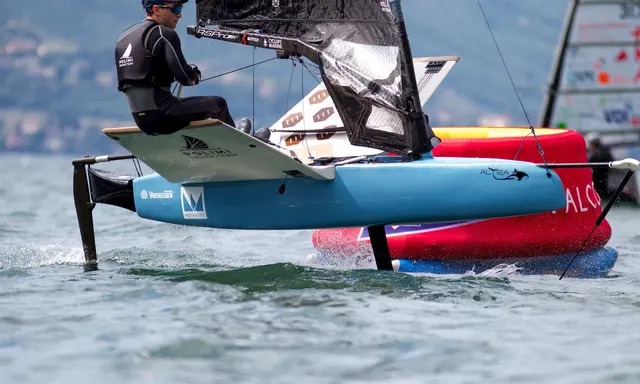
Lead photograph: a general sailing-yacht scene off Ikaria, used for context; it does not depict Quantum's specific 2026 products or their trials. Image author and CC BY-SA 4.0 attribution are recorded in the existing LYG media library.