Wichard previews lighter deck fittings for the 2026 equipment season
French marine-hardware manufacturer Wichard has announced two catalogue additions for Metstrade 2026 in Amsterdam: a family of aluminium padeyes intended for soft attachments, and a nautical-inspired Origin Bracelet. The announcement, dated 4 November, puts the engineering item first. Wichard says the compact padeyes can serve as fixed attachment points or fairleads for control lines, making them pertinent to the working deck of a modern cruising yacht. The two products will be introduced to visitors between 17 and 19 November in RAI Amsterdam's Hall 5, stand 441. For Luxury Yacht Guide readers, the hardware is the more consequential development; the bracelet reveals a separate part of the maker's design language.
What a padeye does aboard a sailing yacht
Padeyes are among the least conspicuous fittings on a boat, yet their placement shapes how rope loads are transferred into the hull or deck structure. In simple terms, a padeye provides an attachment or lead point. It can connect a block, guide a running line or contribute to a restraint system, provided that the fitting, fasteners and structure have been specified for that duty. The deck may look clean when everything is positioned correctly, but the forces exerted by sails, crew and lines remain real. Wichard's new announcement deserves attention because it addresses this practical interface between equipment, line routing and structural support, rather than only a visible helm feature.
Five versions and two installation approaches
According to Wichard, the aluminium soft-attachment family consists of five models. Each model is to be offered with a screw-mounted or threaded-stud installation option. That makes ten mounting combinations in principle, although the announcement does not set out the dimensional differences, individual reference numbers or respective working-load limits. Those details should be verified in the current technical catalogue before an owner or refit team selects a fitting. Installation choices matter: a fitting mounted from above may be accessible for later inspection, while a stud arrangement may suit a different backing structure or surface finish. Neither design should be assumed superior without knowing the load path and access available in the actual boat.
Soft attachments are changing the detail of deck plans
Wichard highlights uses with soft-attached blocks and low-friction rings. A soft attachment generally relies on a carefully specified rope or textile connection where a traditional metal shackle might otherwise have been considered. That can help designers arrange compact line systems, but the purchase decision involves the entire assembly: line material, bending radius, abrasion protection, fitting surface, duty cycle and inspection. The new padeye should not be read as a promise that every metal connector on a yacht can be replaced. A particular rigging designer must establish whether the interface is appropriate for the load case. The manufacturer describes versatility, while the engineering record must establish suitability.
Reefing lines and a more orderly working deck
One application identified by the company is the routing of reefing lines. On a yacht, where reefing may be carried out under increasing wind and motion, the reliability of a line's route matters as much as the convenience of the hardware. A fitting can be used to direct a line towards an organiser, winch or other designed control point, but it must not introduce an inappropriate bend or expose the rope to a sharp edge. For a 12–23.99-metre cruiser, the cockpit, coachroof and mast base can become congested with competing leads. Compact hardware may create layout options in these areas. That potential remains an engineering design benefit to be assessed, not a quantified performance result of the newly announced products.
Fairleads for tack lines and halyards
Wichard also lists use as fairleads for tack lines and halyards. These duties are not interchangeable: the direction and magnitude of loads can change substantially with sail choice and rig configuration. The manufacturer says the padeyes have a refined shape intended to reduce rope chafe and protect the deck. The practical question for installers is how a line will move across the fitting through its whole operating range. A fairlead that looks adequate when tied up may encounter a different geometry with a sail loaded, an asymmetric tack eased or the mast bending. A review of full line travel is therefore as important as judging the padeye's appearance in a catalogue photograph.
Safety lines demand additional scrutiny
Among the stated applications are attachment points for jacklines and lifelines. That brings the announcement into the realm of safety-critical equipment. A jackline anchor can become part of an arrangement intended to help prevent a crew member going overboard, while guardrail systems have their own design and inspection requirements. A manufacturer listing an application is not a substitute for verifying a complete installation to the relevant standard and vessel-specific requirements. Owners should ask for the working-load documentation, safety factors, mounting guidance, maintenance advice and any stated limitations. An attractive fitting is only one link in the system. The supporting laminate, backing plate and fasteners must be considered together with the connection above deck.
Aluminium saves weight only when the design is complete
Wichard describes the new fittings as lightweight and space-saving. Aluminium can offer a compelling strength-to-weight trade-off in selected marine applications, but the announcement does not publish a verified weight saving against a specified stainless-steel predecessor. A useful comparison would measure both fittings in the same load class, include required reinforcement and take account of the corrosion-protection system. Reducing mass high above a yacht's centre of gravity is sometimes a worthwhile objective, but these particular components sit low on the deck, and their cumulative contribution is unquantified. The immediate attraction is therefore compactness and a potentially simpler line path, subject to demonstrable load capacity.
Corrosion and material combinations
Any aluminium deck fitting has to be considered in its installation environment. Contact between dissimilar metals in a conductive, saline setting can create conditions for galvanic corrosion unless suitable materials, coatings and isolation methods are used. The manufacturer's exact finish, permitted fasteners and maintenance schedule have not been specified in this announcement. A prudent refit specification will request those details, particularly where fittings are mounted in areas that retain salt or are hard to rinse. It will also consider whether nearby rope, carbon-reinforced components or other hardware impose specific installation requirements. Good material engineering is about a managed combination, not simply the material name on the product box.
Why the 12–23.99-metre sector should look closely
Luxury cruising yachts in this size range can carry demanding sail plans while retaining expectations of easy operation with a modest crew. Sail handling systems often need to balance accessible maintenance, line clarity, reliable load capacity and visual restraint. A new attachment family potentially gives the designer more choice when arranging these competing requirements. The announcement does not identify particular yacht models or claim that the new fittings have been adopted by any builder. Accordingly, Luxury Yacht Guide treats Wichard's release as an equipment option for evaluation across relevant sailing-yacht projects, not as evidence of a production installation or a tested increase in sailing performance.
Questions to take to Amsterdam
Visitors to Metstrade have an opportunity to move beyond the launch description. Useful questions include the separate working-load limits for each of the five sizes, whether the limits vary by pull direction, how proof testing has been conducted, which fastener and backing arrangements are approved, and which rope diameters or attachment materials are suitable. Installers should ask for guidance on sealing penetrations and checking torque after service. If a fitting is intended to guide a moving line, users will also want to know whether a wear surface can be inspected and how to identify unacceptable damage. Published drawings and installation manuals will carry more weight than marketing phrases when a particular boat is being specified.
Maintenance is part of the value proposition
Even a compact padeye becomes less convenient if it requires difficult access beneath a finished cabin ceiling. A well-planned layout should allow inspection of the underside where practicable, protect threaded parts from unwanted movement and avoid trapping water around deck penetrations. Crews need an inspection routine suited to the actual duty. Connections used during occasional fair-weather cruising may face a different cycle from those handling high sail loads on extended passages. The launch announcement makes no claim about maintenance intervals or a product warranty, so such information should be obtained directly from Wichard. Owners should keep specifications and installation records with the vessel's technical documents for future refit decisions.
Origin Bracelet connects engineering with personal style
The other Metstrade introduction, the Origin Bracelet, is not a load-bearing deck component. Wichard says its design takes inspiration from the pentagon in the brand's original logo. The bracelet pairs a 316L stainless-steel pentagon with a French-made cord and is adjustable with two sliding knots. Announced colours are navy blue, powder pink and vibrant orange. Wichard credits the cord to Gauthier Fils of Vertolaye, approximately 40 kilometres from its Thiers operation, and references the supplier's five generations of braiding work. The company does not list a retail price or availability by market in this release. Buyers should therefore avoid assuming that all colours will be in stock immediately after the trade show.
A maker's heritage interpreted in two ways
There is an interesting contrast in Wichard's pairing. The padeye belongs to the technical language of modern lines, soft connections and performance-conscious deck detailing. The bracelet converts a metalworking motif into a personal accessory. Both make sense as extensions of a company known for marine hardware, but they have very different evaluation criteria. A purchaser choosing the bracelet can primarily consider design, fit and finish; a purchaser choosing the padeye must begin with an engineer's assessment of load paths and structural safety. Treating both launches as equally interchangeable lifestyle products would obscure what matters most to yacht owners and crews.
What the announcement does and does not establish
The manufacturer has verified the product families, five padeye versions, two mounting types, example uses, bracelet construction and show location. It has not published in this release the padeyes' measured mass, detailed dimensions, maximum operating loads, retail pricing, certification documents or an independent test. Wichard's statement about a reduced tendency to chafe is a product-design proposition; there is no comparative test figure here from which Luxury Yacht Guide could calculate a percentage improvement. Readers should also note that the official 17–19 November presentation lies ahead at the time of writing, so direct hands-on assessment and installation feedback remain future steps.
Why this launch deserves its place in the equipment diary
Yacht technology is often discussed in terms of electric power, navigation screens or digital connectivity. Yet small deck fittings can have a direct impact on how a boat is rigged, serviced and used in poor weather. Wichard's 2026 announcement is meaningful because it targets these tangible details and provides a real product family for professional evaluation. For the luxury-yacht segment, the responsible next step is to check each padeye against a documented system drawing and to reserve judgement on unverified efficiency or weight claims. Amsterdam will provide an opportunity to examine the hardware; a properly engineered installation will determine its value afloat.
Primary source: Wichard Marine, 4 November 2026: “Wichard unveils its new products for 2026 at Metstrade”. Product specifications and prices not stated by Wichard have not been invented.
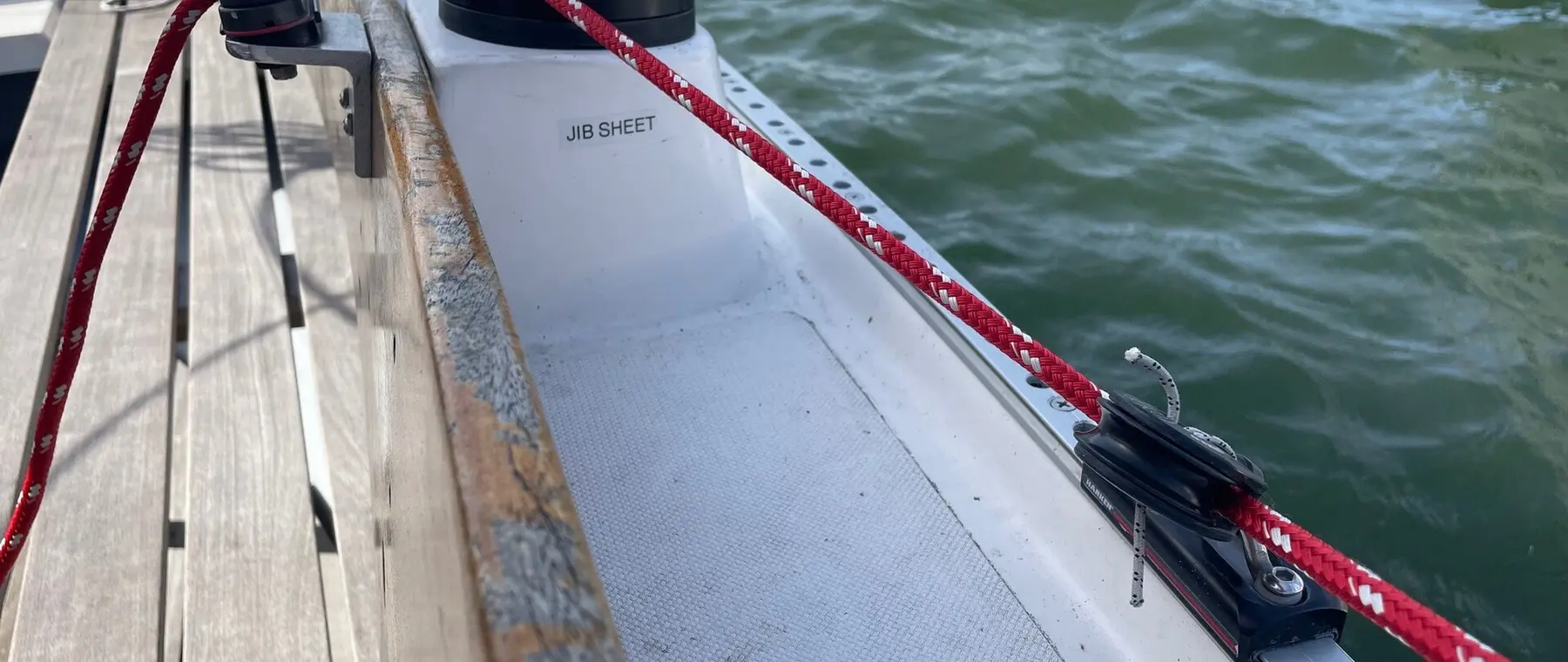
Photograph and licence: Adjustable fairlead and winch line aboard a sailing yacht, photograph by Anaphi61 on Wikimedia Commons, CC BY-SA 4.0; resized for web. This illustrates a running-line routing arrangement, not a Wichard aluminium padeye or Metstrade display.