A new voice at the helm
Francesco “Checco” Bruni has made his first public appearance as the new skipper and helmsman of Tudor Team Alinghi, setting out a programme that is as much about people and preparation as it is about speed. The Italian sailor faced reporters at the Club Nautico in Naples on 6 November 2026, less than two weeks after the Swiss challenger announced his move from Luna Rossa. The occasion provided the clearest outline yet of how the team intends to move from the planning room to the water ahead of the 38th America’s Cup in 2027. It also offered a rare view of the decisions still open inside a campaign where the margins are narrow and the technical demands considerable.
A move between two rival campaigns
Tudor Team Alinghi confirmed Bruni’s appointment on 26 October. He joins from the Italian Luna Rossa programme, where he had helmed in the previous two Cup editions before taking a coaching role. The team identifies him as a seven-time world champion across different sailing classes. His transfer is notable because this is not simply a sailor moving clubs: the America’s Cup is organised around highly specialised design, sailing and operational knowledge. Bruni said discussions involved both teams and the people responsible for authorising a move between competitors. He has made clear that the rules surrounding confidential information remain binding. That distinction is important. Experience at the helm is a portable skill; protected technical information belonging to another challenger is not.
Why Naples matters to this challenge
Naples is both the next venue of the America’s Cup and the centre of the Swiss team’s near-term work. For an Italian sailor returning to the front line, that gives the campaign a particularly personal setting. Bruni spoke about the warmth of the city’s welcome and the practical help received from local people. He was equally candid about the question of support: Italian followers will naturally have a strong attachment to Luna Rossa, yet he hopes to earn some admiration for the rival team through the quality of its sailing. A home-water advantage is not automatic simply because a skipper knows the coastline. It has to be built through repeated sessions in the conditions a team is likely to encounter on the racecourse.
BoatOne moves towards its next stage
The AC75 known as BoatOne is now central to the programme. According to the team's October announcement, the boat was due to arrive in Naples before the team’s return to sailing in December. At the November press conference, Bruni described a particularly intense first week of work, including the boat’s arrival from Genoa and continuing completion tasks at the base. The difference between a boat arriving and a race-ready campaign is substantial. A high-performance foiling yacht requires careful preparation across engineering, rig systems, electronics, crew fit, shore operations and training procedures. The team's immediate objective is to turn the physical platform into a reliable tool for learning, not merely to put an impressive machine on the water for photographs.
The human configuration is not settled
One of the strongest messages from the conference concerned an unresolved question: who will occupy which positions in the cockpit. Tudor Team Alinghi already has sailors including Paul Goodison and Phil Robertson, and Bruni was asked directly who would co-helm with him. His answer confirmed the leadership appointment without declaring a final partnership. Bruni is the skipper, but the allocation of individual sailing stations remains open. He also discussed the issue of which side of the boat he would occupy, a choice influenced by the requirements of the foiling system and the ability of several sailors to perform effectively in different positions. His stated ambition is a flexible group capable of sharing responsibilities, with the eventual configuration chosen through performance rather than assumption.
What a flexible sailing team changes
For the reader accustomed to a 12- to 24-metre performance cruiser, the AC75 may look like a distant extreme. Yet the decision-making principle is familiar. A powerful yacht becomes more effective when every crew member understands the boat, the communication sequence and the limits of the other stations. On an ordinary offshore passage, that might mean a second person who can handle navigation or trim. In a foiling Cup campaign, it means training a highly specialised crew to make fast, accurate decisions under pressure. Bruni’s public emphasis on adaptability suggests the team is treating crew selection as an ongoing test rather than a ceremonial announcement. The exact outcome will become clearer once meaningful sailing data and repeated training sessions are available.
From preliminary regattas to the main programme
Bruni was asked about Tudor Team Alinghi’s performances at its two preliminary regattas. He acknowledged that the team had shown improvement from Cagliari to Naples, while also identifying inconsistencies and areas for further progress. Preliminary events matter because they expose behaviours that cannot be established through calculations or simulator work alone. They show whether calls are understood, how sailors react after an imperfect start and whether equipment and communication retain their quality when conditions change rapidly. Bruni's approach appears to be to examine those lessons and then build a better-performing operation. It would be premature to infer from the preliminary results which challenger will lead in the final event next year.
Experience and reaction time
At 52, Bruni was asked whether reaction speed might be a disadvantage against younger competitors. His response drew a distinction between the speed of pressing a control and the judgement to press the correct one. This was a useful insight into the demands of modern racing. Foiling yachts create very short windows in which a decision must be made, but there is little value in a rapid response if the underlying call is wrong. Experience can help a sailor recognise patterns, avoid repeating mistakes and make a judgement earlier. Youth may provide other advantages. The team’s challenge is to combine those strengths in a cockpit where collective rhythm matters more than any individual’s reputation.
The importance of time on the water
Bruni repeatedly returned to the importance of sailing hours in Naples. The Cup will be decided on the water, and each effective training session provides an opportunity to understand the boat, test coordination and improve reliability. Time spent afloat is not automatically productive. It is possible to use a day of good weather badly if a team arrives without a clear plan, returns without reliable observations or cannot translate feedback into the following day’s work. The opposite is also true: a carefully planned session can resolve important questions without needing perfect conditions. In this sense, the campaign resembles the most disciplined offshore sailing programmes, where preparation before leaving the dock often determines the value of the passage.
A technology competition with a human centre
The America's Cup is sometimes described in terms of radical foils, composite structures and aerodynamic efficiency. Those elements are essential, but Bruni’s remarks underscored that they do not remove the need for leadership. Someone must decide what to test, judge which lessons are reliable and ensure the sailing group remains capable of honest feedback. A challenger may have highly sophisticated systems and still struggle if its sailors cannot communicate clearly or if the engineering and on-water teams pursue different priorities. The leadership role therefore extends beyond steering. It requires connecting the way a yacht is designed, maintained, practised and ultimately raced. That is one reason why the appointment of an experienced helmsman can influence a campaign well before a start gun sounds.
The significance for owners of smaller performance yachts
Although an AC75 is outside the size and practical purpose of a luxury performance cruiser, the lessons are relevant to owners and skippers of much smaller yachts. A new rig setting, instrument package or sail cannot be fully judged until a consistent crew has learned how to use it. Changing several variables at once makes it difficult to identify the cause of an improvement or a problem. Training multiple people in critical positions makes a yacht more resilient when passages are long or conditions deteriorate. There is also value in treating a debrief as part of the sailing day rather than an optional conversation afterwards. These are transferable habits, not a suggestion that cruising owners need the budgets or technology of an America’s Cup team.
Sailing in the Gulf of Naples
The setting itself will become an increasingly important part of the narrative. The Gulf of Naples presents a distinctive sailing environment, combining an open expanse of water with nearby landforms, local effects and the practical demands of operating out of a busy city. It would be unwise to turn a general description of the area into a prediction about Cup race conditions. What matters now is that the teams have a specific place in which to prepare and will be able to compare their boats and sailing procedures against actual days on the water. Bruni has expressed enthusiasm for the prospect of racing in Italy, and the host city now has another high-profile personality around whom anticipation can build.
The next visible milestones
For Tudor Team Alinghi, the immediate sequence is straightforward in principle: complete the outstanding work on BoatOne, establish a productive sailing routine and assess which crew configurations are strongest. Bruni and his colleagues are not yet at a stage where the final answer to every role has been published. He was careful to keep those decisions open. Nor has the team promised an early competitive result. Its official communication points to sailing in December and to the larger objective of competing at Naples in 2027. The next reliable measures will be visible activity on the water, the team's subsequent progress reports and the eventual announcement of its racing configuration.
A consequential opening, not a prediction
Bruni’s first conference is significant because it reveals how the new skipper intends to lead: with enthusiasm, respect for the expertise already in the team and considerable attention to the work still to be completed. The move from Luna Rossa gives Tudor Team Alinghi a renowned sailor, but it does not instantly transform the challenger into a favourite. America's Cup campaigns are the product of many linked disciplines, and most of their value accumulates through months of testing and refinement. For yacht owners following the competition from the Mediterranean, the compelling story in the coming weeks will be whether that combination of experience, a prepared boat and an increasingly settled crew begins to translate into consistent performance.
Primary sources: America’s Cup official press conference account, 6 November 2026; Tudor Team Alinghi official appointment announcement, 26 October 2026.
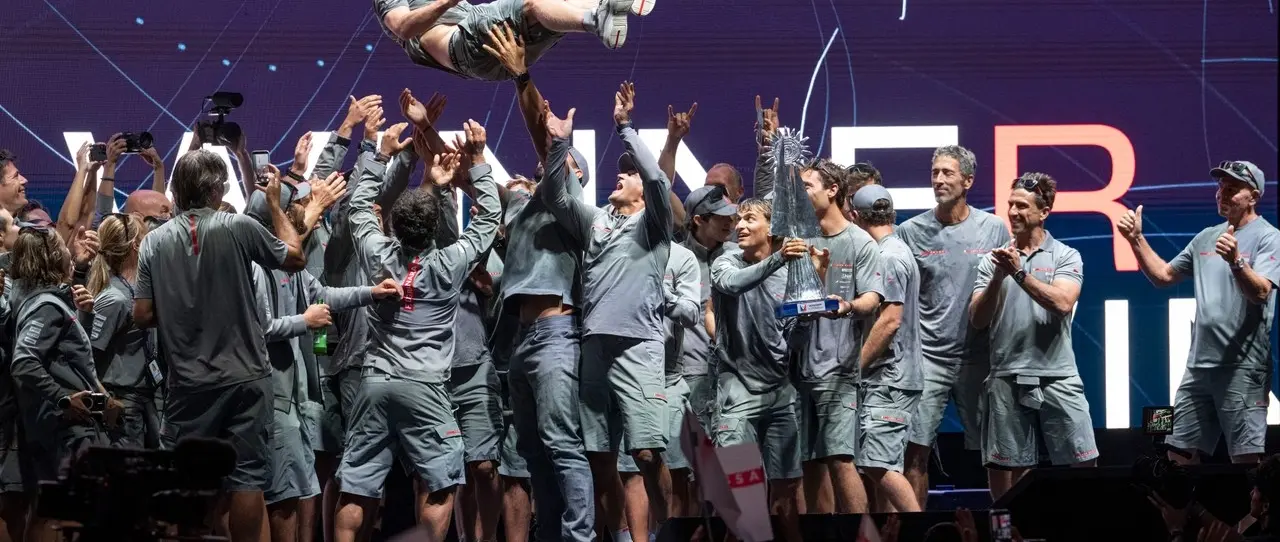
Image: America’s Cup racing in Naples, an earlier official event photograph used for context. It does not depict Bruni’s 6 November press conference.