A retirement confirmed after four days of investigation
Violette Dorange will not resume the 2026 Route du Rhum – Destination Guadeloupe aboard the IMOCA Initiatives-Cœur. Her team confirmed the retirement on 6 November after a detailed inspection in Lorient revealed structural damage that could not be repaired within the race’s timetable. The decision closes an attempted comeback that began almost as soon as the yacht reached shore following an early-race collision. It is a race retirement on safety and engineering grounds, not simply a delay caused by unfavourable sailing conditions.
The development matters in the 18.28-metre IMOCA fleet because it shows how an offshore campaign can be decided by hidden damage rather than by pace on the racecourse. The team had hoped to resume the solo crossing, but examinations exposed problems beyond what its initial stopover inspection could identify. Racing has continued for the other competitors, while Dorange and the shore crew now face a repair programme whose length cannot sensibly be shortened to fit a sporting deadline.
What happened off Bréhat on 1 November
According to the IMOCA class and the Initiatives-Cœur team, Dorange’s monohull collided with Romain Pilliard’s trimaran Use It Again off Bréhat on Sunday 1 November, roughly two hours after the fleet left Saint-Malo. Both boats sustained material damage, but the team reported no injuries. Dorange made for Roscoff, where an initial examination could be carried out, then continued to Lorient for a more comprehensive investigation by the technical team.
The sequence is important because the first assessment did not reveal the full extent of the problem. It also matters that the collision’s circumstances were still being considered by the race jury when the withdrawal was announced. The team explicitly declined to comment on responsibility while that process continued. No conclusion about fault should be drawn from which boat retired, which boat changed course, or the severity of the subsequent repairs. Those are different questions, subject to different evidence.
Why the first inspection was not enough
High-performance offshore yachts use sophisticated composite structures, and a collision can affect material beneath a surface that does not fully reveal the underlying condition. The team said that visual examinations and ultrasound testing were followed by dismantling of damaged sections of the hull bottom. Only then did the technicians establish the more extensive condition of the laminate and its underlying core, a finding that changed the feasibility of returning to the race.
The team described the hull skin as a sandwich composite containing a honeycomb core and said the affected material had become saturated with water. Further damage was discovered below a separate structural component that would also require removal. These specific findings come from the official repair assessment, not an independent survey by this publication. They explain why a seemingly short stop became a major technical intervention, and why an early determination based only on visible damage would have been unreliable.
The repair cannot be treated as a racing pit stop
Initiatives-Cœur technical director Ronan Deshayes explained that the affected areas must be opened up, the yacht brought under cover, the material dried and damaged structures rebuilt. That is a controlled composite-repair operation rather than a simple replacement of deck equipment. The team’s stated priority is the safety of the skipper and the integrity of the boat, even though the decision ends a major race campaign in which considerable preparation and sponsorship have already been invested.
How long the repairs will take has not yet been specified publicly, and there is no responsible basis for assigning an estimated completion date. Drying, damage assessment, structural reconstruction and subsequent testing are all activities that require professional judgment. It would be misleading to imply that a yacht can return to ocean racing immediately after a damaged area has been covered or cosmetically repaired. In a solo transatlantic event, decisions made on shore must remain reliable when a skipper is days from practical outside assistance.
An 18.28-metre yacht built for the IMOCA class
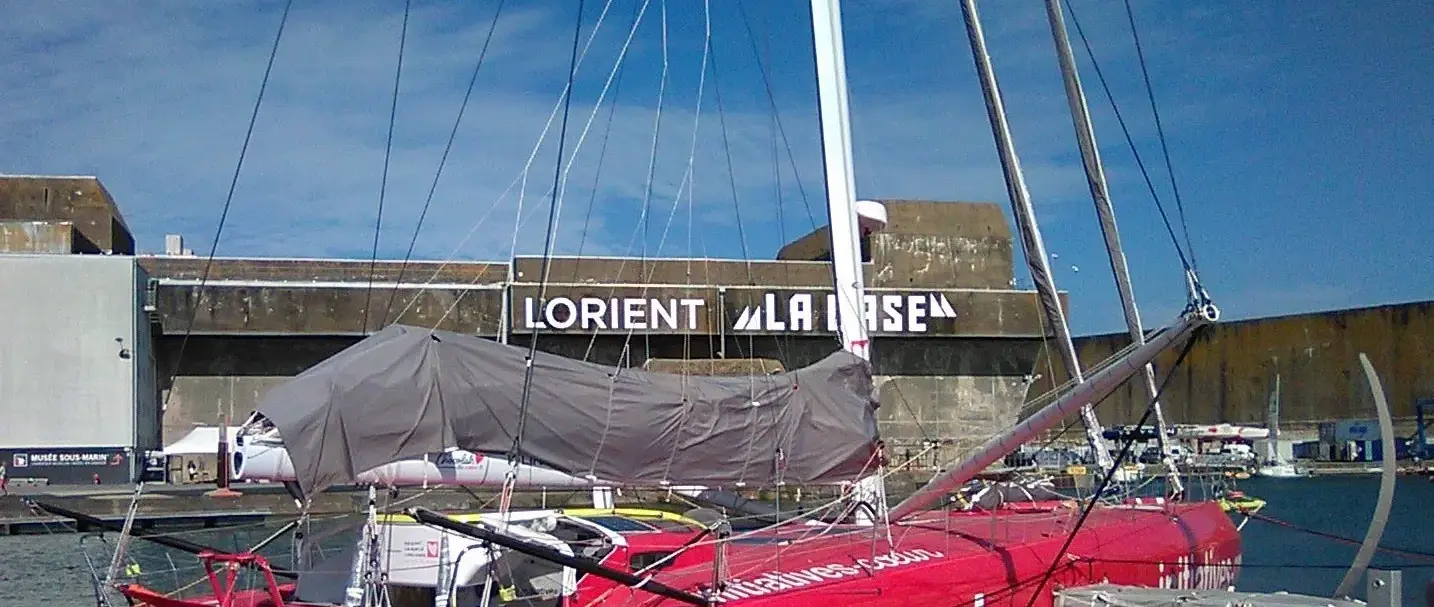
The yacht at the centre of the news is Initiatives-Cœur 4, an IMOCA 60 measuring approximately 18.28 metres. The class’s official vessel record states that the boat was launched on 30 July 2022 and built by Black Pepper using moulds associated with Armel Tripon’s yacht. It is a Sam Manuard design, one of the generation featuring a broad, rounded scow-style bow, with later adaptations to the class rule and demanding ocean-racing use.
This places the yacht squarely in Luxury Yacht Guide’s 12.00–23.99-metre coverage, although an IMOCA racer is obviously not a conventional cruising yacht. Its relevance goes beyond spectacle: the structures and maintenance challenges of an advanced racing monohull are instructive to owners of performance sailing boats, surveyors and refit specialists. A fast 60-footer is a tightly engineered system, so hidden hull damage is a substantive technical issue rather than a routine inconvenience.
Violette Dorange’s first solo season at the helm
Dorange took over as the lead skipper of Initiatives-Cœur for 2026 after sailing alongside Samantha Davies during the preceding season. The team’s official material describes the handover as part of a longer programme looking towards the Vendée Globe 2028. It was a significant step for a young offshore racer who had already built experience across different classes and had become closely associated with the project’s public mission.
The Route du Rhum was intended to be a major solo test aboard this particular yacht. The retirement interrupts that progression, but the team's statement makes no claim that the wider campaign has been cancelled. Instead, it says the 2027 race calendar will be announced once plans are finalised. That is a sensible distinction: an immediate sporting objective has ended, while decisions about future competitions should follow the restoration of the boat and a fresh assessment of its readiness.
A collision investigation remains separate
The official statement confirms that the race jury was examining the events of 1 November. In racing terms, the investigation and the repair are parallel matters. One establishes how a collision occurred and whether any rules or responsibilities are engaged; the other establishes whether a damaged vessel can safely sail. A technical team's decision to stop competing is not equivalent to a formal jury finding about what caused the incident.
That distinction also protects the other project involved. Romain Pilliard’s Use It Again sustained damage, and the Initiatives-Cœur team expressed sympathy and hope that its competitor could return to the event. The available official statement does not establish the trimaran’s ultimate race outcome. Any subsequent race results or jury decisions should be reported against their own dated sources. Offshore racing deserves reporting that distinguishes confirmed engineering facts from questions that are still open.
The charitable objective continues ashore
The name Initiatives-Cœur refers to more than a boat and a racing campaign. The project supports Mécénat Chirurgie Cardiaque, the organisation associated with medical treatment for children with heart conditions. For this edition of the Route du Rhum, Dorange had set a target of helping 20 children. In the withdrawal announcement the team said mobilisation had already helped 14 and emphasised that the fundraising effort would continue despite the sporting setback.
According to the team, sponsors Les Chocolats du Cœur.fr and K-LINE are contributing one euro to the charity for each new follower of the project’s social-media accounts and matching donations made through the dedicated appeal. Those arrangements and the reported beneficiary count are attributed to the organisers; they are not financial figures independently audited here. The result is a campaign whose charitable element remains active even while the racing monohull is in the workshop.
How the team’s next months may be judged
The first measure of progress is likely to be a proper account of the structure and the sequence of work needed to restore it. The team has said it intends to share stages of the repair process, an opportunity for followers to understand the demands of composite ocean-racing construction. That public record can also help distinguish between a boat returning to the water and one being fully ready for competitive transatlantic use, which are not necessarily the same milestone.
The second measure concerns the skipper’s sporting programme. With 2027 plans still to be confirmed and the 2028 Vendée Globe in view, there is no justification for inventing a replacement event or a firm relaunch date. Dorange thanked both the technicians and supporters in Roscoff and Lorient, while expressing a wish to return to racing. The appropriate editorial conclusion is therefore measured: this specific Route du Rhum attempt is finished, but the people and purpose behind it remain committed.
A reminder that seaworthiness outranks a finish line
For yacht owners and offshore sailors, the central lesson is the value of resisting premature certainty after an impact. Initial inspections may be useful without being conclusive, and a demanding passage should not become the reason to ignore questions about a vessel's internal structure. Professional survey and repair decisions should follow the actual materials, loading history and observed damage, not a generic checklist borrowed from another hull.
The Initiatives-Cœur withdrawal is disappointing for its skipper and the many followers of the campaign, but the stated decision is rooted in an engineering assessment. The team reported no injuries in the collision, acknowledged that damaged composite areas required extensive work and accepted that the work could not be completed inside the race window. That is the confirmed story as of 7 November 2026, pending any further technical updates or the race jury’s findings.
Primary sources: https://www.imoca.org/en/news/news/violette-dorange-and-initiatives-c-ur-forced-to-retire; https://www.imoca.org/en/boats/initiatives-c-ur; https://www.initiatives-coeur.fr/skipper; https://www.routedurhum.com/
Photograph: “Imoca Initiatives-Cœur, quatrième du nom (2022) 13.jpg,” by Jug81, photographed at Lorient on 30 August 2023 while the same 2022 hull was sailed by Samantha Davies. Wikimedia Commons, CC BY-SA 4.0. Image adapted to WebP. This is an archival photograph of the actual yacht, not a photograph of the 2026 collision. Original: https://commons.wikimedia.org/wiki/File:Imoca_Initiatives-C%C5%93ur,_quatri%C3%A8me_du_nom_(2022)_13.jpg ; licence: https://creativecommons.org/licenses/by-sa/4.0/