A technical AGM with practical consequences for owners
The Offshore Racing Congress has closed its 57th Annual General Meeting with a set of decisions that matter to sailors far beyond the committee room. Meeting in Las Palmas, the organisation examined the performance of its rule system, voted on revisions for the 2027 season and outlined changes to rating, scoring and entry-level participation. For an owner of a performance cruiser or racing yacht in the 12-to-24-metre bracket, the headline is not a single new class. It is the continuing refinement of the numbers by which very different boats compete together.
ORC reported its conclusions on 6 November 2026. Those changes are therefore fresh, but they should not be treated as already active on every race course. The organisation expects its 2027 rules, publications and certificates to be issued early in January 2027. In the meantime, crews and owners can examine what is proposed, discuss likely implications with measurers and race organisers, and avoid assuming that an untested provisional scoring idea has already been adopted.
A growing international certificate system
ORC says 9,677 monohulls and multihulls had used its system during 2026 to date, up one per cent from the comparable 2025 measure. It also reports 15,630 certificates, an increase of ten per cent. The distinction is important: a certificate count is not a count of unique yachts. One boat can generate different certificate requirements during the season, depending on its class, configuration or programme.
For yacht owners, the relevance of this growth is organisational rather than decorative. An established certificate ecosystem helps race committees group competitors and compare performance over a range of conditions. It also means that measurement accuracy, database maintenance and the ability to explain ratings become more important. The larger the fleet, the more valuable a consistent method is for sailors who want to move from a domestic regatta to a championship elsewhere without relearning the entire handicapping system.
The revised hydrodynamic model
The most substantive technical headline is the adoption of a revised hydrodynamic model within the 2027 ORC Velocity Prediction Program, or VPP. ORC says the revision is designed to improve rating equity for planing hulls and modern scow-bow designs, while causing comparatively small shifts in its All-Purpose Handicap figure. The difference between those effects matters because a single summary number can hide how a yacht behaves in different winds and angles.
A VPP is a numerical model of boat performance, not a promise that a specific hull will achieve a particular speed on any particular day. It draws on measured features and technical assumptions to predict performance across scenarios. If the underlying hydrodynamic representation is improved, the relative scoring of boats with different hull characteristics may become fairer. That is especially pertinent to sailors comparing contemporary wide-bodied, high-powered designs with more conventional displacement-oriented yachts.
Why condition-sensitive scoring gets attention
ORC says the benefit of the hydrodynamic revision should be most visible in condition-sensitive methods, including Performance Curve Scoring, Constructed Course Scoring and Weather Routed Scoring. These approaches differ from a simple fixed handicap because they pay closer attention to the conditions or geometry of the race. An owner therefore needs to know not only the certificate number but also which method an event's sailing instructions specify.
This is not a claim that a particular design will suddenly receive a favourable rating. The outcome for any boat depends on its measured characteristics, certificate and racing conditions. The practical next step is to consult the race organiser and review the relevant 2027 documentation once published. Owners contemplating alterations to sails, appendages or other measured equipment should work with qualified specialists rather than making expensive changes based on a preliminary reading of the AGM report.
Weather Prediction Scoring remains under evaluation
Another development attracted attention without yet becoming a universal rule. ORC demonstrated an offshore scoring method provisionally called Weather Prediction Scoring. It is being considered as an initial or fallback approach when weather forecasts are unusually extreme or unreliable for standard Weather Routed Scoring. The governing body described promising early results but also committed to further testing against twenty previous races across Europe and North America before a public roll-out.
That conditional status is essential to report accurately. A demonstration does not mean that clubs can simply substitute the system next weekend, nor that an owner should change tactics around it now. Offshore racing relies on confidence in the method used to translate elapsed time into results, especially when boats sail through varying conditions. A scoring mechanism intended for difficult forecasts has to be transparent and robust, not just mathematically interesting.
ORC Light could make the first step easier
The Congress approved a guided expansion of ORC Light, an entry-level certificate intended to help clubs attract boats that might otherwise remain outside organised racing. ORC says the format has had success in Italy and can provide a simpler, lower-cost introduction before an owner moves towards ORC Club or ORCi. Importantly, the roll-out is to be managed within individual countries. ORC explicitly says ORC Light is not intended for international use.
For some sailors, the hardest step is not racing well but entering at all. A yacht used mainly for coastal cruising may not have a crew familiar with detailed race measurement or complex documentation. If a national authority and club support an accessible introduction, the route into local competition can be more inviting. That does not remove the need for safety preparation, insurance checks or competent crew; it simply addresses one administrative barrier that can deter capable owners from taking part.
A broader portfolio of events and fleets
ORC's account of the 2026 season covers a diverse racing landscape, including world championships, European and North American championships, sixteen national championships and nearly ninety significant races or regattas on its international calendar. The scope extends from smaller sportboats to large sailing yachts. That variety helps explain why rule development cannot be aimed exclusively at one fashionable hull shape or one exceptionally competitive professional fleet.
For Luxury Yacht Guide readers, the interesting middle ground includes offshore-capable cruising yachts and performance boats that may be used privately for much of the year. Such vessels can compete locally, join offshore events or move between cruising and racing configurations. The most effective rating systems accommodate these patterns while making clear when a different sail inventory or measured setup requires new documentation. Owners should not assume that a certificate automatically covers every configuration they might choose.
Fifty-one submissions feed the rule cycle
The 2026 meeting reviewed 51 submissions from national representatives and the ORC Management Committee, addressing questions from measurement procedures to scoring and racing formats. Technical committee discussions took place in Malta during October, followed by a series of AGM meetings in Las Palmas. Each proposal passes through a process of examination and recommendation before decisions are made by the Congress.
This process deserves more attention than the headline number alone. Rule systems are built on compromises between scientific modelling, practicality for measurers and the expectations of competitors. Changes can introduce costs if new measurements or certificates are required, but refusing to revisit assumptions also creates unfairness as yacht design develops. A transparent submission route offers a way for technical concerns and user experience to be tested in public rather than left to informal argument at the dock.
Sailor Services and the value of usable data
ORC also highlighted continuing development of its digital services. Its Sailor Services platform enables free access to valid certificates and provides paid options for test certificates and performance information, including polar data, speed guides and target speeds. ORC reports that the platform has attracted 49,000 users since 2014; during 2026 to date, 950 users generated 4,700 test certificates and bought 1,175 speed or target-speed products.
The real benefit is not that more numbers are available but that crews can ask better questions of them. Polar data can inform expectations about wind angle and boat speed, while target speeds help crews compare their actual performance with a model. Neither replaces experience, sails in good condition or sensible route decisions. For a yacht that regularly changes hands or crews, however, an accessible, documented performance reference can make the learning process more systematic.
What the calendar says about 2027
The official post-AGM calendar places the Garmin ORC World Championship in the Copenhagen area of Denmark in August 2027, with a European Championship in Málaga in June and a North American Championship in Fort Lauderdale in November. Double-handed and sportboat championships have separate venues and dates. Event details should always be checked against the relevant Notice of Race, which governs eligibility, measurement, safety and scoring.
The geographical spread matters for owners deciding where to base their yachts during a season. A campaign that includes a European championship, a Mediterranean regatta and a later transatlantic or North American event brings a large range of logistical questions: delivery passages, equipment transport, local berths and crew commitments. An early calendar is useful planning information, but entry acceptance and event procedures remain the responsibility of organisers. A published intention is not the same as a confirmed berth or starting place.
The LYG relevance: performance yachts of ordinary ownership scale
Large international events inevitably attract images of the fastest and most expensive racing machines. The broader audience, however, includes people sailing practical performance yachts of around 12 to 24 metres—the segment covered by Luxury Yacht Guide. These owners have a different set of constraints from fully professional programmes. They may need to choose how much money and time to devote to optimisation, who will measure the yacht and which races are appropriate for the crew's experience.
The 2027 changes invite a measured response. First, determine whether the yacht competes under ORC at all. Next, examine the certificate type used by the preferred club or event. Then, when the new rule documentation arrives, compare it with the existing certificate and consult an accredited measurer where necessary. A dramatic-sounding change to hydrodynamics is not automatically a mandate to replace a boat, a sail wardrobe or an entire race programme.
A careful handover from 2026 to 2027
The meeting's significance lies in the combination of technical refinement and accessibility. A revised VPP seeks more equitable treatment of modern hull forms; research into weather-based scoring addresses a recognised offshore challenge; and ORC Light may lower an administrative hurdle for new local competitors. These are distinct initiatives, at different stages, rather than one sweeping replacement of the existing system.
Owners and crew should keep the timetable straight. The 2026 AGM has concluded and decisions have been announced; 2027 rating certificates are expected early next year; the newer offshore scoring approach still faces further validation. That combination is a reminder that competitive sailing evolves through data, debate and practical experience. A fairer race result begins long before the starting signal, with trustworthy measurement and a scoring method that everyone understands.
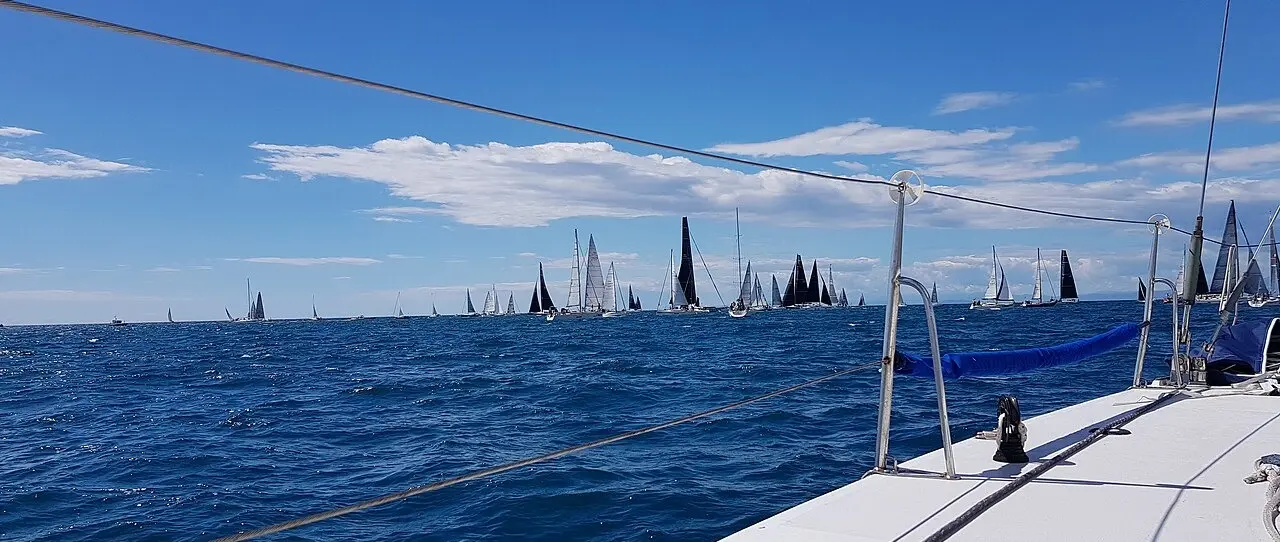
Illustrative archive photograph of the 151 Miglia regatta start in 2019: ElettraSwanLake / Wikimedia Commons / CC BY-SA 4.0. This image does not depict the 2026 ORC Annual General Meeting.
Sources: Offshore Racing Congress, AGM conclusions, 6 November 2026; ORC AGM proceedings and technical presentations; ORC 2027 calendar.