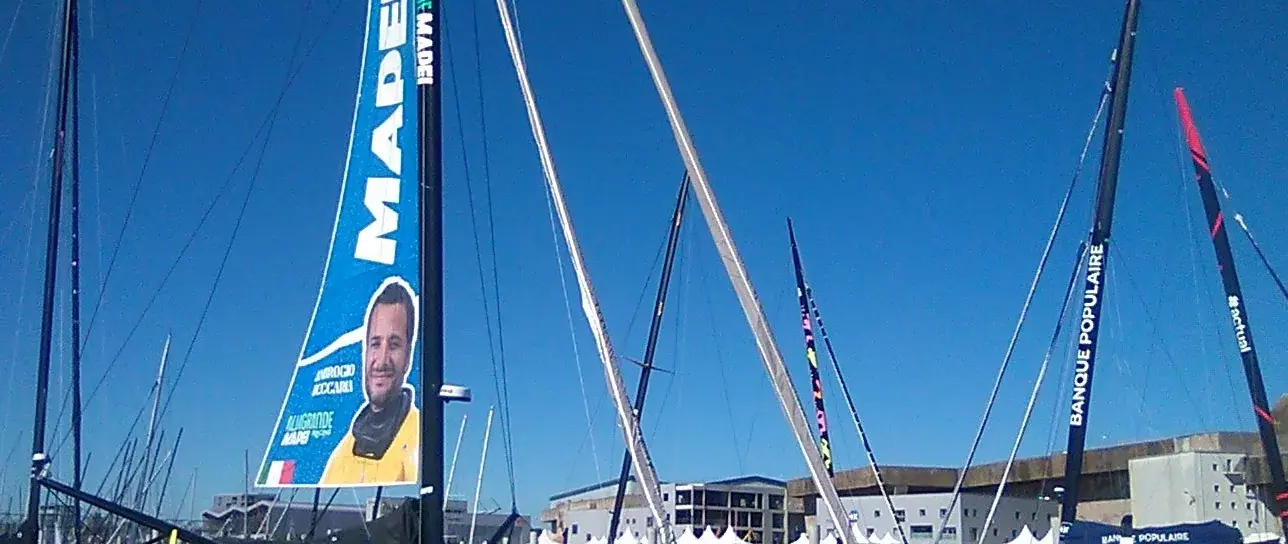
A race comes to an early end
Italian solo sailor Ambrogio Beccaria has retired from the 2026 Route du Rhum–Destination Guadeloupe after suffering a heavy fall aboard his IMOCA Allagrande Mapei. The incident took place in rough seas late on Thursday 5 November while he was running fifth in the class. The IMOCA association reported that he had severe back pain and consulted race medical personnel before deciding to stop racing and head towards the Azores for care. The organiser's accounts published on 6 and 7 November confirm that the diversion and withdrawal followed the injury. The development has removed a prominent competitor from the contest and brought the human risks of single-handed ocean racing sharply into view.
What the official accounts establish
The class association places the fall at 22:07 UTC on 5 November. Beccaria was sailing through rough conditions and was positioned among the leading IMOCA entries at the time. The public statement says he experienced significant back pain, took advice from the race doctors and made the decision to retire. His shore team remained in contact and was preparing to meet him in the Azores, where medical assessment and the boat's return could be organised. These are the facts provided by the race and class authorities. The available public reports do not establish a detailed medical diagnosis, the exact mechanism of injury or a complete timeline for his recovery, so none should be inferred.
The decision to divert
A solo sailor facing a possible injury has to reconsider the original objectives immediately. Finishing a transatlantic race may be the goal of a campaign, but the skipper's condition and ability to operate the yacht safely are more important than a result. The official report makes clear that Beccaria consulted medical personnel before ending his challenge. Choosing the Azores as a destination brought his yacht towards a place where assistance could be arranged without continuing the long Atlantic crossing to Guadeloupe. The reported plan for shore-team involvement also highlights how an ostensibly solo sporting effort depends on a carefully organised support network when circumstances change.
A strong early position
Beccaria was holding fifth place when the fall occurred, according to the race's official statements. That detail helps explain the competitive cost of the withdrawal, but it should not overshadow the reason for the decision. A place near the front of a demanding fleet represents days of navigation, weather analysis, sailhandling and physical effort. Giving up that position is difficult for any professional athlete, particularly in an event that is a major personal goal. The situation demonstrates that race standings are provisional achievements, not rewards guaranteed to survive the next watch. Reliability and the sailor's wellbeing remain conditions for reaching the finish.
The IMOCA context
Allagrande Mapei competes in the IMOCA class of approximately 18-metre ocean-racing monohulls. These yachts are designed for demanding offshore competition, often incorporating powerful rigs, complex sail arrangements and advanced systems to help them sail efficiently. A skipper operating alone cannot step away from essential responsibility simply because the seas become uncomfortable. The boat still needs to be kept on a safe course, the sails managed and its systems monitored. The race's challenge is therefore as much about managing the voyage and one's ability to continue as it is about selecting the fastest route. This makes a medically advised retirement an operational decision as well as a sporting disappointment.
A challenging Atlantic section
The 2026 Route du Rhum started from Saint-Malo on 1 November and sent its competitors towards Guadeloupe across the Atlantic. Several official class and race reports have described difficult conditions during the first week. Such reports provide context but should not be taken as proof that every yacht encountered the same seas at the same moment. Boats can be separated by hundreds of miles, and their skippers choose different routes and sail combinations. What is confirmed in Beccaria's case is that he was in rough conditions when the fall occurred. The event is a reminder that advanced yacht technology does not eliminate the influence of the sea on those operating it.
From successful Class40 sailing to IMOCA
Beccaria entered this edition with a strong record in offshore sailing and particular recognition from the Class40 circuit. The IMOCA association describes him as runner-up in Class40 at the 2022 Route du Rhum, a result that underlined his abilities before his move into the larger class. His participation aboard Allagrande Mapei placed him among competitors operating one of offshore racing's most demanding monohull formats. That progression matters because it shows the depth of experience involved. Injuries and setbacks can affect sailors with extensive preparation as well as newcomers; they are not necessarily evidence of a basic failure of competence.
The shore team’s essential role
The phrase single-handed racing describes the number of sailors aboard, not the number of people who contribute to a campaign. Race preparation involves technicians, weather specialists, logisticians, communications staff and other team members. Once a competitor diverts, those connections become particularly important. Beccaria's team was reported to be arranging to meet him in the Azores and to assist with the boat's return. That work may include transport, maintenance and coordination with appropriate local services, although the precise arrangements had not been fully published in the initial reports. It is an aspect of professional ocean racing that rarely receives attention until a skipper needs assistance.
Why the finish is no longer the immediate objective
In a race, slowing down may be a tactical setback. After an injury, however, reducing demands and reaching an appropriate place for medical attention becomes the priority. The official announcement of Beccaria's retirement reflects that shift. Readers should avoid interpreting his decision through the narrow lens of a leaderboard. A solo skipper must remain capable of handling weather, sail changes and unexpected technical issues throughout the remainder of any passage. When that ability is in doubt, the risks can extend well beyond finishing position. Consultation with the race doctors provided a basis for changing the plan, according to the class association.
A race shaped by individual decisions
The wider IMOCA fleet continued towards Guadeloupe as Beccaria turned towards the Azores. The Route du Rhum is one race, but the skippers do not share identical circumstances. Equipment issues, changing conditions and the demands of fatigue can affect individual campaigns in different ways. The event organiser has also reported a separate bowsprit problem aboard Francesca Clapcich's 11th Hour Racing. That incident involved damage to equipment, while Beccaria's withdrawal followed an injury. They should not be conflated. Taken together, the reports reveal the range of problems a professional skipper may face during a difficult offshore passage, and the need to assess each on its own evidence.
The responsibilities of a yacht skipper
Although a private 12- to 24-metre performance yacht is typically operated differently from a professional IMOCA, the broader principle is relevant. The person in command must be willing to change an itinerary when the circumstances aboard demand it. On a cruising passage, that might mean seeking shelter because a crew member is unwell or because essential equipment is unreliable. On a race boat, the psychological pressure to continue can be particularly intense, but the fundamental requirement to make prudent decisions remains. The example should not be treated as a medical guide or an invitation to second-guess the specific advice Beccaria received from the race doctors.
How offshore incidents are reported
Initial information from a yacht at sea is often necessarily brief. The skipper may be occupied with managing the boat, and a shore team may not yet have a complete account. That is why a report should identify the source and date of its facts and leave room for subsequent clarification. In this case, the IMOCA class and the Route du Rhum organiser provide aligned statements about the fall, back pain, medical consultation, retirement and diversion. Any later information about a precise injury, treatment or recovery would need its own reliable source. Responsible editorial coverage does not turn the absence of detail into an opportunity for speculation.
The competitive consequences
The withdrawal alters the composition of the IMOCA fleet and removes a sailor who was well placed at the time of the incident. It does not establish what his finishing position would otherwise have been. Ocean racing results depend on weather developments, equipment reliability and tactics throughout the passage, not simply on the standings early in the first week. The race can be unpredictable even for competitors who avoid incidents. For spectators, the most useful approach is to follow official race reports for the current picture while recognising that a retirement based on injury is qualitatively different from a routine change in position.
An event watched beyond professional racing
The Route du Rhum attracts interest from owners of cruising yachts because it places familiar maritime decisions in a highly demanding setting. Sail choice, route planning, fatigue management and contingency arrangements become visible in the reports from solo skippers. Those reports should be read with respect for the differences in boat design and professional experience. An IMOCA's potential performance cannot be transferred to an ordinary cruising yacht, nor should its risk exposure be treated as a model for family sailing. What does translate is the importance of keeping the original plan open to revision when the actual conditions or the people aboard require it.
The next confirmed developments
As of the official reports published on 6 and 7 November, Beccaria had withdrawn from the 2026 Route du Rhum and was diverting to the Azores for medical care, with his team preparing to assist on arrival. His later medical findings, schedule for returning home and any decisions about future competition had not been established in those announcements. The immediate emphasis should remain on his safe arrival and wellbeing. For the racing community, the incident is a reminder that sporting ambition relies on the health of the person responsible for the yacht and that an appropriate decision to retire can be the most important judgement of the race.
Primary sources: IMOCA class statement, 6 November 2026; Route du Rhum official incident report; Route du Rhum organiser's 7 November race update.
Lead photograph: Ambrogio Beccaria's IMOCA Allagrande Mapei at the Défi Azimut in Lorient, September 2026, by Jug81, CC BY-SA 4.0 via Wikimedia Commons. This earlier photograph does not show the Route du Rhum fall or diversion.