A bigger order book and a new commercial appointment
British marine-energy specialist Integrel Solutions says its turnover has doubled over the past 12 months, with its order book standing at approximately £7 million. The company has also named Nick Holland chief commercial officer, outlining a further push into boatbuilder relationships, hybrid propulsion and electrical systems for sailing and motor yachts. The announcement was reported by marine trade publications on 5 November 2026. It combines a financial growth claim, a leadership appointment and intended investment in facilities; it is not a set of independently audited accounts or a claim that every announced product is already installed on a production yacht.
The story matters to the 12-to-24-metre luxury-yacht market because electrical architecture is becoming as important a purchase decision as cabin arrangement or cruising speed. Air conditioning, refrigeration, communications, water-making and hotel loads all compete for power. Sailing catamarans may also seek electric propulsion for quiet manoeuvring or short passages, while motor yachts face pressure to run accommodation systems without a conventional generator operating continuously. Integrel is one of the suppliers trying to integrate those requirements into the existing propulsion machinery. Its commercial growth suggests increased builder interest, but owners should still evaluate each installation on its own merits.
What the company has actually reported
According to the November announcement, turnover doubled during the preceding year and the order book reached about £7 million. Those are distinct measures. Turnover concerns revenue recognised over a period, while an order book represents work or product demand not necessarily delivered and billed. Neither number establishes operating profit, cash generation or total company valuation. No audited profit-and-loss statement accompanied the figures in the material reviewed for this report. Readers should therefore understand them as management-reported business indicators, not a financial analysis of Integrel's margins or balance sheet.
Integrel attributes increased activity to interest from boatbuilders and original equipment manufacturers, which incorporate a supplier's equipment into their products. Its new chief commercial officer will be responsible for developing these relationships and international demand. That is materially different from selling a single retrofit kit to an owner: a production boatbuilder needs repeatable installation drawings, training, warranty support, configuration control and dependable component availability. If a system is to appear as a factory option on more mid-sized luxury yachts, those less visible capabilities are central to whether a promising technology becomes a reliable part of the build programme.
Nick Holland arrives from the marine electronics sector
Nick Holland joins after more than 16 years with Navico Group, where the November reports describe his experience with marine power solutions and integrated technology. Integrel has created a chief commercial officer role at a time when the company is preparing to support more builder partners. That appointment offers a signal about the next operational challenge: supplying equipment is only one part of a wider business involving installation, software, dealer training and long-term service. Holland's prior experience may help coordinate relationships with manufacturers, but the immediate effect on customers will depend on execution rather than the seniority of a new job title.
The company says it intends to establish a Boatbuilder Programme in 2027, giving existing and new boatbuilding and OEM partners more structured technical and commercial support. The announcement does not specify how many partners will join, which yachts will be fitted or when any new production agreements will start. Such a programme could help establish common procedures for commissioning and troubleshooting, especially when the boat's main engines, drive system, batteries and electronic controls come from different suppliers. Owners should ask their chosen yard exactly who will carry responsibility for the completed installation and how an issue will be resolved when cruising far from the builder.
Understanding E-Drive on a cruising catamaran
Integrel E-Drive combines electrical power generation with a motor capable of delivering propulsion through the vessel's existing driveline. The manufacturer's own product documentation explains that engine-generated electricity can be managed alongside batteries and electrical loads, while the electric drive can propel the boat in appropriate conditions. This differs from a simple alternator upgrade and from a completely independent electric propulsion pod. It requires coordination of the internal-combustion engine, battery storage, electronics and drivetrain. A buyer should therefore discuss operating modes and failure behaviour as carefully as peak electrical ratings.
The company has a direct 2026 connection to the luxury cruising-catamaran sector: Knysna Yachts selected E-Drive as a hybrid option for its catamarans, according to a manufacturer announcement dated 14 September. In that specific dual-engine application, Integrel describes up to 30 kW of onboard power generation and 40 horsepower of electric propulsion, paired with a 48-volt lithium battery system. These are the supplier's figures for that configuration, not guaranteed outputs for all Integrel products or yachts. Usable electric range and speed depend on the installation, battery capacity, conditions and loads.
Powerboats have a different electrical requirement
The company has also developed E-Power for powerboats, a product family intended to generate and manage electrical energy without relying on a conventional standalone generator in the usual way. Its official information describes versions in the 15 kW and 30 kW classes and makes clear that boatbuilders need to select equipment for the propulsion arrangement and expected onboard loads. This can be relevant to a 17-metre motor yacht carrying substantial air-conditioning and domestic equipment, although the actual installation will depend on engine compatibility, available space and the owner's cruising habits.
It is important to separate power generation from propulsion. E-Power does not automatically mean the main yacht can cruise under electric drive. E-Drive adds that different capability where specified and installed. Marketing terminology around hybrid and electric systems can obscure this distinction, so purchase documents should identify the exact product, its rated outputs, operating modes and battery specification. Claims of lower noise, fuel savings or emissions need to be assessed against a defined baseline, including how often engines would otherwise run, the energy taken from shore power and the required hotel loads.
A proposed expansion in Cornwall and Southampton
Integrel says it plans to enlarge its headquarters and operating facilities at Hayle in Cornwall, alongside further investment in research and development at Hythe near Southampton. The company identifies electric-motor technology as an area of ongoing work. These are plans rather than evidence that enlarged premises are already fully operational. For a manufacturer supplying luxury yachts into multiple markets, additional engineering and production capacity could potentially support shorter lead times, more testing and a wider range of installations, but the November announcement does not provide a completed-project budget or measurable future output target.
The practical test of investment will be seen in documentation, equipment availability and aftersales support. A yacht may be used for a decade or more, often changing owners and cruising regions. Electrical components can be damaged by moisture, heat, vibration or incorrect maintenance, while software revisions can alter the way a complex system behaves. Buyers and refit managers should look beyond the equipment's launch presentation and ask about replacement-part planning, installer certification, diagnostic access and procedures for restoring normal propulsion or power generation if an integrated control system faults.
An established product line, not an untested idea
Integrel's history extends beyond this week's growth announcement. The company traces its work to 2003 and its power-management equipment has received industry design recognition, including DAME awards. Its 2026 public technical library contains E-Drive user guidance, E-Power installation and maintenance material, and software information. That body of documentation does not remove installation risk, but it offers owners and technical teams a useful way to ask concrete questions. A system with accessible instructions and service procedures can be easier to evaluate than one supported only by marketing claims.
There are also signs of real-world integration, rather than solely prototypes. Integrel has reported E-Drive installations and sea trials, and its Knysna relationship gives a named boatbuilder example in the catamaran market. Those statements are manufacturer reports and should not be confused with independent certification for every potential yacht. Before committing to an option, a buyer should request the actual electrical schematic, approved batteries and chargers, thermal-management requirements, expected performance under realistic loads and the warranty boundaries between the engine supplier, yachtbuilder and energy-system manufacturer.
What a 12–24 metre yacht owner should check
A useful specification meeting begins with an energy budget. Owners should list the continuous and intermittent demands from refrigeration, cooking, air conditioning, navigation equipment, watermakers and entertainment systems, distinguishing time at sea from time at anchor. They should then ask which combinations can be supported with engines off and for how long, what charging options exist and what happens when battery charge falls below a reserve. For a sailing catamaran, it is equally important to understand the relationship between diesel drive and electric drive on each hull, especially during harbour manoeuvres or a propulsion failure.
Installation should be examined as part of the whole vessel, not an accessory added after the mechanical layout is settled. Battery weight and position, ventilation, cable routes, fire protection, controls, service access and local electrical standards can affect the project. An integrated installation may simplify some machinery choices while making the system architecture more involved. Experienced owners will ask for operating demonstrations covering normal cruising, low-battery conditions, software alerts and fallback modes. The promised lifestyle benefit is attractive, but reliability and maintainability determine how confidently a family can actually use it.
Why the business news matters now
The appointment of Nick Holland, management's reported £7 million order book and the planned 2027 builder-support programme together suggest that Integrel is trying to move from individual innovations toward broader production partnerships. That shift is directly relevant to the purchase choices available in the luxury-yacht segment. More factory-supported systems could give owners clearer integration and aftersales arrangements than an isolated retrofit, while also increasing expectations for transparent technical specifications, dealer capability and long-term component supply. None of those benefits should be assumed until a particular builder confirms its product offering.
Integrel is due to attend METSTRADE in Amsterdam on 17–19 November 2026, with trade coverage placing it in Hall 3, stand 03.122. The show will give boatbuilders and specialist installers an opportunity to discuss the new commercial direction and ask about E-Drive and E-Power configurations. For prospective owners, the most useful questions remain familiar: which yacht has the system, what are its independently demonstrated operating figures, what does it cost to service and who stands behind it? The company's expansion is a notable industry development, but the answers to those questions will decide its value aboard a specific luxury yacht.
Sources: integrelsolutions.com; integrelsolutions.com; integrelsolutions.com; docs.integrelsolutions.com; marineindustrynews.co.uk; marinebusiness.news.
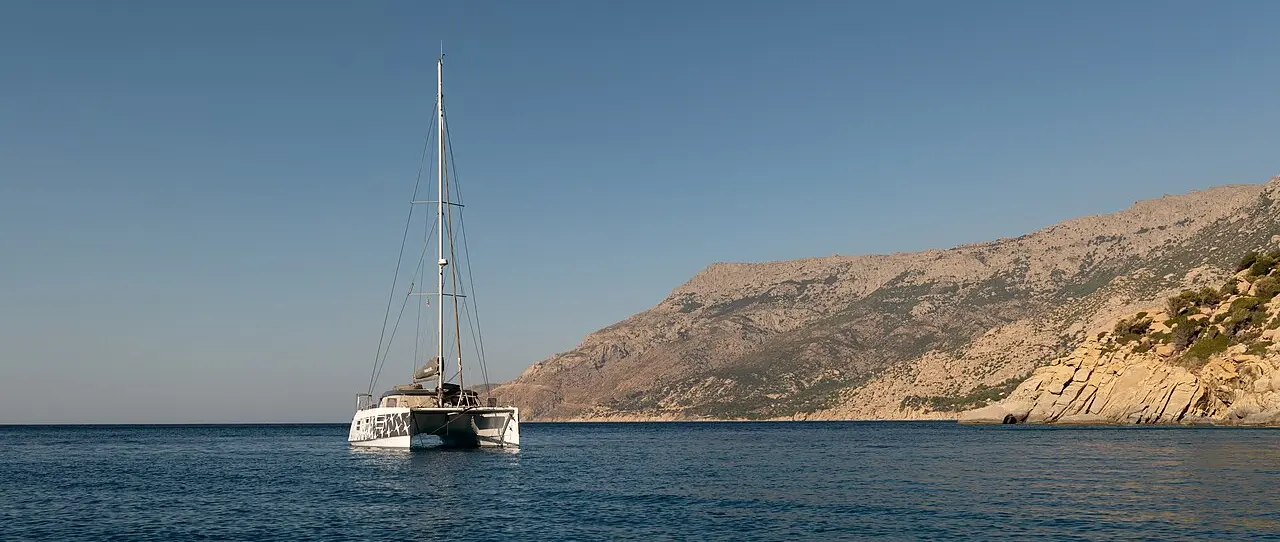
Photograph: Jules Verne Times Two / Wikimedia Commons, CC BY-SA 4.0. A sailing catamaran off Ikaria, Greece; an illustration of the cruising-yacht category, not a confirmed Integrel installation or photograph of Nick Holland. Source photograph; licence. Resized for web under the same licence.