An Amsterdam debut for adjustable tender supports
British marine-equipment maker Rapid Marine is preparing to introduce Uniflex Chocks at METSTRADE 2026 in Amsterdam, a fresh approach to supporting small tenders and personal watercraft aboard yachts. The planned introduction was reported on 5 November, ahead of the trade exhibition on 17–19 November. The company will exhibit at stand 01.580, according to its own show preview and the organiser's exhibitor listing. The key change is that the supports can be adjusted in two directions, lengthwise as well as across the width of the tender, rather than relying solely on a fixed position for a particular hull.
For Luxury Yacht Guide, this is news about practical equipment rather than a new yacht launch. Boats in the 12-to-24-metre range can have exceptionally busy stern platforms: they are boarding areas, swimming terraces, access points for water sports and sometimes the only convenient place to carry a dinghy or jet tender. Every fitting competes for space. An adjustable and removable arrangement could reduce compromises between securing the auxiliary boat and preserving the platform for guests. The proposed advantage is credible as a design goal, but new-product suitability for any individual yacht still requires an installation assessment.
Why moving the chocks matters
Tender chocks are shaped supports that help cradle a small boat when it is out of the water. They sit under selected portions of a hull and work with appropriate securing arrangements to stop the tender shifting during normal operations. Their position matters because inflatable tubes, deep-V sections, strakes and different centre-of-gravity positions place support points in different locations. Rapid Marine says the Uniflex design permits adjustment of both length and width so a user can work around varied tender sizes, hull profiles and deck geometries. The claim concerns configurable support positions; it does not establish unrestricted compatibility with every tender.
On a 16-metre family cruiser, a change from a compact RIB to another tender can create a problem even when the overall length seems similar. The new hull may have a different deadrise, a lower outboard, a different lifting point or wider tubes. A support positioned for the previous boat can bear on an unsuitable area of the replacement. Adjustable chocks potentially make that transition less disruptive than installing a completely new fixed cradle. Owners must still confirm the contact surfaces, loads, tender weight and manufacturer advice for both the hull and its carrying platform.
Two materials for different installations
The forthcoming Uniflex range is described in two versions: traditional iroko timber and a lightweight composite alternative. Iroko has long been used for exposed marine equipment because of its durability and appearance, and Rapid Marine already makes an established range of timber tender supports. The composite version is being positioned particularly for smaller RIBs, dinghies and jet tenders, including situations where a lighter or less bulky support may open installation options. The announcement does not provide a verified weight table, loading limit or price for the new Uniflex versions, so those details should not be inferred from earlier products.
Material choice involves more than matching the deck's colour. An owner may consider the weight and handling of each removable support, the likelihood of contact with painted or gelcoat surfaces, drainage, the way the fitting resists corrosion and how easily it can be cleaned after salt-water use. A premium timber surface may suit a teak-finished platform aesthetically; a composite support may be preferable where crews move components regularly. Neither material alone proves safety. The full assembly, the securing straps and the structure beneath its attachment points must be specified as a system.
A twist-and-lock connection to the deck
Rapid Marine describes a twist-and-lock mechanism with a pivoting handle. Each chock engages with a deck fitting, with the stated intention that it can be locked in position for use and removed once the tender has been launched. The remaining fittings are intended to sit flush with the deck. That approach addresses a familiar concern on a luxury yacht: when the tender is away, proud brackets and large support blocks can become obstacles to walking, lounging, boarding and using the bathing platform. A properly specified flush fitting can return more of the surface to guest use.
The word 'flush', however, should be treated as a design objective that depends on the specific installation. The owner or installer should ask for drawings showing exactly what remains exposed, whether the surface stays comfortable to bare feet, how water is kept out and how the connection behaves after repeated use. Deck penetrations must be compatible with the structure, and the yard should confirm that the attachment arrangement does not compromise a hydraulic platform or access hatch. Where the tender is secured for offshore passages, safe stowage requires more than a convenient release handle.
What the existing Universal Chocks tell us
Uniflex follows Rapid Marine's Universal Chocks, which the company presented at METSTRADE in 2021 and which received attention from the DAME design awards. The established system provides hull support and removable deck hardware for tenders and personal watercraft. Rapid Marine's website describes a range of compatible deck fittings and associated tie-down products. It also publishes load-related information for specific existing variants, but those figures belong to those particular products. They cannot responsibly be transferred to Uniflex until the manufacturer releases new technical documentation and a suitable installation matrix.
The company says user feedback influenced the newer design. According to the November announcement, some customers wanted a positive locking arrangement for the chocks, while others had altered existing installations to position tenders lower. These are plausible concerns for owners seeking an unobstructed view aft or easier access to a swimming platform, yet a lower installation is not automatically better. A tender carried near the water may be more exposed to spray, wake wash or following seas, depending on the yacht. The critical questions are clearance, stability and structural loading in realistic operating conditions.
The 12–24 metre owner's particular problem
Smaller luxury yachts are often run by their owners or a small professional crew. That makes every tender launch and recovery a task involving relatively few hands. A system requiring awkward lifting, complicated alignment or long periods crouched on a wet platform may be acceptable during a showroom demonstration but frustrating over a full cruising season. Removable chocks can make daily use easier only if their weight, grip, storage location and locking steps are manageable. The operator should also be able to confirm visually and physically that both supports are secure before moving the yacht.
Available platform space varies enormously across boats of similar length. Some 13-metre cruisers reserve nearly the entire aft terrace for swimming; some 20-metre flybridge yachts employ a hydraulic lowering platform and can carry a larger tender. The number of guests, whether there is an internal tender garage and how the aft deck is used in port all affect the decision. Uniflex's significance is the prospect of fitting the support arrangement to a real ownership pattern, not the suggestion that all boats need the same accessories. Installation guidance will be decisive.
Matching tender, platform and restraints
A sensible purchase process starts with three sets of measurements. First are the tender's dimensions, hull support geometry, fully equipped weight and outboard or drive-unit clearances. Second are the yacht's platform width, available attachment structure, rated carrying capacity and operating limits when lowered. Third is the route by which the tender will be recovered and moved into position. A folding chock or removable bracket is helpful only if these elements work together. The most attractive arrangement on a static stand could be unsuitable after the tender is fuelled, provisioned or fitted with extra equipment.
Owners should ask the installer to identify the approved load path from tender through support and restraints to deck structure. They should also obtain guidance on strap angles, whether separate tie-down points are required, how the tender is protected against chafe and what inspections the manufacturer recommends. Rapid Marine sells related tie-down hardware, but the presence of products in one catalogue is not proof that every combination has been tested as a complete installation. Independent advice from the yachtbuilder or an appropriately qualified marine engineer is especially important when modifying an existing hydraulic platform.
What visitors should ask at METSTRADE
METSTRADE is a business-to-business exhibition, and Rapid Marine's stand offers a practical opportunity for builders, refit yards, installers and dealers to examine the physical mechanism. Useful questions include the actual adjustment ranges, how the timber and composite versions differ in weight and dimensions, which contact surfaces are replaceable, and what fitting depths are required. Buyers should request the new Uniflex load ratings rather than quoting older Universal Chock values, and they should establish whether the product includes the deck fittings and restraints needed for their particular application.
The launch report indicates that Uniflex is expected to be available in early spring 2027, rather than for immediate shipment at this November's show. That is an anticipated schedule, not a confirmed supply date for a named order. Before placing a deposit or scheduling a refit, owners should seek the final specification, installation manual, warranty details, lead time and evidence of compatibility. A sensible refit timetable allows for survey, any structural reinforcement and testing alongside. The ability to remove the supports conveniently is valuable only when the overall arrangement remains dependable under way.
A useful evolution, with specifications still to come
Rapid Marine's planned Uniflex launch reflects a broader pattern in yacht equipment: owners increasingly want fittings that adapt to different activities rather than occupying the deck permanently. A swim platform can be a tender dock one hour and a social space the next. Equipment that accommodates both purposes speaks directly to the way mid-sized luxury yachts are used. The proposed two-axis adjustment, choice of materials and flush-fitting removable connection make this a development worth watching, provided the eventual production system performs as described.
The important missing pieces remain measurable rather than aesthetic: published dimensions, maximum loads, approved tender shapes, attachment specifications, real installation examples and a delivery timetable. Until those are available, a prospective customer cannot know whether Uniflex will be suitable for a particular 12–24-metre yacht. Luxury Yacht Guide will treat the Amsterdam display as an equipment introduction and the expected spring availability as provisional. That distinction keeps a useful innovation in perspective and gives owners a practical checklist when discussing the product with a dealer or naval architect.
Sources: www.rapidmarine.co.uk; www.metstrade.com; www.rapidmarine.co.uk; marineindustrynews.co.uk; www.rapidmarine.co.uk.
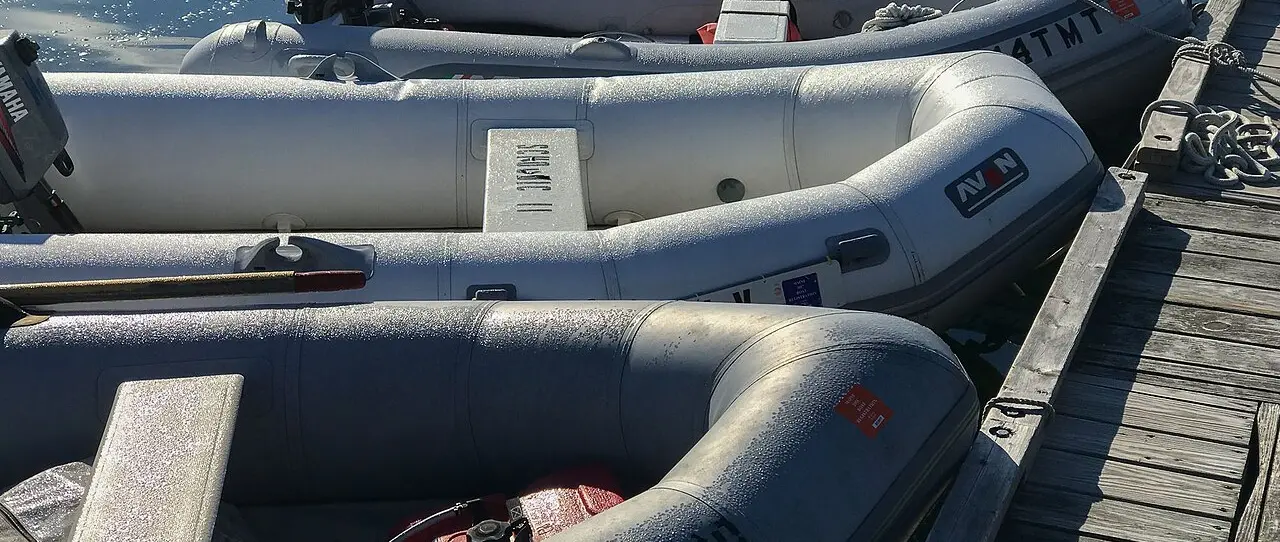
Photograph: HopsonRoad (Stephen Flanders) / Wikimedia Commons, CC BY-SA 4.0. The photograph shows yacht tenders in Northeast Harbor, Maine; it illustrates tender use and does not show Uniflex equipment or a Rapid Marine installation. Original photograph; licence. Resized for web under the same licence.