Annapolis debut for French electric propulsion
French electric motor manufacturer TEMO has introduced its OUTPOD system to the North American market at the 2026 United States Sailboat Show in Annapolis. Presented during the 15–18 October event, the device offers an alternative for small and medium-sized sailing yachts that use auxiliary power for harbour manoeuvres or motoring in light wind. It combines an underwater pod motor with an externally mounted fitting on the transom.
The idea is to retain some of the manoeuvring advantages of a pod without cutting an opening through the hull below the waterline. TEMO already developed electric propulsion products for sailing, and the OUTPOD now becomes available to order through its United States operation. This is a North American introduction rather than a claim that the motor itself has only just been invented.
An outside mount instead of a hull aperture
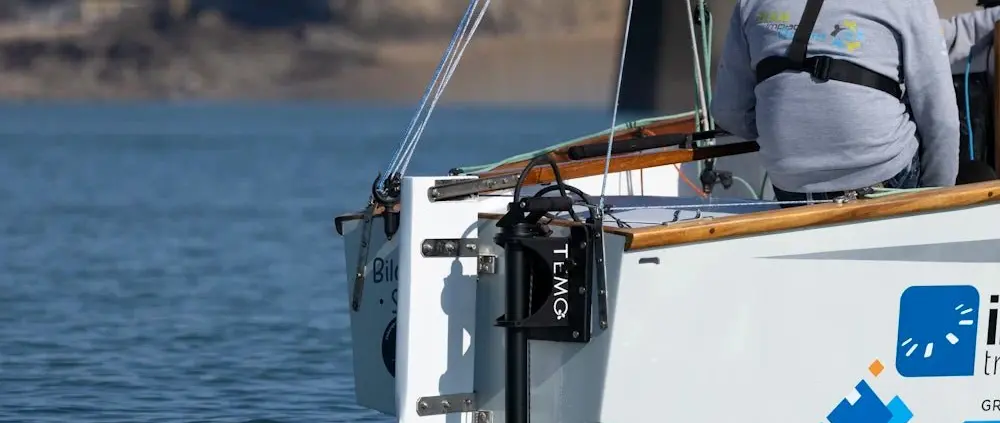
A traditional inboard pod can require major work to fit, while a conventional outboard hangs above the water and carries more weight at the transom. The OUTPOD is attached to the stern with a bolt-on mounting and external guide system. TEMO says the installation can be removed in one movement when maintenance or storage is needed, without a permanent aperture beneath the waterline.
An external fitting still needs careful installation, appropriate transom structure and a suitable location relative to the waterline. A professional should assess any modification to the hull or stern, especially where steering gear, ladders and mooring equipment may interfere. The manufacturer's easier-installation claim should not be interpreted as proof that the system will fit every boat without changes.
A motor that lifts clear under sail
The design includes a height-adjustable mast that allows the drive to be raised using a halyard. With the motor out of the water, the sailboat avoids leaving a propeller and lower unit exposed during sailing passages. The manufacturer says this reduces drag and fouling and allows the motor to be kept away from the water while the vessel is moored.
The ability to lift the assembly is especially useful where owners sail more often than they motor, although the practical arrangement depends on the stern layout and how the lifting line is routed. Operators should ensure that the unit is secured in both its raised and lowered positions. An elevated drive offers no propulsion until it has been returned to its working position.
Two power ratings and stated thrust
TEMO currently offers two OUTPOD versions. The OUTPOD 1000 is rated at 1,300 watts and the OUTPOD 3000 at 3,100 watts, with the company quoting static thrust of 66 and 148 pounds respectively. Both motors weigh approximately 26 pounds, while the larger version has an IP68 protection rating compared with IP67 for the smaller unit.
These figures describe the motor and its performance under the manufacturer's test conditions. They do not by themselves establish the top speed or endurance of a particular yacht. Displacement, hull shape, propeller choice, wind and current will affect real-world results. Prospective owners need performance guidance matched to their boat rather than assuming a wattage rating guarantees a certain cruising range.
Steering and manoeuvring choices
The OUTPOD uses a 48-volt system with remote forward-and-reverse throttle and an electronic display. Its shaft can rotate through 180 degrees, giving the helmsman an additional way to direct propulsion close to a pontoon or berth. TEMO says the arrangement also supports hydrogeneration when the boat moves under sail, with the suitability depending on the selected installation.
Close-quarters handling still requires practice and an understanding of how the yacht responds to wind and current. Rotating drive units do not remove the need to manage lines, fenders or momentum. A new owner should learn the control response in open water before relying on an unfamiliar electric system during a difficult berthing manoeuvre.
Batteries are carried inside the boat
Instead of putting a large integrated battery on the stern, TEMO separates the motor and the energy storage. The company offers 2.3-kilowatt-hour battery cassettes and compatible racks, while some existing 48-volt lithium installations may be accommodated. The system is also designed to work with solar charging and energy recovery through hydrogeneration under suitable conditions.
The arrangement can make it easier to place batteries where their weight and access are more appropriate for the yacht, though any new electrical installation should consider ventilation, protection, fusing and the battery manufacturer's requirements. The actual duration of motoring depends on energy available and power demanded at each speed. TEMO has not promised a universal range for every sailing vessel.
Sales support and quoted US prices
TEMO manufactures its motors in Europe and says its United States sales office and workshop in Portland, Maine will support customers on this side of the Atlantic. The manufacturer offers a three-year warranty upon registration. Having a domestic point of contact may be useful when owners need advice on choosing a motor, arranging installation or addressing a service issue.
The company's October launch release lists an OUTPOD 1000 pack at US$2,600 and an OUTPOD 3000 pack at US$5,400 as suggested retail prices. The total cost of a conversion can still vary with batteries, installation, cabling and accessories. Sailors comparing electric and combustion propulsion should calculate the complete package rather than focus only on the weight or sticker price of the motor.
Where OUTPOD fits in the electric market
The OUTPOD received a Best Innovative Product award at the Paris Nautic Show in 2025 and now reaches North American customers through the Annapolis introduction. Its most distinctive qualities are the external pod-style fitting, ability to lift clear of the water, and choice of compact electric motors. For sailors seeking quiet auxiliary propulsion, those differences may be relevant to the design of their boats.
Before ordering, an owner should ask TEMO to confirm the correct rating, transom compatibility, mounting arrangement, battery configuration and expected performance for the intended use. A trial on a comparable vessel may answer more questions than a specification alone. The system is a new choice for North American sailboat owners, but suitable sizing and safe installation remain essential.