Five versions of a shared 300hp platform
Mercury Marine offers five distinct 300-horsepower outboards based on a common V8 engine, according to a detailed interview with the company's after-sales manager Stefano Arrigoni published by PressMare on 16 October 2026. The range comprises FourStroke, Verado, Pro XS, Racing 300R and SeaPro. The choice is intended to reflect different types of boat and working patterns, not simply five different ways of obtaining extra peak power. Owners comparing repower options should evaluate the complete propulsion installation and the boat’s actual duty cycle.
That distinction matters to owners of fast dayboats, tenders and smaller cruising yachts who may assume the most specialised engine provides the best performance. Mercury's explanation is that hull shape, weight, engine mounting height and desired handling should determine the model. The interview is a technical comparison of an existing product family, rather than the unveiling of five newly manufactured engines.
What the V8 engines share
All five examples use a naturally aspirated 4.6-litre V8 with a 64-degree bank angle, dual overhead camshafts and 32 valves. The bore and stroke are reported as 92 and 86 millimetres. The block uses an aluminium-silicon alloy, while a balance shaft is intended to help control noise and vibration. The engine architecture was designed to keep the overall package relatively compact.
Electronic port fuel injection is managed by Mercury's SmartCraft PCM 112 control system, monitoring information from multiple sensors and controlling ignition, throttle and fuel delivery. A common powerhead does not mean that all five complete outboards have identical lower units, midsections or steering options. Those surrounding systems can make a substantial difference to how an installation behaves in real use.
FourStroke and Verado emphasise different qualities
The FourStroke 300 is positioned as a broadly applicable recreational engine, while the Verado 300 adds integrated electric steering, a more elaborate mounting arrangement and adjustable exhaust characteristics. PressMare reports a FourStroke gear ratio of 1.75 to one and Verado ratio of 1.85 to one. These differences help tailor the engines to different propellers and control systems.
Arrigoni said Mercury's comparative testing showed essentially equivalent outright performance under matching conditions with suitable propeller selection. The Verado's appeal is therefore more about steering refinement, vibration isolation and comfort than automatically delivering extra speed. A purchaser should compare the equipment fitted to the proposed boat, not read the two model names as a simple speed ranking.
Pro XS for light and sporting hulls
The Pro XS 300 uses a TorqueMaster gearcase intended to operate with the engine mounted relatively high, reducing drag on an appropriate hull. It also features a reinforced propeller shaft. The design began with applications such as American bass boats, where acceleration and responsiveness are priorities, but the engine can also suit some lightweight performance RIBs.
On an unsuitable boat, the intended advantage may disappear. PressMare records Mercury's example of a sport-oriented RIB around seven-and-a-half to eight metres long, where the Pro XS may offer benefits if the hull permits the required setup. Owners of heavier boats should not assume the racing-derived gearcase will improve efficiency or top speed simply because it looks more specialised.
The 300R demands a purpose-built installation
Mercury Racing's 300R adds a stronger midsection and Sport Master gearcase for high-performance applications. The lower-unit geometry is designed for high mounting positions and propellers operating partly near the surface. That can improve the intended installation when the hull and propeller are matched properly, but it is not a universal solution for ordinary cruising craft.
Arrigoni explained that fully submerging an aggressively shaped racing gearcase on the wrong hull can create drag and reduce performance. Suitable propellers typically use four or five blades and must be chosen for the loads associated with partial surfacing. Installing a 300R without specialist engineering input can therefore be less rewarding than choosing a conventional FourStroke or Verado for the actual boat.
SeaPro is aimed at sustained working hours
The SeaPro 300 sits at the other end of the range, designed for customers who operate their boats commercially or for long periods. It has a more conservative electronic calibration and a maximum operating speed around two hundred revolutions per minute below the recreational versions, according to Mercury's representative. The intention is to prioritise durability over extracting the last increment of performance.
Potential users include commercial fishermen, harbour services and sailing support teams whose boats spend many hours running during the working day. That does not mean a SeaPro can be neglected. Service intervals and operating limits must still be followed, and a fleet manager should calculate real duty cycles before specifying equipment. Reliability depends on correct installation as well as engine design.
Helm integration and multi-engine layouts
Mercury says the electronic architecture can bring engine information onto compatible multifunction displays from brands including Garmin, Raymarine, Simrad and Lowrance. The Verado platform also supports joystick manoeuvring through integrated steering, with certain options to coordinate compatible bow thrusters. Mercury describes management of as many as six outboards within one electronic system for suitable installations.
Such integrations may reduce the number of separate displays and controls at the helm, but compatibility cannot be assumed without checking the exact engine generation and electronics configuration. Multiple-engine installations need proper shaft lengths, rotation directions and carefully set controls. A tender or owner-operated boat should have a documented installation plan and a crew familiarisation period.
Maintenance and the decision for owners
Mercury's standard servicing guidance for these 300-horsepower recreational applications is generally every one hundred hours or annually, whichever comes first. Genuine competitive operation of a Racing 300R can require shorter intervals, including more frequent oil changes under demanding conditions. Weight also differs between the models because of the steering and mounting systems surrounding the shared powerhead.
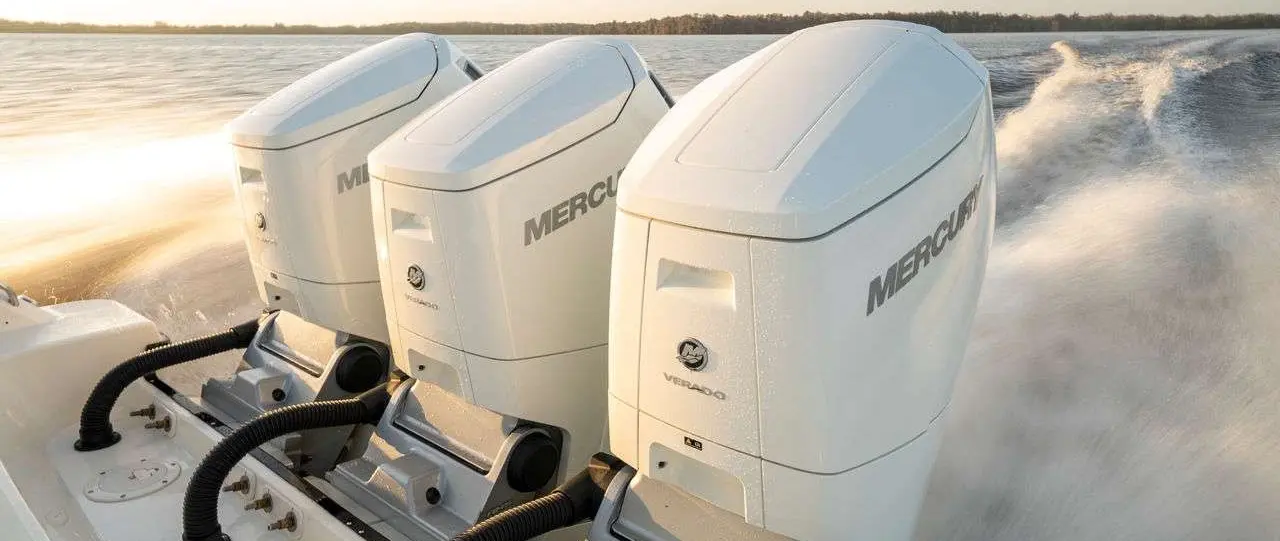
The accompanying photograph shows actual Mercury outboards installed together on a boat, illustrating the product family discussed in PressMare's technical interview. It is not claimed to depict a performance test of each of the five variants. Owners should consult the current manufacturer documentation, qualified installers and the vessel's approved ratings before selecting or replacing a 300-horsepower engine.