An industry membership with a practical purpose
FPT Industrial has joined Confindustria Nautica, Italy's national recreational boating industry association, as the Iveco Group powertrain business seeks deeper links with yachtbuilders and marine suppliers. The development was disclosed in a 2 November 2026 statement attributed to FPT Industrial Marine and distributed through the Italian industry publication PressMare. Although joining an association is not itself a new engine launch, the move is relevant to owners and yards operating in the 12-to-23.99-metre luxury yacht sector. FPT identifies recreational vessels from eight to 24 metres as one of the applications for its products. That is unusually close to the size range covered by Luxury Yacht Guide. The announcement therefore points to where an established industrial engine producer wants to strengthen its marine relationships, rather than to a single boat or a specification that buyers can order tomorrow.
What has actually changed
The confirmed change is organizational. FPT is now a member of Confindustria Nautica, which represents companies throughout Italy's leisure-marine production and service chain. The association was established in 1967, according to the announcement, and its role includes industry advocacy, business development and promotion of nautical tourism. Membership may make it easier to participate in shared industry discussions, connect with yards and address supply-chain concerns. It does not establish that a particular builder has signed a new engine supply contract, that production volumes have risen by a published amount or that a new range is homologated for every yacht. Those distinctions matter because association announcements often contain language about innovation and growth. For the owner assessing a specific engine room, the substantive questions remain installation support, technical compatibility, delivery terms and service provision.
The 230-to-1,000-horsepower yacht range
FPT says its full marine range covers nominal outputs from 85 to 1,000 horsepower, with displacements between three and 15.9 litres. The line explicitly directed at yachts spans 230 to 1,000 horsepower. The company states that its products address vessels from eight to 24 metres, although power requirements vary greatly with hull form and mission. A lightweight planing yacht, a displacement cruiser and a sailing yacht with auxiliary propulsion can have quite different priorities even at the same length. The published power range is consequently a family-level description, not an engine-selection table for a 15-metre or 22-metre boat. Any comparison requires precise engine model, rated speed, duty cycle, power curve, reduction ratio and propeller calculations. Owners should not infer that the headline upper output is suitable for any hull inside the published length bracket.
Why the Italian market matters
Italy remains a central manufacturing base for production yachts and higher-value leisure vessels. FPT's announcement cites a 2026 edition of The State of the Art of the Global Yachting Market to describe an industry that exports more than 90 per cent of its production, accounts for about 18 per cent of the worldwide yacht market and reaches nearly 31 per cent of the market for inboard-powered yachts. Those are figures quoted by the manufacturer from an industry study, not independently recalculated by this publication. They nevertheless explain the commercial setting: an engine producer serving Italian yards is exposed to buyers far beyond Italy itself. A vessel constructed in an Italian facility may ultimately require maintenance, replacement parts or technical assistance in the Adriatic, the Balearics, the Caribbean or elsewhere. The quality of that international support can matter more to an owner than the location of the original factory.
Service support is part of the product
The manufacturer says its marine service network includes more than 200 points around the Mediterranean, alongside over 70 distributors and more than 900 service points worldwide. Those figures describe a network in aggregate; they are not proof that every location stocks parts for every particular engine or can attend a fault at short notice. In practical ownership terms, coverage needs to be tested port by port. A yacht operating principally from the French Riviera may have different needs from one cruising Greek islands or based in Malta. Before purchasing a yacht, an owner can ask the dealer or installer to identify the nearest authorized service organization for the installed model, its call-out arrangements and expected lead times for critical spares. The answer is most useful in writing and should be kept with the maintenance file rather than assumed from a global network number.
Diesel and hybrid-compatible installations
FPT says its products can be configured for conventional internal-combustion propulsion as well as hybrid architectures. That compatibility is potentially interesting at a time when yards are examining electric assistance, on-board energy management and more efficient engine operating profiles. It should not be interpreted to mean every engine arrives with an integrated hybrid system or that a particular combination has already been proven aboard an identified model. Integration can involve propulsion motors, gearboxes, cooling, batteries, charging systems, control software and safety architecture supplied by several companies. Each element has to be engineered as a system. An owner considering such a project should request the complete machinery diagram, compatibility approvals, failure-mode arrangements and maintenance responsibilities. A claim of hybrid suitability is a useful starting point for discussions, but it does not replace a vessel-specific technical assessment.
The shipyard relationship
The release emphasizes that FPT works alongside Italian shipyards to adapt marine engines to the requirements set by naval architects and designers. This relationship matters because an engine is not installed in isolation. Its dimensions influence access for servicing; the weight affects trim; intake and exhaust requirements affect hull engineering; and the cooling arrangement can shape both machinery space and future maintenance. On a 12-to-24-metre yacht, the volume available for these systems is valuable and often restricted. A builder that involves the supplier early may be able to resolve practical integration questions before tooling and production details are frozen. Nevertheless, FPT's announcement does not name a fresh build contract or a yard that has selected a particular new engine. The appropriate news is an intention to reinforce existing relationships, with project outcomes to be verified separately when announced.
Company-reported momentum
FPT describes rising interest in recreational marine engines and portrays its association membership as timely. The same material says two new vessels fitted with its marine engines are launched in Italy on an average day. This is a manufacturer-provided statement, not an audited daily launch register. It does not tell readers how many boats fall inside the luxury yacht category, what engines they carry, whether each delivery represents a new customer or how future order intake is developing. Demand claims are useful to understand a supplier's strategy but do not prove a market trend without comparable independent data. An owner or broker should be particularly cautious about reading them as evidence of resale value. Engine choice can influence marketability, yet condition, hours, documented service history, spare-part availability and the broader vessel specification remain central to any valuation.
The owner's due-diligence list
A prospective buyer evaluating a yacht with FPT machinery should first establish the exact engine nameplate details and compare them with the vessel's original build records. Next come installation and commissioning documents, scheduled service records, records of warranty work and any software or electronic-control updates. The engine hours should be assessed in the context of operating profile and maintenance, not treated as a standalone measure of health. A competent survey or mechanical inspection may include fault-code review, cooling and exhaust checks, fluid analysis and an appropriately controlled sea trial. It is sensible to confirm where authorized service can be obtained in the intended cruising area before committing to the purchase. The membership announcement does not certify the condition of an individual yacht and should never be used as a substitute for vessel-specific technical evidence.
Questions for builders and refit yards
For a new build, the important discussion is whether the proposed engine matches the design brief and documented performance calculations. For a repower, it is whether changes to mountings, shaft lines, electrical loads, controls or exhaust arrangements can be accommodated without introducing unreasonable cost or risk. Certification, emissions requirements and insurance conditions may also vary with the vessel's flag, age and use. FPT's stated interest in collaborative design is relevant to these conversations, yet the company release does not announce a universal retrofit package for every older craft. A refit quotation should define scope, exclusions, acceptance testing and who is responsible for integration across multiple systems. A warranty on one component cannot automatically be assumed to cover the design of the entire propulsion installation.
Why association membership may help over time
Confindustria Nautica's wider membership connects engine manufacturers with shipyards, equipment producers, services and policy discussions. For an international group supplying domestic Italian yards, that contact can help identify where technical standards, training, maintenance capability and customer expectations are changing. The benefits, however, are prospective. It will take later product announcements, installation projects, dealer appointments or measured service improvements to show whether the decision delivers something tangible to owners. The most useful consequence for the mid-sized yacht industry may be more consistent communication between those designing boats, selecting machinery and maintaining it once delivered. That is an editorial assessment of the potential relationship, not a claim made by an individual builder about an already-completed collaboration.
The next evidence to watch
The release makes no claim that Confindustria Nautica membership changes prices, engine warranties or approved dealer lists immediately. The information owners can use now is the stated yacht power range, the eight-to-24-metre application band and the company's published support network. Future updates worth checking include model-level performance information, named installations, validated hybrid projects and more detailed service arrangements in the principal cruising regions. Luxury Yacht Guide will treat any such announcements on their own evidence rather than fold them into the current statement. FPT's new association membership is a credible business development at the intersection of Italy's yacht production and propulsion supply chain; the practical value to a buyer will emerge through the equipment and support actually supplied to specific yachts.
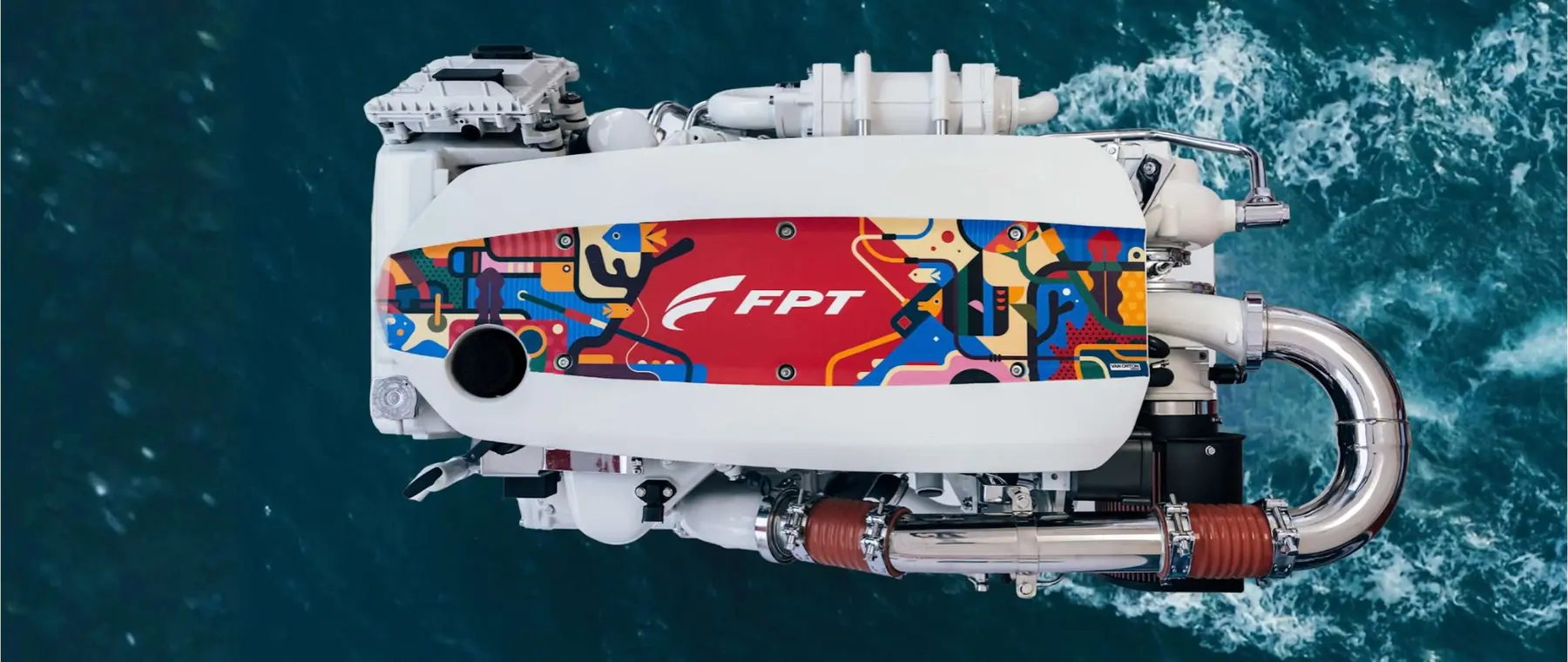
Primary source: FPT Industrial Marine statement distributed through PressMare, 2 November 2026; figures and commercial claims attributed to FPT. Photo: Manufacturer-supplied editorial release image accompanying that FPT Industrial Marine statement, reproduced with source credit to FPT Industrial Marine / PressMare. The image is the source's original article image and does not constitute an independently documented installation aboard a particular yacht.