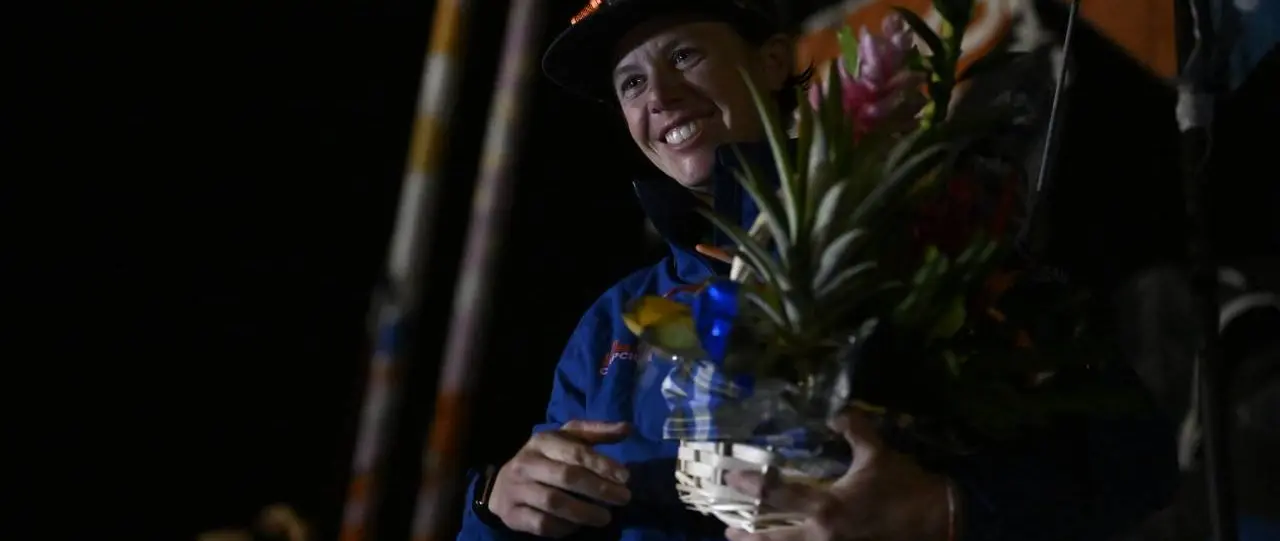
Francesca Clapcich has become the first woman to win the IMOCA Globe Series championship, completing her breakthrough 2026 season after an eighth-place finish in the Route du Rhum–Destination Guadeloupe. The Italian-American skipper accumulated 466 points, 36 more than runner-up Sam Goodchild, while Élodie Bonafous finished third with 388. IMOCA formally announced the result on 13 November, placing it within a season that combined solo transatlantic competition and crewed ocean racing. The title does not mean Clapcich won every event or took the Route du Rhum line honours. Its importance is the cumulative performance across a demanding championship format, and the historic achievement of finishing ahead of the field in a class that has traditionally offered women fewer visible opportunities at its very top.
How the championship was secured
The eighth place in the Route du Rhum sealed the title after earlier results had established Clapcich's advantage. IMOCA's published points table shows 466 for the champion and 430 for Goodchild, a precise 36-point margin. Bonafous's 388-point total gives another reference for the size of the lead at season's end. These figures are championship totals, not finishing times in a single race. The distinction is essential for readers trying to understand why a sailor finishing eighth in a transatlantic event could still win the annual title. A points competition rewards the pattern of performance over a series of events, with the format and grading of those events shaping the final order.
A first full season in the IMOCA circuit
IMOCA describes 2026 as Clapcich's first season on its full circuit, despite her extensive earlier ocean-racing career. She began with fifth in the solo 1000 Race and another fifth in the Vendée Arctique. Those early results gave the campaign a consistent foundation, avoiding the need for a spectacular final victory to recover from several poor performances. In a technical class, repeatability means maintaining the boat, learning its limits and minimising costly mistakes in addition to sailing quickly. The fifth-place finishes do not establish that the yacht was the fastest in either race. They show instead that the team could collect meaningful points in different conditions and events, the discipline a season-long championship is designed to reward.
The Ocean Race Atlantic added a crewed result
Clapcich also led a mixed international crew to second place in The Ocean Race Atlantic between New York and Lorient. IMOCA names Alberto Bona, Elodie-Jane Mettraux and Will Harris among the sailors, with Julien Champolion working as the onboard reporter. That was the only crewed race of the season within the programme highlighted by the class, making the result a useful contrast with her solo contests. Moving between formats changes the distribution of decisions and workload, and the skipper has to make adjustments without losing confidence in the boat. The result illustrates versatility rather than proving that tactics for a crewed ocean passage can simply be transferred to a single-handed race.
A Route du Rhum finish under pressure
The Route du Rhum was a crucial final event because it supplied the remaining points and placed the season's accumulated work under competitive pressure. An eighth-place finish may seem modest when viewed alone, but it can be strategically decisive when the championship rewards multiple outings. A sailor balancing an overall title with a race result still has to make real decisions about sail plan, weather routing and protecting the boat. The published championship account does not provide an exhaustive explanation of every choice Clapcich made offshore. It would therefore be misleading to present her finishing position as evidence that she deliberately sailed conservatively or took a particular tactical gamble. The confirmed achievement is finishing and securing the accumulated points needed.
The mechanics of IMOCA season points
According to IMOCA, championship scores reflect results from events assigned grades one through four, with the grade acting as a multiplier. Only round-the-world races receive grade one. This is not a simple table in which every event contributes identically, and readers should avoid recalculating scores from finishing places alone without the relevant rulebook. The system creates incentives to plan a season intelligently, because some starts have greater potential influence than others. It also means that reliability and campaign financing matter: a boat that cannot reach the starting line or complete a race loses more than the immediate opportunity for a trophy. The 466-point total records a successful combination of sporting performance and programme management.
From Olympic sailing to open-ocean competition
Clapcich was born in Trieste and represented Italy at the 2012 and 2016 Olympic Games before moving further into offshore racing. Her route to the IMOCA title has not been linear. She sailed in the 2017–18 Ocean Race with Turn the Tide on Plastic and later competed in La Solitaire du Figaro, finishing 25th in 2021. Those experiences help explain the mixture of skills apparent in the current programme. Olympic training builds technical discipline and high-frequency tactical judgment, while solo ocean racing adds sustained maintenance, navigation and fatigue management. One specialism does not automatically make a sailor excellent at the other, and the championship is significant partly because Clapcich has invested time in becoming effective across them.
Previous victory with 11th Hour Racing
Clapcich was part of the 11th Hour Racing Team that won The Ocean Race 2022–23, becoming the first Italian to lift the event's overall trophy, according to IMOCA. That achievement gave her experience of a major professional crewed campaign, but the new Globe Series championship is an individual season-long distinction earned in a different setting. The two milestones should not be merged. Winning as part of a team demonstrates the ability to operate within a coordinated programme; topping a solo-heavy championship means assuming a different share of responsibility on the water. Together they show an unusual breadth of competitive experience, one reason the current result deserves more than the label of an isolated historic first.
The boat and the Vendée Globe ambition
In early 2025 Clapcich and sponsor 11th Hour Racing announced an ambition to contest the 2028 Vendée Globe. The campaign acquired the former Malizia–Seaexplorer, a VPLP-designed IMOCA now sailing under the 11th Hour Racing name. This is a second-hand professional racing boat with its own performance characteristics and development history, not a newly announced production yacht for owners. The team has to invest in understanding and evolving its systems while preserving enough reliability to finish long solo events. A championship title is a strong step toward its stated 2028 goal, but it does not guarantee entry, a future race result or freedom from the technical setbacks that are routine in the class.
A second podium place for a woman
The championship podium itself is notable because Bonafous finished third as Clapcich took the top position. IMOCA states that the highest previous series ranking by a woman was third, achieved by Swiss skipper Justine Mettraux in 2024. The comparison establishes a factual first without suggesting that women's ability in offshore racing suddenly appeared this year. Women have long competed in difficult ocean events, often with unequal access to budgets and opportunities. The result demonstrates what a well-supported competitive programme can achieve within the current field. It also invites sponsors and professional teams to examine whether they are identifying and developing talent consistently across the sport, rather than relying on a historic result to resolve structural questions.
Why the sponsor matters to long campaigns
11th Hour Racing is more than a name on the sails in the official team history: the organisation has backed the pathway towards the 2028 Vendée Globe. Professional IMOCA racing requires engineers, weather specialists, sailmakers, insurance, shipping, logistics and repeated maintenance as well as athletes. Championship success cannot be reliably attributed to a single financial figure because the organisation has not published a comprehensive season budget with the announcement. Nevertheless, a sustained platform gives a sailor time to learn a boat and develop procedures, an advantage over campaigns forced to rebuild their support structures constantly. The editorial point is to recognise the role of long-term investment without making unverified claims about its scale or returns.
Where this connects to the broader yachting industry
Although an IMOCA is a specialist racing platform, its competitive cycle intersects with a large network of marine suppliers, composite specialists, electronics manufacturers and professional crews. Long-distance reliability, operational visibility and knowledge transfer matter to cruising yachts too, even where deck layouts and performance targets differ greatly. Readers interested in 12–23.99m luxury sailing yachts can draw lessons about structured maintenance and the importance of completing a season, while acknowledging that a racing boat's foil configuration and minimal accommodation are not normal cruising specifications. The wider sport also offers a visible platform for career development and sponsorship, topics with consequences for boatbuilding and the marine workforce beyond the racing fleet.
How to assess the next competitive step
Clapcich's 2026 title is already a confirmed sporting record, and it should not be downgraded to a prediction about future races. The next relevant milestones will concern the progression of her 2028 campaign, any official changes to the boat and further event results released by the class. IMOCA's championship table and original announcement provide the authoritative score; individual campaign communications can add technical context when independently confirmed. The important achievement today is precise: 466 points across the season, a title ahead of Goodchild and Bonafous, and the first female winner in IMOCA Globe Series history. Future success remains to be earned, but this distinction will remain part of the class's record.
Related Luxury Yacht Guide reporting
- Francesca Clapcich Keeps Racing After 11th Hour Racing Loses Its Bowsprit
- Malizia 4 Takes Second in Route du Rhum IMOCA Class
- Malizia 4 Faces First Solo Atlantic Test as Boris Herrmann Races 18.23m IMOCA
- Ferrari Hypersail Adds Ocean-Racing Navigator Simon Fisher and Yacht Club Italiano Partnership
Primary reporting and image credit
Primary manufacturer and organiser source(s): https://www.imoca.org/en/news/news/francesca-clapcich-crowned-2026-imoca-globe-series-champion-a-first-for-a-woman. © IMOCA / Route du Rhum 2026 media accreditation; original association-hosted race-arrival photograph from the published championship report. Image is used only for correctly attributed factual editorial coverage and never represented as open-licence stock photography.