A new IMOCA moves from launch programme to solo ocean test
Boris Herrmann’s Malizia 4 is undertaking its first solo race with its skipper in the 2026 Route du Rhum – Destination Guadeloupe, a significant step for a yacht launched only in July. The 60-foot offshore monohull left Saint-Malo with the racing fleet on 1 November, beginning a transatlantic voyage towards Pointe-à-Pitre. For the team, the campaign is not simply another event on the calendar; it places a new-generation hull, its systems and its sailor into the particular demands of single-handed ocean racing.
As of 7 November, Team Malizia’s published race updates describe Herrmann sailing south amid complicated Atlantic weather. Conditions and fleet positions change through the day, so a fixed placing would quickly misrepresent a live race. What can be reported confidently is the progression: a boat developed over two years, launched in summer, exercised in crewed competition and now placed in the hands of one skipper for a major offshore test. It is an 18-metre yacht story with technical consequences beyond the result.
The scale and origin of Malizia 4
Team Malizia states that its new IMOCA hull measures 60 feet, approximately 18.23 metres, in accordance with the class framework, with a bowsprit extending forward. That makes it squarely relevant to Luxury Yacht Guide’s 12.00–23.99-metre segment even though its purpose differs from a leisure cruiser. The yacht was launched at Lorient on 6 July 2026 after an extended design and construction programme, with offshore endurance and high-level competitive performance in mind.
The project is connected to naval architect Antoine Koch, design office Finot-Conq and structural specialist Gsea Design, with construction work undertaken at CDK in Lorient. The team’s public account emphasises the value of combining practical sailing experience with new modelling and design approaches. A race yacht should not be evaluated by promotional claims alone, however. Extended sailing provides the feedback that helps separate promising design decisions from measurable offshore advantages.
A shared development effort with two other teams
One distinctive aspect of the design programme is collaboration between three IMOCA projects. Team Malizia, Thomas Ruyant’s TR Racing and the Banque Populaire team associated with Loïs Berrehar joined a shared development effort, according to Team Malizia’s original announcement. Each boat was intended to follow a common design concept while incorporating decisions suited to the individual skipper and campaign. That differs from the simplified idea that every top-level racing team must develop its hull entirely alone.
The arrangement is interesting to designers and builders because pooling early research can reduce duplicated effort while leaving room for distinct operating choices. It does not mean the three racing boats are mechanically identical in every detail or that their eventual results can be attributed to a single design factor. Sail selection, configuration, equipment reliability, weather routing and decisions made under pressure remain important differences. The Route du Rhum offers one more context in which these projects will learn from actual use.
Why sailing alone changes the engineering questions
A yacht may behave very differently when only one person is aboard to trim sails, manage navigation, monitor power and deal with mechanical problems. On a 60-foot foiling monohull, the apparent simplicity of a streamlined deck hides a large number of interacting systems. The skipper’s ability to work safely, move within the cockpit and maintain essential functions matters alongside speed. It is therefore meaningful that this is Herrmann’s first solo race on Malizia 4 rather than the yacht’s first outing of any kind.
Team Malizia’s launch material discussed the new cockpit arrangement and detailed elements of the rig, including a mast reaching about 27 metres above the deck. These are figures from the builder’s campaign, not independent measurement by this publication. Such dimensions help explain why ergonomics and system reliability become critical on a long offshore passage. A boat optimised for two or more crew members may need a different operating routine when a single sailor must perform every task without relief.
The Route du Rhum as a distinctive test
The Route du Rhum is a solo race from Saint-Malo in Brittany across the Atlantic to Guadeloupe. Its 2026 edition began on Sunday 1 November, with different classes sharing the spectacle of the start but racing in their own divisions. Herrmann is competing in IMOCA rather than in the much larger Ultim multihull category or the smaller Class40 division. That distinction matters because hull types, speeds, rules and operational constraints are not interchangeable between the fleets.
The challenge begins with the racecourse rather than a simple point-to-point line. Weather routing, changing wind angles and sea conditions influence every decision, and the quickest theoretical path is not necessarily the safest or fastest practical passage for a given yacht. The team’s early November update referred to a complicated Atlantic pattern as Herrmann worked south. That should be read as an account of the conditions during those days, not a forecast for the remainder of the crossing.
A campaign connected to longer-term ocean racing
Malizia 4 was conceived with objectives beyond one November race. The team introduced it as part of its next period of offshore competition, including future editions of The Ocean Race and the Vendée Globe. A new IMOCA is a substantial investment in hull design, sail systems, data and crew experience. The accumulated information from every offshore event helps reveal how the boat performs when theoretical expectations meet changing seas and real operating loads.
For Herrmann, the first solo programme creates the opportunity to establish personal familiarity with a new cockpit and handling character. The team’s October material highlighted preparation for the Route du Rhum and the need to learn the yacht before departure. None of this guarantees a finishing position, and a race report should not imply that a launch schedule or prior team success makes an outcome inevitable. The durable news is the progression of the new yacht and the acquisition of practical ocean miles.
What is confirmed, and what remains live
Team Malizia’s official reports establish the July launch, the 1 November start and Herrmann’s participation aboard the new boat. They also document a complicated opening phase in the Atlantic, with the skipper reporting on his progress during the first days. Public race trackers supply changing positions and speeds; those values belong to specific report times and should never be published as an unqualified current fact hours later.
As with all offshore competition, further developments may alter the story. A competitor can gain or lose many miles through route choice or a weather shift, and a precise forecast of finish time is not a result. Readers seeking positions should consult the race organiser’s live tracker. This article concentrates on the yacht’s development and solo-racing transition, the aspects that remain informative after the leader board has changed.
A rare example of documented design collaboration
The three-team collaboration behind Malizia 4 also provides a useful case study for the wider yacht industry. Designers, builders and racing teams often face the same problem: how much knowledge should be shared in development, and where should differentiation begin? The 2025 project announcement made the shared effort unusually public, identifying the design and structural partners and explaining that individual boats would retain room for team-specific choices.
For the cruising-yacht owner, the direct transfer of a racing solution cannot be assumed. An IMOCA seeks competitive performance within a specialised rule, whereas a family cruiser balances livability, maintenance, cost and simplicity. Nevertheless, the development method itself is instructive. Serious boatbuilding depends on clear responsibilities between naval architecture, structural engineering, construction, testing and operation. Malizia 4 gives observers a visible contemporary example of those disciplines working together.
The photographs show the actual yacht, not a race reconstruction
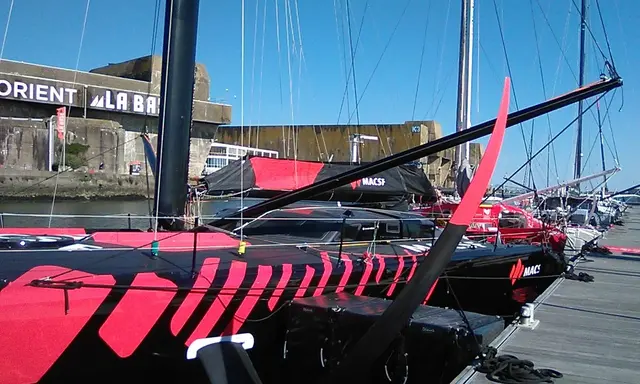
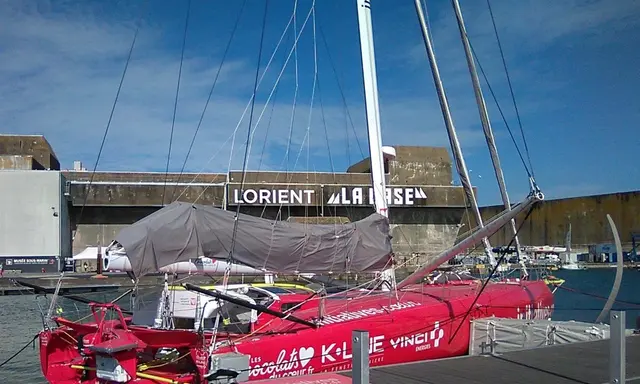
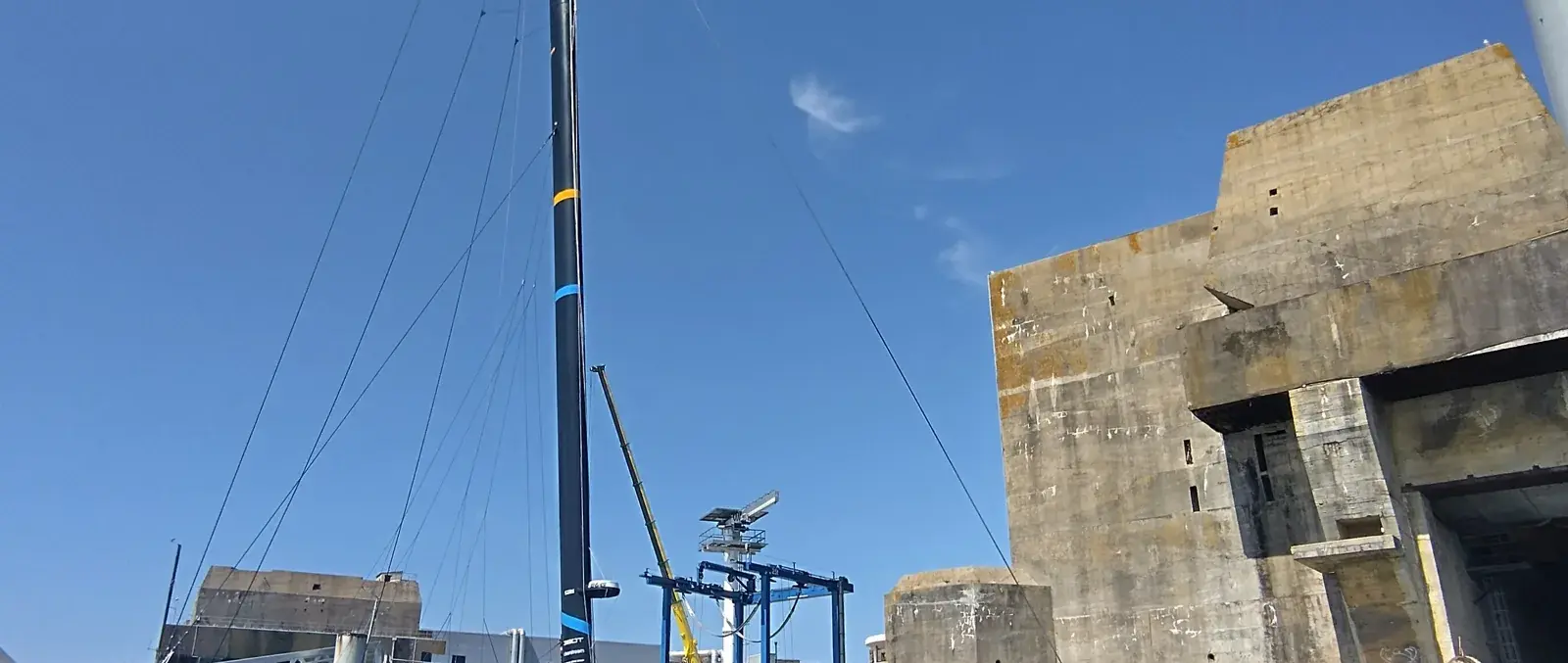
Images of offshore racers can become misleading when old hulls or a different team’s yacht are used to illustrate current news. Here the accompanying photograph depicts Malizia 4 herself at Lorient in August 2026, after launch and before subsequent racing. It is an archival shore photograph of the actual boat and is not presented as an image of the 1 November Route du Rhum start or the present conditions in the Atlantic.
The photograph was created by Wikimedia Commons contributor Jug81 and released under a Creative Commons Attribution-ShareAlike licence. It helps readers identify the correct boat while the body of the article supplies the up-to-date sporting context. The distinction is worth making because sail numbers, sponsors and hull ownership can change over time, especially among older IMOCAs. Accurate identification is part of accurate reporting.
The bigger question is what the voyage will teach
A race result will establish a finishing order, but a first solo campaign on a fresh IMOCA can reveal much more: which handling choices work in sustained conditions, where systems demand attention, how the skipper manages rest and whether initial design aims survive demanding practical use. Some of those findings may remain internal to the team. Observers should avoid claiming knowledge of performance data, engineering faults or comparative advantages that the team has not released.
For now the verified story is that Herrmann is racing the new 18.23-metre Malizia 4 across the Atlantic in the November 2026 Route du Rhum, after a July launch and a collaborative design programme. It connects a current event with the broader story of modern offshore yacht development. As the race proceeds, fresh source-backed updates can cover sporting results without rewriting the underlying history or inventing a performance verdict before the voyage is complete.
Primary sources: https://www.team-malizia.com/news/boris-herrmann-and-team-malizia-launch-malizia-4-their-new-generation-imoca-race-yacht; https://www.team-malizia.com/news/a-new-imoca-for-boris-herrmann-s-team-malizia-co-designed-innovative-and-triple-powered; https://www.team-malizia.com/news/team-malizia-s-boris-herrmann-set-for-first-solo-race-aboard-new-malizia-4-in-route-du-rhum; https://www.team-malizia.com/news/route-du-rhum-day-3-a-race-turned-upside-down-; https://www.routedurhum.com/
Photograph: Jug81, Malizia 4 in Lorient on 3 August 2026. Wikimedia Commons, CC BY-SA 4.0. Photographed before the 2026 Route du Rhum; no claim it depicts the race start. Image converted and resized to WebP. Original: https://commons.wikimedia.org/wiki/File:Malizia_4_Imoca_02.jpg ; licence: https://creativecommons.org/licenses/by-sa/4.0/ .