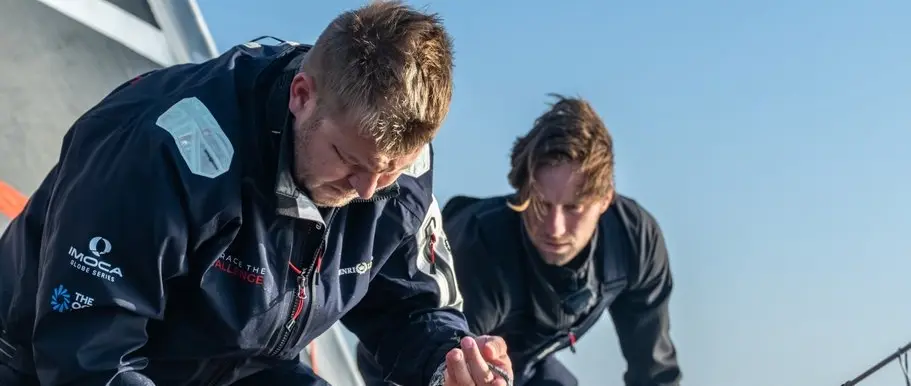
Embrace The Challenge has chosen six international sailors for its 2027 around-the-world Ocean Race campaign, with Swiss skipper Oliver Heer planning to take four aboard for each competitive leg. The team announced its selection from Gosport on 24 November 2026, naming Annemieke Bes, Rosalin Kuiper, Lincoln Dews, Tom Dolan and Dee Caffari MBE alongside Heer. Its official announcement distributed by The Ocean Race sets out a plan that deliberately blends Olympic sailing, the Figaro circuit, solo ocean racing and previous round-the-world competition. The significance is not merely an impressive collection of biographies. Embrace The Challenge is betting that flexibility, continuity between watches and disciplined collaboration will be as important as raw boat speed after the scheduled Alicante start on 17 January 2027.
Six sailors for four places on each leg
The fundamental crew decision is that four people will race on each leg, chosen from a pool of six. That makes the announcement different from a fixed starting line-up. Heer can adapt the make-up of the boat to a leg's expected demands, while giving some sailors time to recover between sections of a long campaign. The organisation has not announced a complete leg-by-leg selection, so it would be premature to say who will sail any particular ocean. A wider squad can also complicate handovers because a substitute may have less recent experience of a new configuration or defect. For that reason, flexible selection has value only if shared technical records and standard procedures are as strong as the individuals taking part.
Oliver Heer moves from solo to collective command
Heer completed the Vendée Globe in 2025, becoming the first Swiss-German sailor to finish that solo circumnavigation. He is now making the demanding transition from controlling virtually every onboard decision personally to coordinating a small team that must act together for weeks. The official release also places the campaign within his longer-term preparation for the 2028 Vendée Globe. That combination introduces an interesting management challenge: training colleagues to make independent decisions while preserving a common boat-handling philosophy. It would be wrong to assume that a successful solo skipper automatically becomes an excellent team leader. Leadership in this setting means distributing authority, listening to specialists and resolving disagreements before a mistake becomes expensive offshore.
Annemieke Bes adds Olympic precision
Dutch sailor Annemieke Bes brings three Olympic campaigns and a silver medal from the 2008 Beijing Games, alongside participation in the 2017–18 and 2022–23 Ocean Race editions. Her sporting history reaches from short-course sailing, where timing and small tactical errors are highly visible, into the prolonged uncertainties of ocean competition. That range may help the team examine manoeuvres and trim choices with unusual precision, provided the crew can translate short-course habits into sustainable offshore practice. The article's central claim is not that Olympic medals directly measure open-ocean endurance. Rather, the team has selected someone accustomed to structured training, technical debriefs and operating under pressure, all useful disciplines when a very small crew needs consistently repeatable procedures.
Rosalin Kuiper's knowledge of the previous race
Kuiper sailed with Team Malizia in The Ocean Race 2022–23 and subsequently skippered Team Holcim-PRB to third place in The Ocean Race Europe 2025. Those are particularly relevant qualifications because contemporary IMOCA competition requires rapid decisions about sail selection, autopilot use, motion, damage and endurance. Experience of the format can also improve how sailors discuss disagreements when everyone is tired. Kuiper's addition does not transfer the technical history of another team to Embrace The Challenge automatically. Boat setup, systems architecture and personnel differ; skills must be retested with the new colleagues. Her value is that she has encountered the wider pattern of challenges before and can recognise which details deserve scrutiny before a demanding leg begins.
Lincoln Dews bridges sailing and data
Australian Lincoln Dews is the team's co-skipper and data analyst, and his background includes postgraduate study in meteorology and data analytics. He also knows Embrace The Challenge's recent programme through The Ocean Race Atlantic, giving him a direct view of the boat and its current operating habits. His role points to a familiar development in modern offshore sailing: performance decisions increasingly depend on reading information critically rather than accepting a screen's output. Sensor calibration, weather uncertainty and sailing polars can lead to misleading decisions if treated as absolute truths. A strong analyst must ask when measured performance diverges from expectation, whether the data are trustworthy and how to explain recommendations clearly to a tired person on deck.
Tom Dolan and the strength of short-handed racing
Irish skipper Tom Dolan won La Solitaire du Figaro in 2024 after several earlier attempts, an achievement built on racing that punishes poor preparation and indecision. Solo and short-handed competition develops an ability to prioritise critical tasks while dealing with an incomplete picture of weather and rival performance. Embrace The Challenge can use that perspective when four sailors share an offshore workload, because a watchkeeper may still need to make immediate calls without convening the entire crew. Dolan's presence should not be read as a prediction of results, but his background explains why the selection combines specialists rather than choosing sailors from only one established race team. Different pathways can expose weaknesses in habitual thinking.
Dee Caffari supplies leadership and endurance experience
Dee Caffari MBE has completed seven circumnavigations and was the first woman to sail solo, non-stop around the world in both directions, according to the campaign announcement. She also skippered Turn the Tide on Plastic in the 2017–18 Volvo Ocean Race. The team expects her to contribute mentoring and knowledge of demanding southern routes, as well as direct racing ability. Endurance experience matters especially because not all performance losses come from equipment. Sleep deprivation can make even a technically simple manoeuvre hazardous; persistent stress can make communication less accurate. A mentor who knows the patterns may help the crew recognise those risks early, although accountability for safe operation remains a collective responsibility, not a single senior sailor's burden.
A balanced group without a token selection formula
The new squad contains three women and three men, a characteristic the organiser says emerged from choosing sailors for skill and fit rather than from an imposed ratio. That distinction is worth respecting. The main performance question is whether all six are empowered to contribute their expertise when it matters. Public statements about inclusion are meaningful only if supported by operational practices: transparent selection criteria, access to technical information and consistent expectations for each watch. Offshore racing can give audiences visible examples of mixed teams handling high-pressure technical problems together, but the crew's ultimate sporting record will be established on the water. The announcement provides a credible starting position, not a completed evaluation of its culture.
Gosport workshop starts the integration process
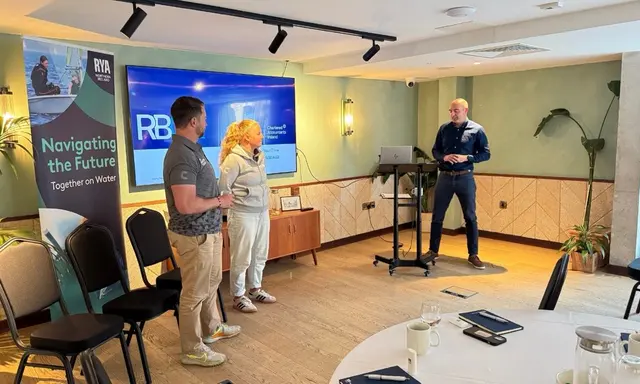
All six sailors gathered for a two-day shore-based workshop at the programme's Gosport headquarters before the announcement. The team says preparation will continue with a delivery voyage from Gosport to Alicante. Shore workshops allow sailors to discuss roles and challenging scenarios in comfort, but some assumptions only become testable when the boat is wet, noisy and moving. Watch changes, food preparation, reefing communication and defect reporting are obvious areas where a shared approach can be developed. A team may contain exceptional sailors yet still suffer from inconsistent language or undocumented routines. Making that practical handover work is essential when the crew can change between legs and still needs to maintain a consistent safety standard.
Human performance in a confined working environment
A racing IMOCA offers very little of the private space associated with a luxury cruising yacht. People who would normally work independently are required to sleep, eat, analyse weather and perform urgent manoeuvres in close proximity. Strong interpersonal skills can become measurable in fewer errors and faster identification of problems. The official announcement identifies mental-performance support from Jenewein, suggesting that the programme recognises the human dimension of sustained competition. There is no published clinical outcome or performance metric attached to this partnership, and none should be invented. The important editorial observation is that professional teams increasingly treat collaboration as something to practise deliberately, not a quality guaranteed by signing six talented people.
Why the campaign matters beyond professional racing
Owners, captains and yacht builders in the 12–23.99m segment face different priorities from an IMOCA race team, yet several operating principles transfer directly. A cruising yacht crossing an ocean must define who has authority in an emergency, maintain a realistic watch plan and ensure that more than one person understands vital systems. Crew changes are common in charter and owner-operated cruising, making written handover information particularly valuable. Racing procedures should not be copied without adaptation, but the underlying lesson is clear: safe performance emerges from a system involving people, training and maintenance rather than a heroic individual. The broader marine sector benefits when elite teams explain these methods without treating competition as a blueprint for recreational passage-making.
Commercial support and the route to the start
Embrace The Challenge acknowledges backing from Bossard Group and Burgerstein Vitamin, together with performance partners including Henri Lloyd, Dubarry, Katadyn and Norqain. The announcement does not disclose sponsorship amounts or prove a commercial return, so this coverage does not estimate either. Such support helps a campaign provide training, equipment and professional services across a lengthy season. With the start scheduled for 17 January 2027, immediate milestones are the delivery to Alicante, additional crew practice and a public confirmation of the leg-specific selections when ready. The official source presents a serious, adaptable team assembled from multiple forms of elite sailing. Whether the approach produces a competitive advantage remains an open sporting question for the coming race.
Related Luxury Yacht Guide reporting
- Francesca Clapcich Keeps Racing After 11th Hour Racing Loses Its Bowsprit
- Malizia 4 Takes Second in Route du Rhum IMOCA Class
- Malizia 4 Faces First Solo Atlantic Test as Boris Herrmann Races 18.23m IMOCA
- Ferrari Hypersail Adds Ocean-Racing Navigator Simon Fisher and Yacht Club Italiano Partnership
Primary reporting and image credit
Primary manufacturer and organiser source(s): https://www.theoceanrace.com/en/news/16081_Embrace-The-Challenge-announces-six-strong-sailing-squad-for-The-Ocean-Race-2027. © Embrace The Challenge / Oliver Heer Ocean Racing; official campaign press photo distributed by The Ocean Race. Image is used only for correctly attributed factual editorial coverage and never represented as open-licence stock photography.