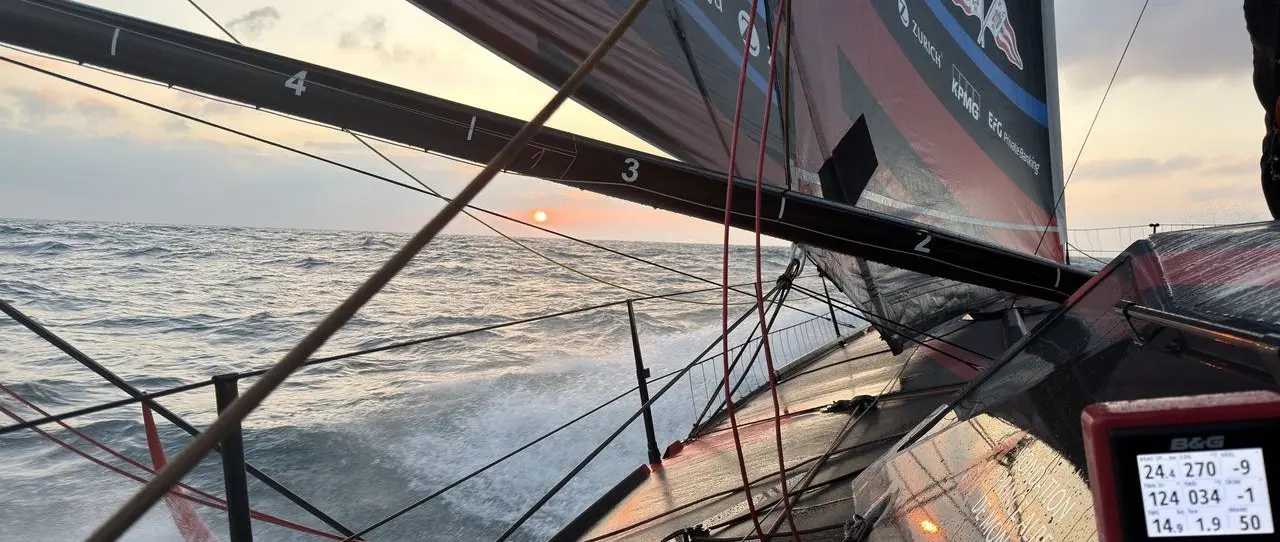
A podium on the new yacht's first solo crossing
Boris Herrmann brought Team Malizia's new IMOCA yacht into Pointe-à-Pitre on Thursday 12 November 2026, taking second place in the class in the Route du Rhum. The team's official announcement gives a finish time of 08:10:36 UTC, corresponding to 04:10:36 local time in Guadeloupe, after 10 days, 20 hours, eight minutes and 36 seconds at sea. For the Monaco-associated team, the result represents an important test of a new racing platform in a demanding single-handed environment. For owners of performance-oriented sailing yachts, the particular interest is the connection between the engineering of the vessel, the skipper's ability to operate it alone and the technical preparation undertaken in the months between its launch and the crossing. The 60-foot IMOCA class is within Luxury Yacht Guide's length range, although its boats are specialised offshore racing machines rather than conventional cruising yachts. Their design priorities and operating methods must therefore be considered in their own context.
The distinction between the course and distance actually sailed
The 13th edition of the Route du Rhum started from Saint-Malo on 1 November. The organiser's fleet comprised 115 competing boats divided among six classes, with 22 sailors taking part in the IMOCA competition. According to the team, Malizia 4 travelled 3,887.29 nautical miles, averaging 14.94 knots over the ground. Those figures represent the team's reported actual track and average speed rather than the length of a straight line between the departure and destination or a prediction of performance for another voyage. In ocean racing, the desired route depends on the wind fields, the boat's performance characteristics and the strategies available. An offshore sailing yacht used for private cruising has additional priorities including passenger comfort, the requirements of its crew, reserve capability and acceptable exposure to weather systems. The racing result is useful evidence about the Malizia campaign under the particular conditions of this event, not a recommended speed or passage schedule for a cruising yacht of similar dimensions.
A weather pattern that changed the tactical picture
The team describes an Atlantic crossing that differed from the conventional expectation of a passage driven by established trade winds. The expected winds did not develop in the usual fashion, and the fleet consequently operated farther north. The race combined extended periods of weak wind with considerably faster and more physically demanding conditions. A significant separation occurred on 3 November when the leading boats encountered different wind conditions. Corentin Horeau, aboard MACSF, retained an advantage while some boats farther north became trapped in unstable, light air. Herrmann, who had been positioned to the south, was able to make progress westward despite having been less favourably placed earlier. For an observer accustomed to the steady improvement of a boat's displayed position on a chartplotter, the episode illustrates the difference between immediate progress and the longer-term consequences of a routing decision. The fastest theoretical track is not independent of the changing conditions along it. Even a modest separation between racing boats can lead to very different experiences of the same ocean.
How the second position developed
Malizia 4 moved through third place into second during the early hours of 4 November. The contest remained close, with Sam Goodchild and Francesca Clapcich pursuing Herrmann as the fleet progressed across the Atlantic. Goodchild briefly moved ahead of Herrmann on 7 November, before the latter regained second on the following morning. A further compression of the fleet in light winds on 10 November created another difficult stage close to the destination. The team reports that Herrmann was subsequently able to rebuild separation from Goodchild and Élodie Bonafous as he approached Guadeloupe. This sequence matters because finishing position alone conceals the variability of the competition. A boat that appears securely positioned on one day's leaderboard can face a different set of circumstances the next day. The result reflects continued tactical decisions and the skipper's ability to preserve progress through changing conditions, rather than a simple uninterrupted advantage established at the start.
Horeau's record and a demanding closing approach
Corentin Horeau won the IMOCA class aboard MACSF in nine days, 17 hours, 12 minutes and nine seconds, bettering the previous class race record by more than two days, according to Team Malizia. Herrmann's result followed one day, two hours, 56 minutes and 27 seconds later. The approach around Guadeloupe added another distinct challenge as the team describes weakening and variable wind on the leeward side of the island, with much of the closing stage undertaken at night. These final miles provide a useful reminder that the environment close to land may differ considerably from the offshore conditions experienced earlier in a passage. For the captain of a private yacht, the decisions appropriate to coastal arrival should be based on local navigation information, the boat's actual manoeuvring characteristics and the interests of the people aboard. A solo race finish is not a model for the arrival of a family cruising boat. Nevertheless, the importance of maintaining effective decision-making until the vessel is securely at its destination is shared by both types of operation.
What reliability means at this stage of development
Herrmann's assessment after the finish placed particular emphasis on the reliability of the new boat and the work of the shore team. His comments indicate that the campaign was able to complete the crossing without a significant breakdown reported in its arrival announcement. That distinction is important: a positive assessment following one race does not establish a comprehensive failure history or guarantee future performance. A new racing yacht accumulates practical evidence as its systems are operated in different conditions and as the crew discovers how particular components interact. A commissioning programme for a privately owned yacht also benefits from progressive testing, although its objectives will differ substantially. The owner should establish appropriate acceptance criteria for machinery, electrical systems, navigation equipment and accommodation, with responsibility for resolving problems clearly assigned. An owner who relies exclusively on the successful completion of a short demonstration may overlook behaviour that becomes apparent after a longer period at sea. The Malizia result demonstrates the value of an extensive preparation programme under the campaign's specific requirements.
Preparing a yacht for single-handed operation
Even when the race yacht is sailed by one person, its operation is the outcome of collective work before departure. The team reports that Malizia 4 had accumulated more than 15,000 nautical miles in a little over four months. That experience included crewed operation before the solo Route du Rhum. Designing a boat for one person to handle during an ocean race introduces particular requirements for access to controls, visibility of information, the time needed to undertake tasks and the skipper's ability to continue functioning under fatigue. A conventional sailing yacht may never be intended for a similar solitary programme, but owners intending to operate with a small crew can ask related questions during specification and refit. Are the systems accessible when needed? Can the people aboard recognise a developing fault? Are normal operating procedures clearly understood? The answers should depend on the actual sailing programme and the capabilities of the intended crew. Equipment advertised as suitable for short-handed operation is not a substitute for training and appropriate staffing.
From the Caribbean to the next preparation cycle
The team's immediate plans involve returning Malizia 4 to Alicante with a crew led by Will Harris. A refit is planned to begin at the end of November, followed by further training and preparations through December. The next objective is the crewed Ocean Race, scheduled to start on 17 January 2027. The transition between solo and crewed competition is a reminder that the same yacht can have different operational requirements at different stages of its campaign. The configuration and procedures suitable for one event may require review before another. Owners planning a change in the use of their private yachts can similarly consider how the new programme affects equipment, crew and support arrangements rather than treat a previously successful passage as evidence that no further preparation is needed.
A result that establishes a useful benchmark
The second-place finish is Herrmann's best result in his three Route du Rhum appearances and adds to his second-place finishes in The Transat CIC and New York Vendée in 2024. Its significance for this campaign is that it establishes a racing benchmark for the new yacht before the next major competition. The accompanying official team photograph was taken by Herrmann during the first evening aboard Malizia 4 in this race. It records the early part of the actual voyage rather than the arrival in Guadeloupe. Team Malizia's published media contacts include helene@borisherrmannracing.com for press releases and marie@borisherrmannracing.com for image enquiries. The team's September 2026 press kit describes the terms for editorial imagery. The campaign's longer-term results remain to be established, but the combination of an accomplished finish, a newly developed platform and the stated reliability experience provides a meaningful basis for observing the next stage of its offshore programme.
Sources and photograph
Source documentation: https://www.team-malizia.com/press-releases/team-malizia-s-boris-herrmann-claims-outstanding-second-place-in-thrilling-route-du-rhum-2026, https://www.team-malizia.com/news/team-malizia-s-boris-herrmann-claims-outstanding-second-place-in-thrilling-route-du-rhum-2026. Photograph: First evening aboard Malizia 4 during the Route du Rhum 2026 — Boris Herrmann / Team Malizia. Official Team Malizia editorial-use photograph, credited to Boris Herrmann / Team Malizia, as documented in the team’s September 2026 press kit.