A new crew appointment at a Genoa ceremony
Ferrari's Hypersail programme has formally welcomed British ocean-racing navigator Simon Fisher while announcing a partnership with the Yacht Club Italiano. The developments were presented in Genoa on 26 November 2026, where Ferrari chairman John Elkann and club president Carlo Cameli marked the relationship at a public event attended by sailing and regional representatives.
The crew appointment is a confirmed organisational milestone, not evidence that the ambitious foiling yacht has already completed its intended ocean trials or an offshore record. The programme is still developing, and the key questions about sustained performance and reliability must ultimately be answered on the water.
Fisher brings offshore experience
Fisher is known for major ocean-racing campaigns, including victories in the 2014–15 Volvo Ocean Race and The Ocean Race 2022–23. The announcement also points to the Magnus Olsson Prize awarded in 2023 and his involvement in the crew that secured the Jules Verne Trophy in January 2026.
These achievements help explain the appointment, but they should not be treated as a guarantee of future results. Different yachts and competitions place different demands on navigators and crews. The value lies in the experience of making decisions under pressure during long passages.
Why navigation is central to the project
A fast ocean-going sailing yacht needs more than a powerful rig and advanced hull. The route must be chosen in relation to changing weather, the vessel's performance characteristics and the endurance of its crew and systems.
The navigator therefore plays a critical role in balancing speed and risk. A theoretical optimum route may become impractical if conditions threaten equipment reliability or put the yacht beyond its safe operating limits. That trade-off becomes especially important in a new technical programme.
Bringing racing experience into development
Experienced sailors can help designers and engineers understand how systems behave during demanding operations. Their observations may influence the arrangement of controls, the information presented to the crew and the sequence of tasks during manoeuvres.
Fisher's appointment can support such development, but the exact scope of his technical responsibilities has not been fully detailed in the public announcement reviewed here. It would be premature to assign him ownership of a particular design element or computer system without confirmation.
The Yacht Club Italiano relationship
The formal link with the Genoa-based Yacht Club Italiano connects the industrial programme with one of Italy's established sailing institutions. Elkann and Cameli presented the partnership together, indicating the club's intended place within the broader Hypersail effort.
A partnership announcement is different from confirmation of a particular race entry, training schedule or joint financial commitment. Those details should be reported when the organisations publish them. The immediate news is the formal relationship and the context in which it was presented.
A project that combines two cultures
Ferrari is closely associated with high-performance motorsport, while ocean racing requires crews to manage changing natural conditions for days or weeks. The Hypersail challenge brings these cultures into contact through engineering, operational discipline and competitive ambition.
There are useful parallels in data analysis, materials and reliability, but a yacht is not a car placed on water. Hydrodynamics, rig loads, wave interaction and the need to function without immediate shore assistance require different solutions.
Giovanni Soldini's role in the origins
At the Genoa event, Elkann acknowledged Giovanni Soldini's contribution to the initial idea. He described how discussions during the pandemic led toward the possibility of undertaking a technical challenge outside Ferrari's traditional field.
That history helps explain the ambition, but it is not a claim that every aspect of the finished yacht has been designed by Soldini or that a specific record attempt has already been approved. The roles of participants should follow the project's official organisation.
The ambition to develop a fast monohull
One objective described at the event was to bring the monohull back into prominence at the highest levels of ocean-racing performance. Modern foiling designs can behave very differently from traditional displacement sailing yachts, potentially reducing hull contact with the water in suitable conditions.
The performance benefits have to be balanced against complexity, loads and reliability. A fast theoretical design is not the same as a vessel proven across a lengthy ocean passage. Fisher's experience may be particularly relevant as the team evaluates those practical demands.
Endurance is as important as peak speed
Elkann drew a distinction between a high-speed demonstration and the sustained demands of an ocean challenge. In his framing, the relevant comparison was closer to endurance racing than to a short Formula 1 event.
That perspective is useful because racing records are determined by the complete voyage. A yacht that can reach an extraordinary speed for a few minutes still needs to function in changing weather while its crew manages energy, equipment and navigation.
The 2027 development horizon
Earlier Ferrari Hypersail announcements have pointed toward a 2027 launch and trial programme for the approximately 100-foot foiling monohull. The new November crew and club announcements provide organisational progress but do not independently confirm that the final launch date or test schedule has been achieved.
Any future milestone should identify the actual vessel, date and type of operation. Launching, commissioning, foiling trials and completing an offshore passage are separate stages. Treating them as interchangeable would obscure what has really been demonstrated.
Crew coordination under load
An offshore racing crew has to coordinate steering, sail handling, navigation and technical maintenance. Decisions can affect both immediate performance and the yacht's ability to continue operating safely for the remainder of a passage.
The benefit of recruiting an experienced navigator includes familiarity with communication during complex situations. Even so, no individual can make a novel yacht reliable alone. The programme needs effective collaboration among all its sailors and engineers.
Data can inform better decisions
Performance analysis can help identify how different sail configurations and routes influence progress. For a development project, recorded information may also expose weaknesses that require changes before longer trials.
The announcement does not publish a complete list of sensors, software or algorithms intended for Hypersail. A report should therefore avoid inventing a specific artificial-intelligence navigation system or claiming it has already been independently validated.
Foiling increases engineering demands
Hydrofoils can generate lift, changing the relationship between the hull and the water. The arrangement may offer performance opportunities while introducing substantial structural and control challenges, especially when waves and loading change.
These systems require careful engineering and realistic testing. The performance of a completed racing yacht will depend on more than the presence of foils. Conditions, control response, crew technique and system durability all play a part.
An international sailing programme
The Genoa presentation included figures from sport and regional government, underlining the wider profile of the initiative. It also brought together individuals with experience in sailing campaigns and the management of sophisticated technical projects.
High-profile participation may support public interest and cooperation, but it does not establish a particular economic impact or a guaranteed competitive result. Those claims would need separate evidence.
What the venue contributes
Genoa has a long relationship with Italian maritime activity and sport. The Yacht Club Italiano's involvement places Ferrari Hypersail within that history, even as the project seeks to develop new technology.
A ceremony at a prestigious club can be symbolically important without changing the technical status of the yacht. The distinction between institutional support and engineering achievement should remain clear in subsequent coverage.
How private-yacht owners may view the project
Most luxury-yacht owners will never commission a foiling ocean-record machine, but the project could attract interest because of its approach to materials, energy and systems. Some innovations from racing eventually influence other marine applications.
That possible pathway should not be presented as a confirmed product pipeline. Technology developed for extreme sailing may be unsuitable or too complex for everyday cruising without substantial adaptation. Owners need proven equipment and dependable support rather than promises based on a racing concept.
Attention to reliability and maintenance
A development yacht must be inspected repeatedly as its systems are refined. Engineers need to understand how components age under load and whether a modification changes the behaviour of another part of the vessel.
A high-profile programme should be judged by documented tests and transparent technical milestones. Public statements about ambition do not replace the careful work required to make an unconventional design reliable offshore.
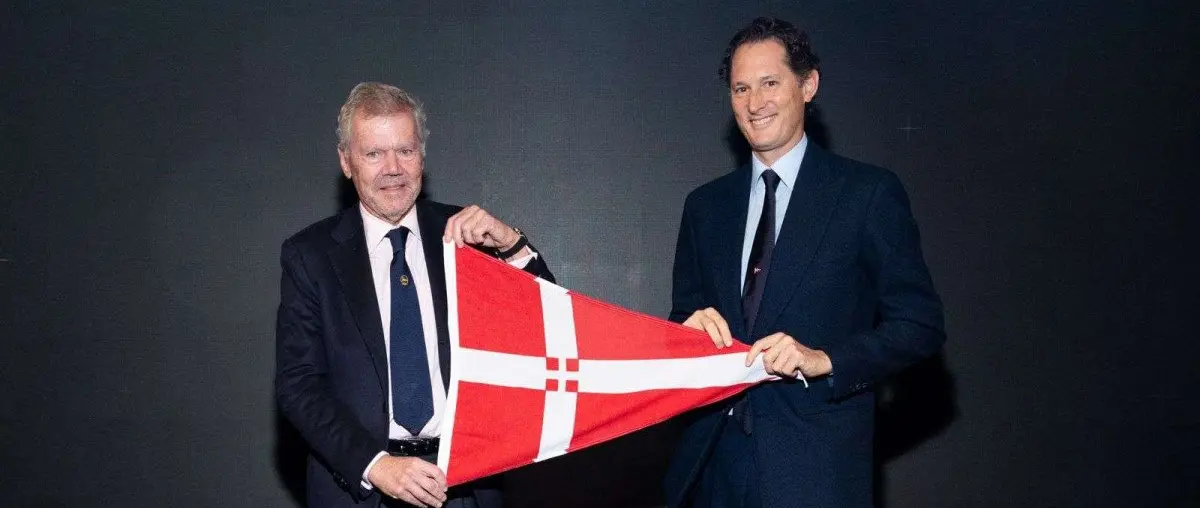
The photographs document the ceremony
The accompanying image shows Ferrari and Yacht Club Italiano representatives with the club burgee at the Genoa event. It is sourced from the contemporary event report and should not be mistaken for a photograph of Simon Fisher at the helm or a completed Hypersail yacht underway.
This is an important distinction because publicity images from a formal announcement can circulate long before a vessel's final technical configuration is available. The photograph supports the partnership announcement, not a performance claim.
A meaningful organisational step
The official 26 November presentation confirms two developments: the involvement of a proven ocean-racing navigator and the club partnership. Neither establishes the outcome of future trials, yet both are relevant to preparing a demanding offshore programme.
For LYG readers, Ferrari Hypersail remains an unusual meeting of engineering and competitive sailing. The next decisive reports will come when the vessel's physical progress, testing and operational achievements can be verified independently.
Primary reporting and image credit
Primary report: https://www.pressmare.it/en/media/press-mare/2026-11-26/ferrari-hypersail-record-breaking-navigator-yci-burgee-94389. © Pressmare / original Ferrari Hypersail event photographer. Image shows Ferrari and Yacht Club Italiano representatives at Genoa; it is not Simon Fisher sailing. Image is used only for correctly attributed factual editorial coverage and never represented as open-licence stock photography.