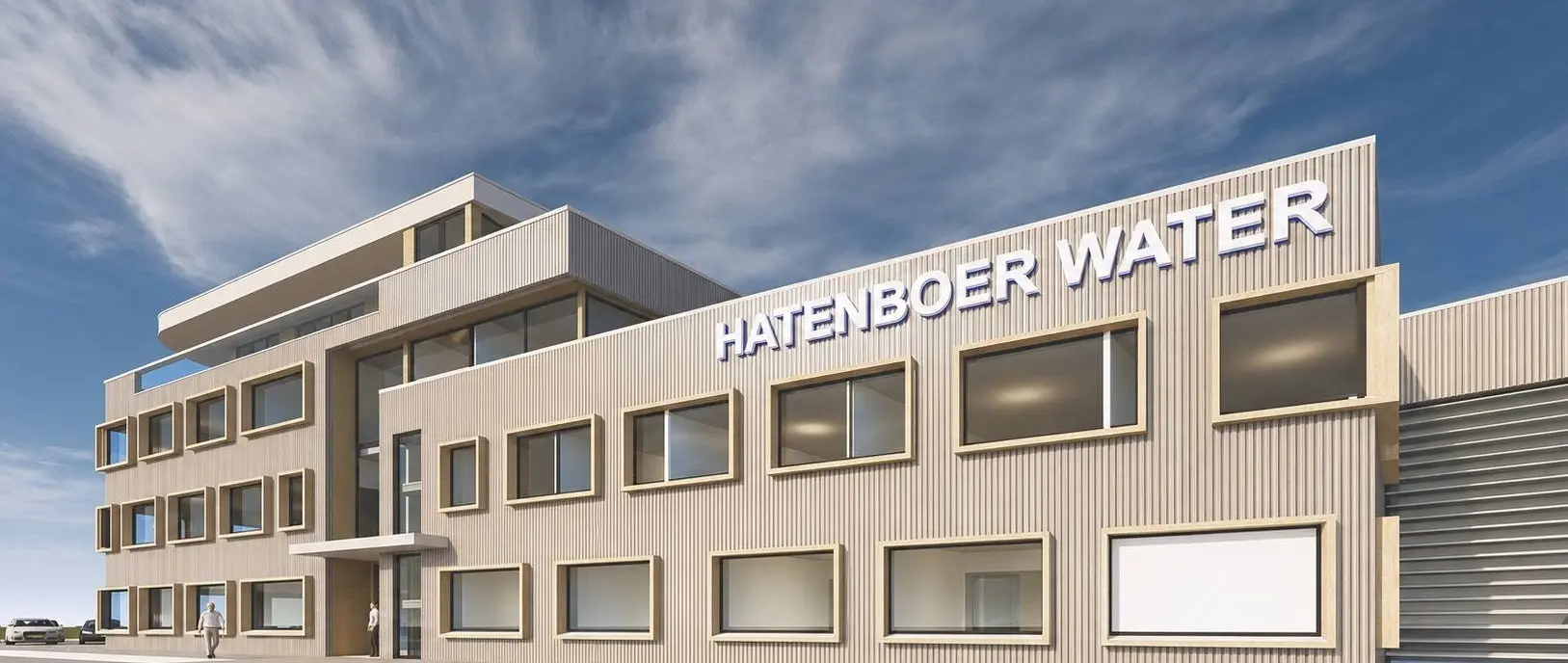
A new manufacturing investment at the Port of Rotterdam
Dutch water-treatment specialist Hatenboer-Water has begun building a replacement headquarters at its existing site in Schiedam, with expanded workshops and a plan to double its capacity to test maritime water systems. The company announced the start of the project on 20 November 2026, after the first foundation pile was driven on 19 November. Construction is scheduled to finish during the third quarter of 2027.
The milestone concerns a new industrial facility, not a newly commissioned watermaker or the completion of a production yacht. The significance for builders and yacht owners is that reliable freshwater management requires design, manufacturing, commissioning and support throughout a vessel's life. The investment aims to give the supplier more capacity to carry out those functions.
From a local supplier to an international operation
Hatenboer-Water was founded in Rotterdam in 1906 and is marking its 120th year in business. Its activities now include integrated water-treatment equipment, water-quality monitoring, sampling and technical support for maritime and offshore customers. Those services serve a broader market than private yachts alone.
The company's anniversary gives context to the expansion. A long history does not guarantee the performance of an individual water system, but it helps explain why its management is investing in facilities intended to serve customers for many years. Technical specifications and operating records remain the correct evidence for evaluating each installation.
Why the existing site needs replacement
According to the company's announcement, its present Schiedam premises have reached their physical capacity. The project will reorganise manufacturing areas and engineering workshops while retaining the business within the Rotterdam maritime cluster.
An expansion made on the existing site avoids some of the complications of relocating an entire business. It does, however, require a carefully controlled construction programme because people and equipment must continue working while the premises change around them.
Doubling the ability to test systems
The new facility is intended to provide twice the current system-testing capacity. Hatenboer-Water says this will let its teams run several demanding tests simultaneously, rather than waiting for one project to finish before another is evaluated.
Testing matters because a marine water system must work with the particular vessel's pressure, electrical supply, piping arrangements and operational requirements. A successful factory test does not remove the need for checks after installation, but it can detect problems earlier in the production process.
Capacity is different from throughput
A plan to double testing capacity is not a promise that deliveries will automatically double. Actual throughput also depends on component availability, staffing, design work and how complicated each customer's equipment may be. The company expects shorter waiting times and improved service, but measured outcomes will emerge after the facility begins operation.
This distinction is important in a sector where bespoke systems can require lengthy engineering and approval. Owners should seek realistic project schedules rather than treat a factory-capacity percentage as a delivery guarantee.
A production layout built around movement
The company describes a building with improved material flow, updated production equipment and more efficient movement between work areas. Industrial layout has practical consequences: parts need to reach the correct workstation without causing delays, while completed systems need space for safe handling and inspection.
A well-planned layout can support quality, but its performance needs to be demonstrated once the factory is operating. The public announcement does not provide an independently audited productivity projection for the completed building.
Operations will continue during the build
Hatenboer-Water says it will use a phased approach, sometimes described as a chessboard plan, so that existing work can continue while new sections are constructed. Staff and equipment will move into completed areas in stages.
For yachtbuilders relying on a supplier during this period, continuity is an important consideration. A factory project should not leave customer installations without technical support. Nevertheless, customers with time-critical projects should confirm individual lead times rather than assume there is no possibility of disruption.
A modern all-electric building
The planned headquarters is described as fully insulated, all-electric and free of natural-gas operation. This represents an intended feature of the new premises, not evidence that the construction process or the water systems manufactured there have no environmental impact.
The environmental performance of any building depends on its actual energy use and the energy sources supplying it. Future reporting could compare measured consumption with the previous premises once the facility is complete, while keeping the construction and operating phases distinct.
Confidential projects need separation
The plans include improved IT infrastructure and access controls, together with restricted office areas for work involving confidential customer information. This can be relevant in marine engineering, where project specifications, equipment layouts and commercial arrangements may be sensitive.
Security does not depend only on controlled rooms. Organisations also need disciplined handling of drawings and electronic files. The company has announced an intended layout, but has not publicly supplied a full independent assessment of the future site's information-security measures.
Meeting spaces for visiting customers
The proposed headquarters will offer shared meeting areas for visitors, allowing shipyards and other clients to discuss requirements with technical staff. Such contact can help align a system design with the realities of installation aboard a particular vessel.
A meeting at the factory cannot substitute for accurate drawings, agreed acceptance criteria and a clear contract. It can, however, make misunderstandings easier to resolve before a large system is built and shipped.
Why marine freshwater is not an accessory
Freshwater systems support crew welfare, hygiene, cooking and hotel services aboard cruising yachts. Even a small failure can affect how a vessel is used. Larger and more complex yachts may need redundancy, monitoring and procedures for maintaining water quality throughout storage and distribution.
Reverse osmosis is one method of producing freshwater from seawater, but the complete onboard system also includes pumps, piping, tanks and treatment and testing equipment. Owners should evaluate these elements together rather than purchase on the basis of a headline output figure alone.
Reverse osmosis requires proper management
A reverse-osmosis installation uses pressure and specialised membranes to separate water from dissolved substances. Its actual performance depends on operating conditions, the quality of the incoming water and routine maintenance. Pre-treatment and post-treatment may also be important.
No single generic output figure can predict what every Hatenboer-Water system will produce aboard a particular yacht. Builders should obtain the specified design capacity and operating envelope for the vessel, and verify that the equipment can be maintained in the space allocated.
Water testing supports an owner's duty of care
The supplier emphasises the connection between water management and crew health. Monitoring and sampling can help identify problems before they affect those aboard. The appropriate procedures depend on the water source, system design, intended use and the rules that apply to the vessel.
A responsible management programme includes documented cleaning, inspections and appropriate tests. Remote monitoring may assist but should not be treated as a replacement for physical sampling or properly trained crew.
Service networks matter away from the yard
Schiedam also functions as a central base for regional operations in Aberdeen, Dubai, Houston, Singapore and Hamburg. This international presence matters for yachts that travel far from the original installation yard.
Before selecting equipment, an owner should establish what service can actually be provided in the yacht's principal cruising areas. An international office network is useful, but it does not by itself guarantee that a specialist technician or replacement component can reach every remote anchorage immediately.
Local manufacturing connections
Remaining in the Rotterdam maritime cluster keeps the company near European shipbuilders, engineers and offshore service organisations. Such proximity can simplify project discussions and make collaboration more practical during design and commissioning.
Geographical closeness alone does not establish superior quality or lower emissions. It may help reduce delays and support coordination when problems arise, provided the relevant people and parts are available.
A changing technical market
Hatenboer-Water identifies increasing demand from shipping and offshore energy customers as an important reason for the investment. Yachtbuilders may benefit indirectly from capacity improvements, but the announced growth is not described as being driven solely by the luxury-yacht sector.
That is an important qualification. Equipment manufacturers frequently serve commercial vessels as well as private yachts, and their production decisions reflect several markets. Readers should not interpret a broader marine investment as proof of a specific increase in yacht orders.
What the supplier's management has said
Chief executive Willem Buijs connected the project to increasingly demanding reverse-osmosis applications and the need to develop capacity and technical expertise. Supervisory board chairman Peter Willem Hatenboer described the milestone in the context of the company's founding in 1906.
Those comments indicate how the company views the investment. They should not be treated as a guarantee of financial results or exact future system performance. The strongest verification will come from the completed building and how it supports customer projects.
Considerations for a new yacht specification
Owners commissioning a yacht should ask the builder and water-system supplier about rated freshwater production, energy requirements, tank arrangements, spare parts and quality testing. They should also understand whether the installation needs specialist procedures after a long period out of use.
Different operating patterns create different needs. A yacht that remains near developed marinas may rely heavily on shore supply, while a vessel making longer passages may require greater autonomy and redundancy. The right configuration depends on the actual voyage plan.
A factory opening is not a yacht launch
The artist's impression accompanying this article comes from Hatenboer-Water's issued project material and illustrates the proposed headquarters. It is not a photograph of completed construction or a finished watermaker installed on a particular yacht.
That visual distinction preserves the chronology. As of the announcement, the first foundation pile had been driven and the project was expected to continue through 2027. Later photographs and site updates will provide evidence of the construction progress achieved.
The next milestone
The relevant future development will be completion of the new Schiedam facility and confirmation that the expanded manufacturing and testing operations are in use. That would allow a more substantive assessment of the capacity and continuity objectives described in the announcement.
For LYG readers, the project is a reminder that reliable yachting depends on an industrial network behind the finished vessel. Water treatment is one such essential service, and Hatenboer-Water's investment shows how a long-established supplier is preparing to support increasingly complex maritime demands.
Primary reporting and image credit
Primary report: https://www.marinelink.com/amp/news/hatenboerwater-breaks-ground-new-544505. © Hatenboer-Water. First-party company-issued artist's impression of the proposed Schiedam headquarters, not a completed building. Image is used only for correctly attributed factual editorial coverage and never represented as open-licence stock photography.