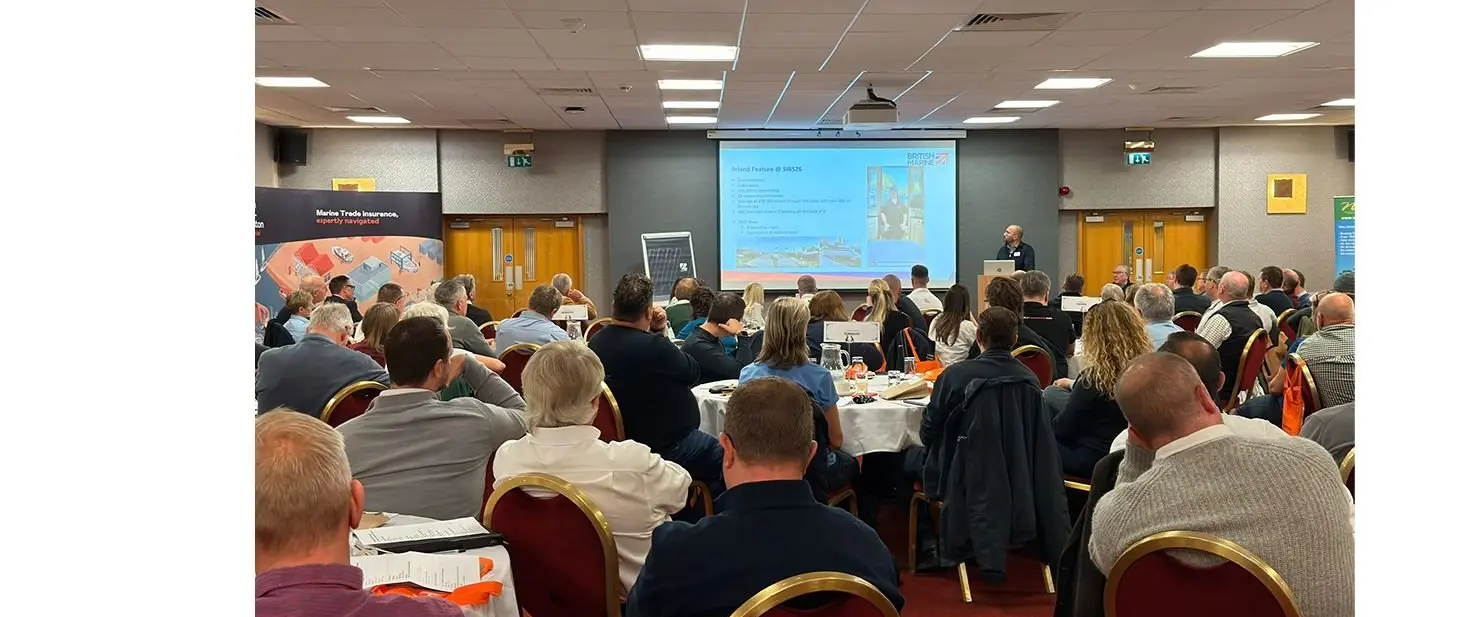
A national meeting for inland boating
More than 120 marine professionals gathered at Cranfield University on 12 November 2026 for British Marine's annual Inland Conference, bringing together operators, boatbuilders, suppliers and navigation organisations to exchange ideas about the UK's inland waterways economy. The trade association published its report on 18 November, confirming the attendance and identifying the event as a forum for business development and collaboration.
This was a completed conference, not a future event or a regulatory announcement. The organiser did not publish a single new law, binding business forecast or set of detailed policy commitments in its summary. The news is the scale of the gathering and the emphasis placed on cooperation between businesses whose activities depend on reliable waterways and services.
Mitchell Hall provided the setting
The meeting took place at Mitchell Hall on the Cranfield University campus. The location brought delegates into an academic setting, offering a venue for industry discussion without suggesting that the university itself was the author of every position expressed during the conference.
Marine businesses routinely interact with education and research organisations, particularly when new technology or skills are involved. A conference at a university can encourage that connection, but claims about formal research partnerships or funded projects should be based on separate agreements rather than the choice of venue alone.
A sector with different types of business
British Marine describes attendance from marina operators, boatbuilders, navigation authorities, service firms, equipment suppliers and other inland marine businesses. That diversity matters because a cruising boat's operating experience depends on several organisations that may never appear on its builder's specification sheet.
A marina must provide safe berths and services, a navigation authority manages access to a waterway, and specialists may be needed for electrical work, propulsion or maintenance. Problems in one part of the system can influence customers and businesses elsewhere.
Inland waterways have their own operating demands
Canals and navigable rivers present different challenges from open-sea yachting. Bridges, locks, water levels, restricted channels and changing local rules can influence what type of vessel can be used and when journeys are possible.
An owner moving between inland and coastal waters must evaluate both sets of conditions. The Inland Conference did not publish a universal solution for every navigation route, but it offered a space in which organisations facing similar practical issues could compare experience.
Why network relationships matter
The organiser's report emphasised reconnecting with established contacts and creating new business relationships. That can be particularly useful where a supplier works with several different marina operators or yards and needs to understand the practical constraints each faces.
Networking by itself is not a commercial outcome. Relationships become valuable when they lead to better service, reliable communication and well-defined work between organisations. A meeting can begin that process without guaranteeing any particular contract.
Listening across different responsibilities
A navigation authority may prioritise safety and the continuity of essential infrastructure, while a boatyard focuses on the timing of work and its access to customers. Marina managers consider occupancy and service quality, and manufacturers need information about the equipment boat owners actually require.
A conference allows the parties to hear these different priorities. Agreement is not automatic, but understanding the reasoning behind another organisation's decisions can help participants identify workable compromises and avoid unnecessary misunderstandings.
More than a single product presentation
The British Marine summary refers to industry updates, business challenges and opportunities rather than an exhibition devoted to one new vessel or piece of equipment. Such programmes can be useful to companies evaluating their place in a changing market, even when no headline product launch emerges.
For a professional audience, the value often lies in questions about regulation, staffing, customer expectations and practical service needs. The original report does not provide the full content of every talk, so this article does not attribute detailed arguments to unnamed speakers.
Marina operation requires long-term planning
An inland marina's responsibilities can include access, utilities, berth management and maintaining facilities in a demanding outdoor environment. Operators need to plan investment while responding to changing occupancy and the preferences of customers who may use their boats in different ways.
The conference's mix of marina professionals and suppliers creates opportunities for those practical discussions. Any claim about the costs of a specific redevelopment or the success of a particular marina, however, would require its own evidence.
Boatbuilders need feedback from operators
Builders design boats to attract buyers, but a vessel must also work in the places where it will be operated and serviced. Information about lock dimensions, berths, power connections and access to technical help can affect decisions made during design.
Communication with marina and navigation specialists can help builders avoid difficulties that emerge only after delivery. It cannot replace compliance with construction standards, and each boat still needs an appropriate specification for its intended use.
The role of technical suppliers
Equipment businesses contribute propulsion, plumbing, heating, electrical systems, safety products and other components. Their products need to remain maintainable after installation, especially when a customer uses a boat across several waterways or keeps it for many years.
Supplier participation at an industry meeting can help businesses understand service and installation constraints. A useful product is not merely one that performs well in a demonstration; it also needs clear documentation and a support arrangement suited to its customers.
Changing owner expectations
Boat owners increasingly compare their onboard experience with the convenience and connectivity of everyday life ashore. Some may want simpler digital controls, while others prioritise reliability, access to repairs or lower operating costs. Those preferences do not always point toward the most complicated technical solution.
The conference summary discusses future challenges broadly, but it does not quantify a particular change in consumer preference. Companies should use customer feedback and actual service records to judge which investments are worthwhile.
The importance of safe infrastructure
Safe inland travel depends on waterway conditions, navigation notices and the proper maintenance of facilities. Infrastructure concerns can affect journey plans and marina businesses, even when the boats themselves are in excellent condition.
Navigation authorities play an important role in providing reliable information and coordinating work. Effective collaboration with operators and boat owners can make disruption easier to manage, although the conference did not announce a completed infrastructure programme for a named waterway.
Training and professional skills
An industry that relies on mechanical, electrical and customer-service expertise needs ways to introduce new workers and support those already employed. Smaller firms may be especially dependent on individuals with a wide range of practical skills.
Education providers, trade associations and employers can explore training routes that match real work. But a conference discussion is not proof that a new apprenticeship, qualification or funded course has been approved. Those programmes must be reported through their own verified announcements.
Understanding the business climate
Marine companies may be affected by changes in materials costs, labour availability, interest rates and customers' willingness to make discretionary purchases. Their effects differ between a yard building boats, a marina supplying long-term berths and a service company with a seasonal workload.
Exchange of experience can help businesses interpret these pressures. The published conference report does not provide audited trading figures for the sector, so no specific national growth rate or financial loss can responsibly be assigned to the meeting.
Sponsors supported the event
British Marine named Haven Knox-Johnston as the headline sponsor. Supporting sponsors included EP Barrus, Waterways Holidays, Lalizas UK, Leesan, Metpow and Marina & Holiday Park Solutions. These companies and organisations represent different services connected with boating.
Sponsorship is evidence of support for the conference, not an endorsement of every statement made during it. The organiser thanked the sponsors for helping deliver the programme, while the technical merits of individual products remain separate questions for buyers.
The role of insurance and risk awareness
Insurance providers are part of the wider marine-services ecosystem because boats and boating businesses face risks that vary by use and location. An inland cruising craft may encounter different operating circumstances from an offshore vessel or a boat undergoing a substantial refit.
Owners should evaluate their actual policy terms and discuss changes in use with qualified advisers. The involvement of an insurance-related sponsor does not create a new insurance requirement or establish coverage for any particular yacht.
Waterways tourism and local economies
Inland navigation can bring visitors to towns and rural areas where marinas, hospitality businesses and maintenance firms form part of the local economy. The quality of an itinerary depends on services that are reliable and accessible, as well as on the attraction of the waterway itself.
The conference creates a useful setting for operators to consider those connections. It did not provide an independent economic impact study, and no monetary benefit to local communities should be inferred from the attendance figure.
Lessons for the broader luxury boating sector
Even readers interested primarily in coastal luxury yachts can recognise the value of coordination among builders, operators and authorities. Good facilities, professional support and communication affect ownership satisfaction in every boating market.
However, an inland-waterway conference should not be misrepresented as a superyacht launch or a gathering focused exclusively on large ocean-going vessels. Its relevance lies in the shared business and operating principles rather than identical technical requirements.
A positive audience response is not a survey
British Marine described a constructive and enthusiastic atmosphere, with delegates using the day to ask questions and meet colleagues. That qualitative observation is part of the organiser's own account. It does not establish that a scientifically representative sample of the UK boating sector agreed on one policy.
A useful follow-up would collect feedback about which sessions or issues were most valuable and whether businesses subsequently adopted any changes. Such evidence could help the association improve future programmes.
The next conference cycle
The organiser invited the industry to continue the conversation in 2027 and provided contact information for prospective participants and sponsors. That is a statement of intent to maintain the event's role, not confirmation of an exact 2027 agenda or a particular new location.
Future dates and registration details should be obtained from British Marine when formally published. No attendance prediction is justified merely by the success of the 2026 gathering.
Putting cooperation into practice
For businesses that attended, the useful work begins after the event: following up on technical questions, discussing service improvements and considering whether new partnerships could solve practical problems. Those steps can turn an enjoyable conference into a more effective business network.
The association's public account does not identify completed commercial agreements arising from the gathering. It is therefore more accurate to describe the potential for collaboration than to assign results that have not been reported.
A clear milestone for inland boating
The 2026 Inland Conference drew more than 120 participants to Cranfield and gave an important part of Britain's marine industry a setting for practical discussion. Its organiser has documented the event, the broad attendance and the companies that supported it.
The next meaningful evidence of progress will come from specific projects, partnerships and improvements undertaken by the participating organisations. For now, the verified result is a completed industry gathering that demonstrates the value of bringing different parts of the waterways sector together.
Primary reporting and image credit
Primary report: https://www.britishmarine.co.uk/news/2026/november/british-marine-inland-conference-2026-brings-industry-together-cranfield-university. © British Marine / original event photographer. Authentic 12 November 2026 Inland Conference photo, first-party trade association coverage. Image is used only for correctly attributed factual editorial coverage and never represented as open-licence stock photography.