A difficult start to the round of sixteen
The Copa do Mundo da Vela moved into its round of sixteen on Guanabara Bay in Rio de Janeiro on 26 November 2026, with wet and highly variable conditions bringing the first day's programme to an early halt. Estonia's Icebreakers won the opening Group A race, while Chile's Finis Terrae crew took victory in Group B before the wind increased sufficiently for organisers to send the fleet ashore.
The event's official Star Sailors account, distributed on 27 November, describes two completed races rather than a completed round of sixteen. That distinction is essential: the results provide an early picture of the contest but do not establish the final qualifiers, quarter-final teams or the winner of the overall competition.
Rio presented a different face
Guanabara Bay is often pictured with clear sunshine and the city's landmarks visible from the racecourse. For the start of this phase, the crews encountered rain and heavy cloud. Winds from the south-southwest were initially reported around fifteen to seventeen knots, before stronger squalls passed across the water.
The change in conditions altered the sailors' workload. Crews had to deal with variable pressure and shifting wind angles while maintaining speed and control. The official report describes gusts and lulls, not a single stable wind reading for every team throughout the day.
The opening Group A contest
Estonia, Hungary, Tahiti and Ecuador formed the Group A line-up. The defending champion Hungarian Shamans did not enjoy a particularly strong start, while Ecuador and Tahiti found different approaches to the line. Estonia remained well placed to take advantage as the crews began the first upwind leg.
The conditions rewarded teams able to respond rapidly to changes in the breeze. A strong start provides useful position, but the longer course gives experienced competitors opportunities to recover. The first race illustrated both sides of that problem.
Estonia took control on the water
The Estonian Icebreakers, already impressive in the earlier round of thirty-two, passed the Tahitian Black Pearls on the way upwind and extended their advantage. Their crew handled the gusty conditions with an approach that combined steady boat speed and controlled manoeuvres.
That result is a confirmed race win, not a declaration that Estonia has already qualified for the final. The round contains additional scheduled racing, and a single victory must be considered alongside the event's scoring system. It nevertheless gave the Estonian team a valuable start.
Hungary recovered to second
The Hungarian Shamans managed to rebuild their position after the poor start and held second place despite a late challenge from Tahiti. The Star Sailors race account describes the Tahitian crew closing the gap significantly near the last windward mark.
Hungary's recovery demonstrates the value of persistence in fleet racing. A slow opening does not automatically end a race, particularly when wind variations create opportunities for tactical decisions. The result also shows why a report should avoid judging the champions' prospects on the first few minutes alone.
Tahiti remained a competitive threat
The Tahitian Black Pearls pushed hard, approaching the final windward mark only seconds behind Hungary. Although they did not gain second place, the close contest provided evidence of the group’s competitive balance behind the Estonian leader.
A useful race report distinguishes a near overtake from an actual result. Tahiti's challenge deserves attention without changing the finish order. Informal comments about which team looked faster at a particular moment should not replace the official classification.
Ecuador has work ahead
Ecuador found itself behind the leading competitors in Group A. The day's account offers fewer details about a sustained challenge by the Ecuadorian crew, so it would be inappropriate to invent positions or incidents beyond those recorded by the organiser.
A difficult first race does not necessarily determine the outcome of a multi-race stage. The crew's subsequent performance and the scoring rules will decide whether it can recover. Any later result should be checked against the official event table.
Mati Sepp describes the conditions
Estonian helmsman Mati Sepp spoke about the advantages of the crew's earlier experience in the round of thirty-two and the need to handle wind changes without taking excessive risks. The organiser's account emphasises how preparation can help sailors make sound choices when conditions become demanding.
The comments should not be stretched into a claim that Estonia had secret equipment or a unique weather forecast. The advantage described was practical familiarity with the event, the boat and the local race environment. Such familiarity can be valuable without guaranteeing repeated success.
Group B began with stronger wind
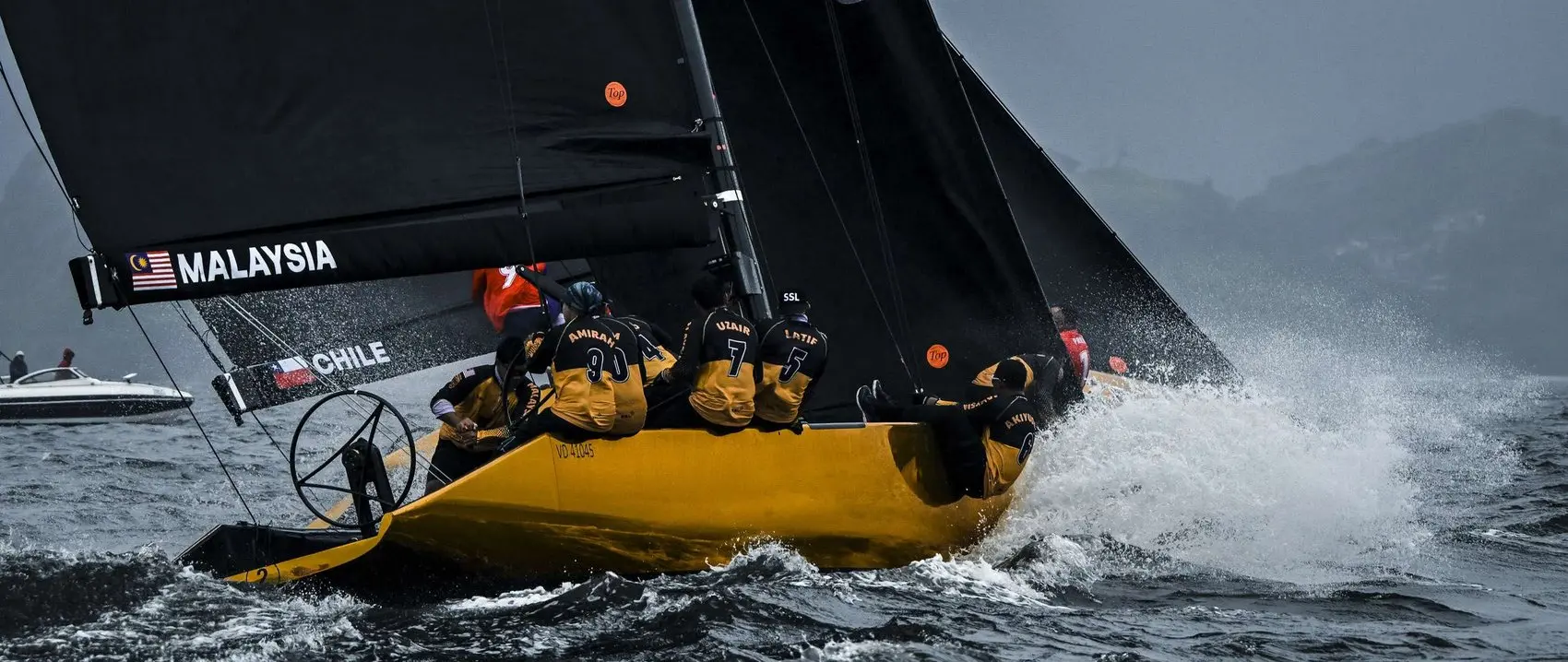
By the time Group B started, the wind was reported around twenty knots. Chile, Portugal, Malaysia and South Africa faced increasingly difficult conditions, with significant changes in pressure across the course.
The crews had to balance aggressive racing with the need to remain in control. The higher wind speeds could produce fast sailing, but gusts made hoists and gybes more complicated. The account describes a close race in which the lead changed as teams responded to the shifts.
An equipment problem for South Africa
South Africa's Ubuntu crew suffered a technical problem involving a keel trim tab. Shore support came to assist, and the issue took the team out of the race. The report does not establish a complete forensic account of why the component failed.
It would therefore be inappropriate to assign blame to the crew or an equipment manufacturer. The confirmed point is that the problem interrupted the team's participation in this race, demonstrating how an individual technical issue can have an immediate sporting consequence.
Chile started strongly
Chile's Finis Terrae crew was prominent at the start and remained among the leading competitors during the early legs. Portugal applied pressure, and Malaysia also became a factor as the teams found different wind patterns.
A good first beat did not give Chile an uncontested path to victory. The changing conditions repeatedly altered the relative advantage of the competitors. The official account describes tactical and handling decisions that mattered as much as initial position.
Portugal recovered from an error
Portugal's Navigators experienced a major broach during an early gybe, briefly losing ground. The crew subsequently recovered and challenged the other leaders, showing how quickly the situation could change on the downwind legs.
This should be described as a sporting incident rather than an equipment failure unless further evidence emerges. In strong and gusty winds, a broach can be a consequence of the combined demands of sail control and steering. The race report does not justify a more specific technical explanation.
Malaysia found a path into the lead
The Malaysian Monsoon team used a different area of breeze to move forward while Chile and Portugal concentrated on one another. The sequence illustrates the difficulty of choosing the best side of the course when pressure varies rapidly.
A leading position at a rounding mark is not the same as victory. The group remained close, and the final downwind stretch provided another opportunity for a change of order. This uncertainty is part of what made the day's racing unusually intense.
A decisive late Chilean move
Chile recognised stronger wind on the left side of the course and used an early gybe to gain the advantage. The official account credits the crew's tactical judgement and sail handling as the conditions changed.
Pedro Felipe Robles, the Chilean helmsman, explained afterward how difficult it had been to maintain steering control through strong gusts and sudden holes in the breeze. His observations offer useful insight into the work involved without requiring speculation about performance measurements unavailable from the source.
Portugal finished second
Portugal's crew recovered sufficiently to secure second place, ahead of Malaysia, while Chile won the race. The result reflected several position changes and a demanding sequence of manoeuvres rather than a simple start-to-finish victory.
These are the race results for the first Group B contest, not a final classification for the entire round. Later racing could alter the group's standings. A publisher should make that distinction clear when presenting results during a tournament still in progress.
Strong wind ended the day's programme
After the two races, the wind reportedly reached more than twenty-five knots. Organisers brought the competitors ashore, preventing further racing that day. The decision limited the results available to the initial Group A and Group B contests.
It is not responsible to invent results for the other groups or claim that they completed races during the same session. Any revised schedule or completed later racing must be established from subsequent official announcements.
Why the gusts mattered
Strong but steady wind can be challenging; rapidly changing wind creates an additional tactical and technical problem. A crew may need to adjust its sail trim and steering continuously as the boat moves between gusts and calmer patches of water.
The event's class of racing relies heavily on teamwork. Trimmers, tacticians and helmspeople must communicate clearly, often while spray and noise make that difficult. The reported conditions provide a credible explanation for the close contest and demanding manoeuvres.
The role of the grinders
The organiser noted the intense effort required from grinders as crews handled their sails. Grinders operate mechanical systems that help control the rig under load. Their contribution is less visible in photographs than the helmsman's, but it can have an immediate effect on how efficiently a boat changes configuration.
The physical demands of a short race do not reduce the need for careful technique. Efficient teamwork can preserve energy and help the yacht maintain speed, while mistakes can cost substantial distance. The first two races illustrated that connection between human effort and tactical decisions.
Preparation from earlier rounds
Teams that had already spent several days racing in Rio may have gained experience with the boats, courses and local wind patterns. Estonia's crew specifically referred to the value of that familiarity. Other competitors may draw similar lessons as the tournament progresses.
The effect should not be overstated. A crew can prepare thoroughly and still encounter conditions that differ from practice. The most important skill is adapting safely to what actually develops on the water.
Spectators and results need reliable sources
The Copa do Mundo da Vela is promoted internationally as a nation-based sailing competition. Its format creates recognisable teams and a tournament structure familiar to viewers of other sports. That can make individual results particularly interesting to supporters who may not follow professional sailing every week.
However, online clips and reactions may circulate before a complete classification is issued. The organiser's official updates are the appropriate source for final positions, penalties and subsequent qualification. A live commentary clip should not be used to create an unsupported result.
What remains to be decided
Estonia and Chile recorded the opening race wins, while Hungary and Portugal placed second in their respective groups. The remaining round-of-sixteen programme still had to be completed after the strong-wind interruption described by the official report.
The next editorial milestone is the verified classification of all groups and confirmation of the teams proceeding to the next stage. Until then, the tournament remains open. The first day gives evidence of form, not a completed bracket.
A showcase for demanding sailing
The event's Rio competition demonstrates the technical and physical demands of high-level yacht racing in variable conditions. The decisions taken by the Estonian and Chilean teams are useful sporting examples without requiring invented statistics or conclusions about the final championship.
For luxury-yacht readers, the relevance lies in seamanship, crew coordination and the spectacle of elite sailing. The accurate result for 27 November reporting is narrow but compelling: two racing wins, a series of close contests and an early finish because the wind exceeded a safe operating window for the day's programme.
Primary reporting and image credit
Primary report: https://www.pressmare.it/en/regattas/star-sailors/2026-11-27/wet-wild-opener-copa-mundo-vela-1-16-finals-94392. © Star Sailors League / original event photographer, officially distributed through Pressmare. Authentic competition vessel image from the 27 November 2026 report. Image is used only for correctly attributed factual editorial coverage and never represented as open-licence stock photography.