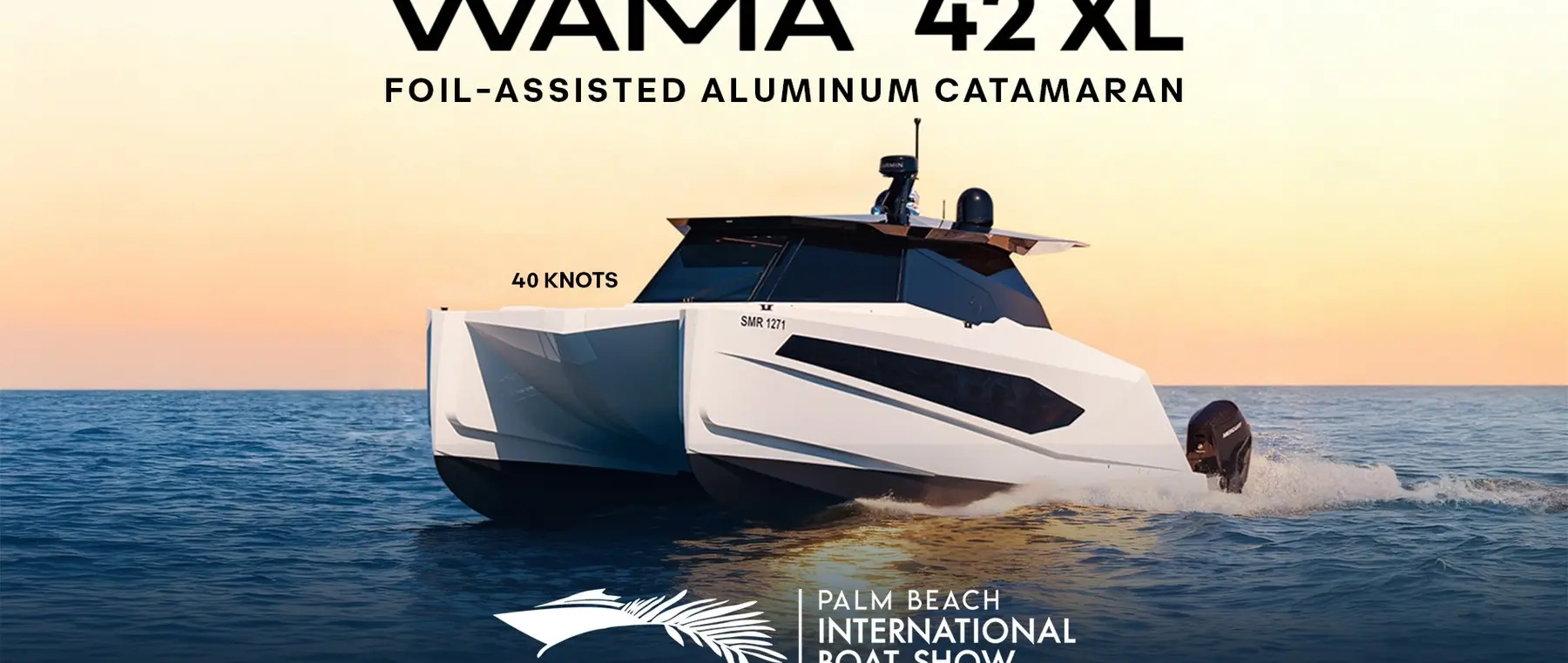
A Tunisian builder enters a bigger conversation
WAMA Yachts' 42XL power catamaran offers a concrete example of the growing ambitions of Tunisia's recreational boatbuilding sector. The compact, approximately forty-two-foot model places aluminium construction and optional foil assistance into a size category often associated with moulded composite motor cruisers. It is also a yacht that falls within Luxury Yacht Guide's twelve-to-twenty-four-metre editorial remit. Rather than presenting the builder as a newly established industry giant, the relevant news is the way a specific export-oriented design illustrates an emerging manufacturing capability along the southern Mediterranean coast.
A Reuters report published on 9 November 2026 describes an industry that has developed from a small supplier base into a wider network of boatbuilders, marine contractors and specialist businesses. Its figures refer to the Tunisian industry overall, not WAMA's individual revenue or order book. That distinction is essential when reporting on a relatively young yacht brand. WAMA has its own published model material and promotional appearances, including a presence at the Palm Beach International Boat Show in March 2026, while the national economic picture helps explain why such products now attract international attention.
A market beyond traditional yachtbuilding centres
European buyers commonly associate production yachts with established yards in Italy, France, Britain, Germany and the Netherlands. Tunisia's location across the Mediterranean creates a different manufacturing proposition, combining proximity to important cruising waters with industrial capability that has grown through international supply relationships. Reuters reported exports for the sector of approximately €500 million in 2025, while describing an increase in the number of industry businesses over the last decade. These are broad sector figures, subject to the definitions used by the reporting source.
The important question is how export growth translates into consistently supported yachts rather than simply more boats built. A luxury-yacht owner needs confidence in component traceability, documentation, certification, commissioning and after-sales service, particularly if the vessel will be kept hundreds of miles from the factory. A favourable build price cannot compensate for inadequate maintenance information or difficulties obtaining spares abroad. International participation and a visible dealer network matter because builders serving the Mediterranean and overseas markets must demonstrate what happens to owners long after the initial handover.
What makes the WAMA 42XL distinctive
WAMA markets the 42XL as a foil-assisted aluminium power catamaran, a combination that brings several engineering trade-offs into sharp focus. The manufacturer's brochure identifies marine-grade 5083 H116 aluminium for major structural elements and presents optional hydrofoil equipment. Buyers should be careful not to mistake a foil-assisted hull for a yacht that is necessarily designed to fly completely clear of the water. Foil assistance is usually intended to change hydrodynamic lift, drag and trim characteristics, but the actual effect depends on speed, loading and design details.
The boat's twin-hull arrangement also deserves attention independent of its foil claims. A power catamaran typically provides generous deck width for its length and can create useful living and circulation space compared with some monohulls. It also brings different behaviour in crosswinds, a distinctive boarding arrangement and the need to find suitable beam clearance at marinas. The finished yacht should be assessed as a whole: hulls, structure, drives, deck access, machinery space and accommodation. An appealing technical headline alone does not establish whether it suits a particular owner's cruising pattern.
Aluminium construction and craftsmanship
According to WAMA's official material, aluminium is central to the 42XL's identity. Properly designed and fabricated marine aluminium can offer structural strength, repairability and freedom to tailor certain elements of the build. It is not automatically free from maintenance problems, however. Welding procedures, surface preparation, coatings, protection against galvanic corrosion and isolation from dissimilar metals all matter in service. An owner should also understand who will inspect and repair a damaged panel should the yacht operate away from the builder's home region.
A survey should cover weld documentation, appropriate material grades, penetrations, electrical bonding arrangements and the manufacturer's inspection programme. The fact that a hull is aluminium is not by itself evidence of its weight or long-term condition. Good fabrication depends on quality control, appropriate engineering and consistent workmanship. For an owner evaluating a compact customisable yacht, the most useful proof would include construction records, relevant inspections and the opportunity for an independent surveyor to examine both the structure and the finished systems before final acceptance.
Foil assistance and the importance of measured results
WAMA's marketing places considerable emphasis on the foil-assisted concept, including the possibility of hydrodynamic efficiency gains. Such claims are plausible engineering objectives, but they must be distinguished from results independently measured under repeatable conditions. A sea trial should record displacement, sea state, wind, speed, fuel use and trim, with the test condition explained clearly. A single maximum-speed figure or promotional video cannot tell an owner how the boat behaves over a full holiday with guests, stores, water and a tender aboard.
A buyer would also want to understand the foil's service implications. A structure extending beneath or between hulls may affect inspection, shallow-water operations, lifting arrangements and the consequences of contact with underwater objects. These questions do not imply that WAMA has a particular defect; they are ordinary diligence for a design with more underwater geometry than a conventional hull. The manufacturer and the appointed surveyor should explain the exact equipment offered on the purchased boat, its protection, access and repair provisions.
Power and fuel planning for real passages
The official WAMA 42XL brochure identifies twin Mercury Verado V12 engines at 600 horsepower each as a standard propulsion offering, with configurations and options to be confirmed for the individual build. Those numbers describe a substantial power installation on a compact catamaran, and owners should evaluate its real-world consequences carefully. Higher available power can make certain passage plans possible, but it does not mean the yacht should cruise continuously at its maximum speed or that its consumption will be modest at every operating point.
A useful fuel plan starts with manufacturer or trial data at several speeds, reserve policy and the actual route. The owner should also establish where fuel quality, engine diagnostics and authorised servicing can be obtained. When buying outside an established local dealer network, service support may be as important as the hardware specification. A sensible acceptance trial should include manoeuvring, handling at different loadings and the ability to operate confidently in a busy marina, not merely a straight-line sprint in open water.
A luxury catamaran must work at anchor
Compact power catamarans are often chosen for the comfort they can offer as private coastal homes. The broad platform can support social spaces and separate areas of accommodation, but good design still depends on practical details. The owner needs to understand the relationship between sun protection, boarding steps, side decks, tender handling and the safe movement of guests around the boat. Space that looks generous in a photograph may feel constrained when six people bring luggage, food and watersports equipment aboard.
At anchor, buyers should examine how the yacht sits in wind and swell, how guests reach the water and how service tasks can be performed discreetly. Practical matters such as water storage, waste capacity, electrical generation, air-conditioning and anchoring equipment determine whether the yacht remains pleasant over several nights. No single specification can establish the answer for every use case. The strongest product evaluation combines a proper sea trial with extended discussions about how the owner actually intends to spend time aboard.
International boat shows as a test of credibility
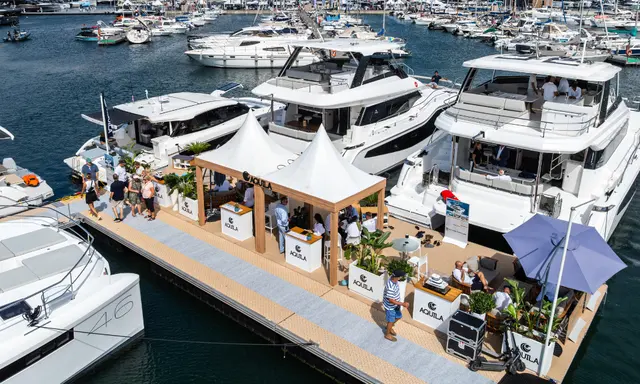
WAMA promoted the 42XL at the Palm Beach International Boat Show in March 2026. A public show appearance is useful because it allows potential buyers and marine professionals to see the yacht in context, inspect details and ask the builder direct questions. It is not proof that the yard has established a comprehensive global service network or that every proposed option has been independently certified. Those questions must be addressed through documentary evidence, contractual terms and the manufacturer's actual support arrangements.
The brand's overseas presentation nevertheless demonstrates a clear commercial ambition: to compete for customers who might otherwise have considered more familiar European or American production names. That ambition is particularly relevant to Tunisia's expanding marine economy. Bringing a boat to an international show is one step in the process; consistent commissioning, transparent technical data and responsive warranty service are what build lasting confidence after a first sale.
Certification, delivery and owner protection
Anyone placing an order should verify the model's applicable design category, conformity documentation, hull identification and equipment specifications for the particular delivery market. Registration, VAT, import duties and local operating rules depend on where the yacht is delivered and ultimately kept. Owners should obtain professional advice on the proposed purchase structure rather than assuming a low displayed factory price will be the final landed cost. For buyers outside Tunisia, transport, commissioning and acceptance testing deserve explicit contractual treatment.
The specification should distinguish standard equipment, optional equipment and features that remain conceptual. The manufacturer's published brochure is a starting point, but current quotations and signed build schedules govern the actual boat. It is also sensible to clarify which changes may be made during construction, whether the buyer may appoint an independent surveyor and how any outstanding defects will be resolved. These disciplines apply to all builders, not only newer yards, and help ensure an attractive design becomes a satisfactory ownership experience.
The broader significance for Tunisia
Reuters' November industry report describes a sector aiming to build export strength, expand capability and create skilled employment. For yacht buyers this may eventually provide more competition and more design choices in a market where some established production builders have moved towards ever-larger and more expensive models. That potential should not be exaggerated into a claim that Tunisian yards already match every long-established European manufacturer. National industry development is a process, not an automatic guarantee of quality at the level of a specific hull.
The WAMA 42XL gives that development a recognisable product rather than an abstract economic statistic. Its aluminium structure, compact luxury-catamaran format and optional foil assistance all raise legitimate questions for owners and naval architects. A responsible market report should identify the verified design features and leave performance, delivery and support claims at the level that published evidence allows. The story is one of industrial possibility, not an independent verdict on the boat.
What buyers should watch next
The next useful evidence will come from documented customer deliveries, operating experience and support arrangements for boats used beyond the factory's local waters. Owners considering the model can request current drawings, complete technical specifications, a recent sea trial and an explanation of how the planned purchase will be surveyed and commissioned. The more distinctive the technology, the more important it becomes to establish who can maintain it and what records will accompany it throughout its service life.
For Luxury Yacht Guide, the relevant news is that a Tunisian manufacturer is offering a substantial twelve-metre-plus power catamaran into the international luxury-yacht market at a time when the country's boatbuilding industry is attracting fresh attention. The official WAMA materials establish the model's design direction, while Reuters provides the larger industrial context. Neither source alone substitutes for inspection of an individual yacht. The opportunity is genuine enough to merit attention, and the outstanding questions are exactly the ones an informed buyer should ask.
Source documentation: wamayachts.com. www.reuters.com. Actual WAMA 42XL catamaran in the manufacturer's official Palm Beach Boat Show promotional photograph.