Smartgyro sets out the next step in its mid-size range
Smartgyro has introduced the SG65, a new gyroscopic stabiliser intended for boats between 55 and 68 feet, placing the product directly in the market for owner-operated and professionally managed luxury yachts. The manufacturer is presenting the equipment ahead of METSTRADE in Amsterdam on 17–19 November 2026, where visitors will be able to examine the new unit alongside its smaller SG45. It is an equipment announcement rather than a claim that any specific yacht has already completed a successful installation or sea trial. That distinction matters to owners assessing a substantial machinery investment.
The company says the SG65 delivers fifteen per cent more stabilisation performance while using ten per cent less energy and weighing fifteen per cent less than its outgoing SG60 comparator. These figures are manufacturer comparisons, not independent measurements by Luxury Yacht Guide. They establish a useful question for naval architects: can a stabiliser intended for an approximately seventeen-to-twenty-one-metre yacht offer worthwhile motion control without imposing an excessive machinery-space, electrical or mass penalty? The answer will depend on vessel dimensions, loading, seakeeping and how the yacht is operated.
A launch aimed at the machinery room
Smartgyro describes a redesigned mechanical platform rather than a cosmetic update. Its SG65 is designed to occupy a footprint only three per cent larger than the smaller SG45 and twenty per cent smaller than the SG80. The manufacturer has also reorganised major components to make access easier where the surrounding engine room is crowded. That is significant because yachts near the twenty-metre mark often have little spare clearance once generators, air-conditioning plant, exhaust systems and firefighting installations have been arranged around the main engines.
A product might fit the dimensions on a brochure and still be unsuitable for a particular hull. The full installation envelope includes service access, foundation structure, lifting routes, electrical connection, cooling, ventilation and the path engineers need to reach other equipment. Some engine rooms have practical hatch access for major components; others require partial dismantling to reach a chosen position. The correct starting point is a site survey with accurate drawings and current manufacturer installation instructions, not a visual judgement based on the machine's exterior size.
What the claimed performance gains mean
The quoted fifteen-per-cent improvement in stabilisation performance is a headline comparison against the SG60, not a promise that any yacht's roll angle will fall by fifteen per cent in every sea condition. Roll behaviour changes with hull form, weight distribution, speed, wave period and how a stabiliser is controlled. Owners need to distinguish a laboratory or rated-unit comparison from the measurable experience of sitting in the saloon or sleeping in a cabin. Smartgyro's published announcement does not provide an independently verified trial across a representative fleet of different production yachts.
The ten-per-cent lower energy-consumption claim is similarly useful but needs context. Equipment demand over a cruise depends on how long the gyro runs, how frequently the owner uses it at anchor and how the yacht generates electricity. A lower operating figure does not automatically deliver a ten-per-cent saving in a yacht's total fuel bill. A sensible comparison would consider the stabiliser's complete duty cycle, associated pumps and controls, generator efficiency and whether shore power is available in berth. Those calculations should be made with the ship's engineer or an appropriately qualified installer.
Rethinking the braking arrangement
Among the specific engineering changes, Smartgyro highlights a patent-pending braking design with part of the hydraulic manifold integrated directly into the cylinders. The stated purpose is to reduce external hose runs, simplify the arrangement and limit potential failure points. For an owner this is more meaningful than a fashionable technology label: hydraulic hoses, connectors and access panels determine how quickly a technician can locate a leak, isolate a problem or perform routine maintenance without disturbing nearby systems.
The same approach calls for appropriate scepticism. Fewer hoses may reduce some maintenance demands but do not remove the need to inspect hydraulic connections, follow fluid specifications and maintain control electronics. The new design should be assessed against real service procedures, parts availability and documented warranty conditions. Before commissioning, owners should request a complete system drawing, recommended maintenance intervals and clear fault-response instructions. A good installation is one that qualified engineers can service predictably years after the original sale.
Access to bearings, sensors and the enclosure
Smartgyro says it has adopted a simpler two-section sphere architecture and placed sensors outside the vacuum chamber to make critical parts easier to access. A redesigned two-piece cover is intended to improve routine inspection in confined spaces. The company also points to greater component standardisation with its SG45, including shared motor and bearing assemblies. Common parts may help dealers reduce stock complexity and support visiting engineers, especially for yachts cruising beyond their builder's home region.
Yet service access is not solely the machine manufacturer's problem. A stabiliser may be easy to open in a workshop but difficult to reach after it has been fitted beneath a platform or behind electrical cable runs. Owners should demand a maintenance-access demonstration based on the actual proposed yacht layout. That includes sufficient headroom to remove covers, adequate isolation of moving and powered components, and an explanation of what work can realistically be performed aboard without a lift or a significant strip-out.
Why the 55–68ft segment is important
The SG65's stated target of fifty-five to sixty-eight feet corresponds approximately to sixteen-point-eight to twenty-point-seven metres, squarely within the Luxury Yacht Guide sector. This is the size range where some owners take the helm themselves while others employ a skipper, and where many boats alternate between weekend coastal passages and longer holidays at anchor. Comfort is a commercial selling point, but the engineering behind that comfort must remain compatible with normal crew arrangements and constrained service spaces.
A yacht in the correct length bracket may nevertheless be too heavy or too light for a particular equipment recommendation. Smartgyro places the SG65 at displacement levels up to roughly fifty tonnes, another reason to check a real boat's fully loaded mass rather than its lightship marketing figure. Fuel, water, tenders, equipment and personal stores all change the operating condition. The final decision requires the manufacturer's current sizing guidance, the hull designer's input where necessary, and an installer prepared to take responsibility for commissioning.
New builds and retrofits are different propositions
For a new yacht, a stabiliser can be considered while foundations, power distribution and machinery arrangements remain open for design changes. The naval architect can allocate space in a structurally appropriate location and make sure routine access is not blocked by later systems. Builders can also consider whether the owner's cruising profile makes a gyro a higher priority than alternative comfort equipment or extra storage. The best time to debate these trade-offs is before the deck and technical compartments are finalised.
A retrofit adds different complications. The vessel already has machinery, established ventilation and cable routes, and a carefully balanced weight distribution. A proposed installation needs to account for any load-bearing structure that must be modified and for the impact on displacement and trim. Onboard systems should never be moved merely to make room without checking their original clearances and safety requirements. A trustworthy retrofit quotation should identify the physical and electrical works separately from the gyro purchase price.
Comparing a gyro with fins and interceptors
Gyroscopic stabilisation is only one approach to motion control. Fins, interceptors and other hull-control technologies operate on different principles and may bring advantages in different speed and sea-state conditions. A gyro is especially associated with controlling roll, including when a yacht is at anchor, while some other systems influence running attitude and motion underway. It would be misleading to treat the SG65 announcement as proof that one solution is best for every boat or that two different systems can simply be compared by a single percentage.
Owners should make a list of the uncomfortable situations they actually experience. Is the issue a long swell at anchor, a lively beam sea under way, or motion felt in the forward cabins? How often does it occur, and at what loading? The answer informs the choice of equipment. A dealer demonstration on a similar yacht can help, but any claimed before-and-after effect should specify sea conditions and operating modes. There is no substitute for a properly controlled evaluation of the individual vessel.
Electrical design and operating discipline
Because gyros contain a high-speed rotating mass, they are not incidental plug-in appliances. The proposed electrical arrangement must reflect start-up, running demand, protection and the load-management strategy already used by the yacht. Cooling and control connections also deserve design attention. Smartgyro's published headline provides a relative efficiency comparison but not a substitute for the final electrical specification of the actual SG65 model selected for installation.
Owners should ask how the stabiliser behaves during a change from shore power to generators, after a supply interruption and during a high-speed turn. The manufacturer should explain its built-in protections and what alarms appear on the helm or dedicated display. Maintenance and operating instructions need to be accessible to the people who actually run the boat. These questions are particularly important on smaller privately operated yachts where the owner may be the person responding first to a fault.
What METSTRADE visitors should ask
Smartgyro says the SG65 is available to order, with first deliveries scheduled for 2027. The planned preview is at stand 08.808 during METSTRADE 2026, alongside the SG45. The stated delivery schedule is forward-looking and buyers should confirm production dates, configuration and commissioning arrangements directly. A trade-show display is an opportunity to inspect parts and ask engineering questions; it is not evidence that a particular yacht's installation has been completed or independently tested.
Visitors with a specific project would benefit from bringing the vessel's length, displacement, machinery-space drawings, electrical details and typical cruising programme. Questions should cover required foundations, clearances, warranties, consumables, service network and the physical process of reaching critical components. Owners who seek a specific reduction in roll should request comparable test evidence rather than an unqualified promise. A professional supplier should welcome a detailed suitability conversation grounded in the actual boat.
The significance of the SG65 announcement
The SG65 points to a continuing shift in luxury-yacht technology towards more sophisticated machinery that can be supported within a realistically constrained boat. Smartgyro's claims about greater performance, lower energy use, less weight and improved service access are all relevant to this market, but each remains a product claim until supported by the appropriate specifications and operating evidence. The new braking design and component commonality are practical subjects for builders and refit yards to examine.
For readers considering a seventeen-to-twenty-one-metre yacht, the sensible conclusion is not that a new gyro is automatically essential. It is that a new option will enter the market in 2027, with enough detail to start serious discussions now. The owner who compares installation quality, accessible maintenance, realistic electrical demand and demonstrable performance alongside purchase cost will be better placed than one choosing on a percentage headline alone. This article is independent technical reporting based on Smartgyro's official release, not a sea trial or an endorsement.
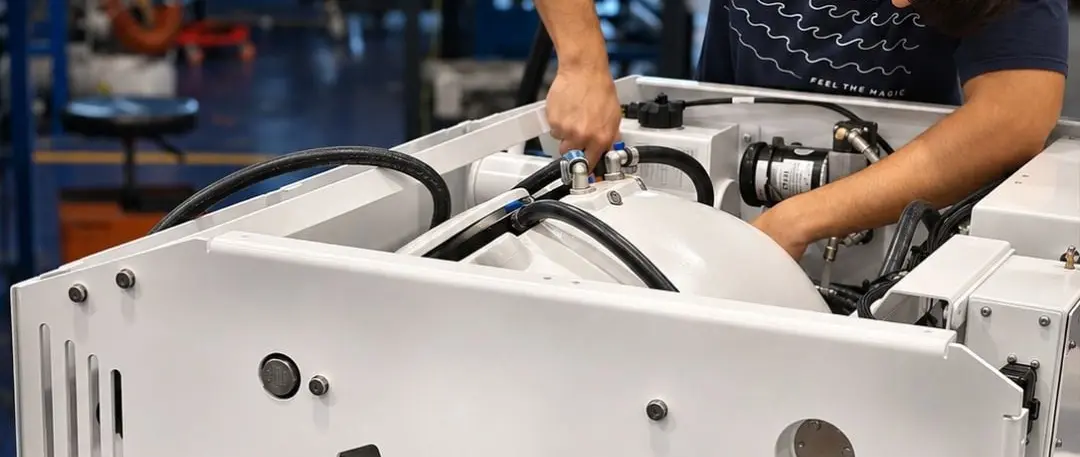
Source documentation: blog.smartgyro.com. Smartgyro SG65 stabiliser, manufacturer's official product announcement photograph.