Fuel contamination monitoring receives a DAME award
Florida-based OHNOH2O has won the Safety and Security Aboard category of the 2026 DAME Design Awards with WIF-Pro, its system for identifying water in marine fuel filtration equipment. The award was announced at METSTRADE on 17 November. Unlike a fuel filter that is inspected only periodically, the manufacturer's system offers different levels of indication and monitoring intended to bring developing contamination to the attention of the crew.
The company describes applications for diesel engines and generators as well as certain outboard installations. For Luxury Yacht Guide readers, the relevant applications include the inboard diesel propulsion and generating machinery widely encountered in the twelve-to-twenty-three-metre cruising-yacht sector. Compatibility with the specific engine and filtration arrangement is essential: it is not a universal accessory for all marine fuel systems.
The award highlights the difference between an appliance that performs a physical separation function and equipment that provides information about what is happening within that appliance. Both can play a useful role, but they address different aspects of fuel management.
The distinction between filtration and monitoring
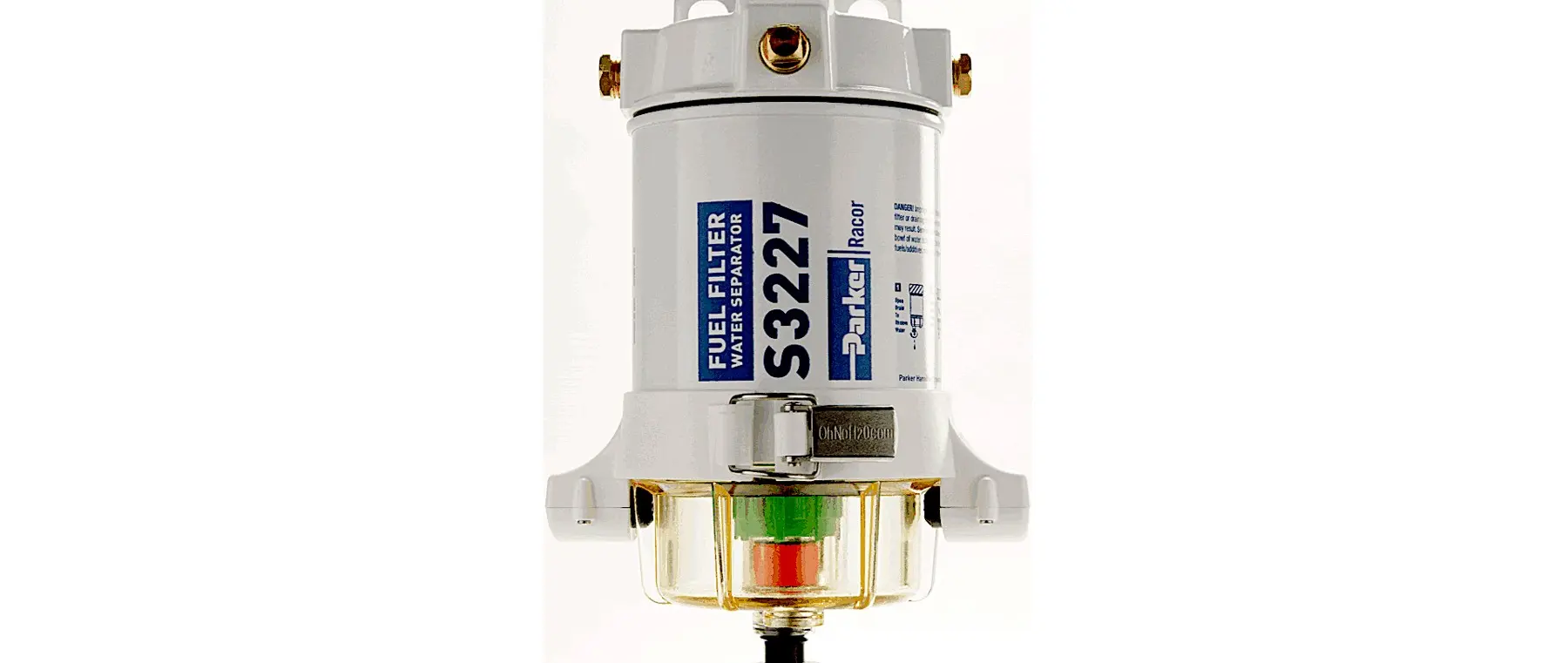
Fuel separators and filters are intended to intercept unwanted material before fuel proceeds towards an engine. In certain filtration arrangements, separated water collects in a bowl or other designated part of the assembly. Depending on the installation, the accumulated material may be visible during an inspection.
The challenge addressed by WIF-Pro is the interval between inspections. If a filter is installed in a machinery space that is not continuously occupied, the crew may have no immediate indication of a changing condition at that filter. Monitoring can supplement scheduled inspections by bringing a detected condition to the attention of the operator.
OHNOH2O describes its patented technology as using a float sensor near the point where water accumulates in the primary filtration system. The product is intended to identify contamination before it reaches the engine. Its published material describes visual indication as well as more advanced arrangements capable of audible alerts and NMEA 2000 communication.
That is a detection proposition, not a method of cleaning an entire fuel tank or removing every possible contaminant. The effectiveness of the installation depends on the sensor, the filtration equipment and the circumstances under which they operate.
Why the location of detection matters
An engine can be affected by changes to fuel quality that arise elsewhere in the vessel's fuel storage and supply arrangements. Contamination may occur during bunkering, through the condition of the fuel system or through other routes specific to the vessel. Identifying the source is a separate task from identifying an accumulation of water at one point in the supply system.
By placing the detection function at the filter, the manufacturer aims to make use of the location where the relevant separator is already intended to collect water. This can give the operator a useful indication of a condition that requires attention. It cannot demonstrate the state of every part of the fuel tank or supply network.
A yacht with several tanks and multiple engines may have a more complicated fuel-routing arrangement. Monitoring one filter does not automatically provide information about another independent system. A qualified marine engineer should establish the relationship between the filters, tanks, fuel consumers and any monitoring equipment when specifying the installation.
That distinction matters in interpreting the information received at the helm. An alert concerning one unit should be identifiable as such, rather than being confused with an indication relating to a different engine or generator.
Compatibility with diesel machinery
The manufacturer describes WIF-Pro as compatible with certain gasoline outboards, diesel outboards, inboard diesel engines and diesel generators. Its published FAQ explicitly excludes gasoline inboard engines and gasoline generators. For diesel applications, the company identifies specific Racor turbine-series assemblies as the relevant filter family.
A prospective buyer should therefore begin with the actual fuel-system equipment installed on the yacht. The manufacturer provides a filter compatibility resource, but the exact assembly, electrical configuration and applicable requirements need to be confirmed before a product is specified. Similar-looking filter bowls do not necessarily have identical technical characteristics.
For a motor yacht, the engineering assessment may include both main engines and an auxiliary generator. A sailing yacht may have one auxiliary engine as well as a generator or other diesel equipment. In either case, the monitoring arrangement should be considered alongside existing alarms, control panels and machinery inspections.
The public material is not an installation manual. Fuel systems have important safety requirements, and the suitability of any modification should be assessed by a competent person using the current manufacturer documentation and relevant vessel standards.
Multiple levels of indication
The company offers different ways to communicate information to the operator. A visual indication at the filter may assist inspection by someone physically present. Audible or electronic alerts can provide another route for communicating a detected condition. Integration with a compatible marine network may allow information to be displayed in a different part of the yacht.
These options are significant because yacht crews do not always occupy the machinery space while an engine is running. On a sailing yacht, the person operating the vessel may be on deck, while a motor yacht's controls may be distributed between interior and exterior helm stations. The value of a networked alert depends on whether the installation reports useful information to the appropriate locations.
The manufacturer also describes arrangements for monitoring between one and four engines as standard, with further custom configurations. This is a statement about the available system configurations, not a specification for every multi-engine yacht. Owners should establish how individual sensors are identified, how the control equipment is powered and whether their chosen display arrangement is supported.
The goal should be an understandable alarm system rather than simply the addition of another electronic device. Operators need to know what an indication means and when the condition requires further inspection.
Interpreting the limitations correctly
OHNOH2O's own product disclaimer is unusually relevant to interpreting the news. It acknowledges that detection systems can produce both false positive and false negative results. The company identifies variations in fuel composition, contaminants, temperature, vibration and other operating conditions as possible influences.
The disclaimer also states that the product is not a replacement for proper maintenance. Those qualifications are important in the yacht sector, where owners may interpret an award-winning safety product as a broader guarantee of reliability than the supplier actually provides.
A good monitoring arrangement should form part of a defined process for examining potential problems. It should not encourage the crew to ignore scheduled checks simply because no alert has been received. The absence of an indication does not establish that fuel is uncontaminated, and an alert is not necessarily definitive evidence of the severity or source of a problem.
Owners should discuss the interpretation of alerts and appropriate responses with the vessel's technical adviser and consult the relevant manufacturer procedures. This becomes particularly important where several machinery installations and different electrical systems are present.
Service access and everyday ownership
The manufacturer also describes equipment intended to simplify access to the filter during servicing and handling of collected fluid. It refers to a spacer arrangement and a dedicated drain bottle in its product literature. These features address service practicality rather than the accuracy of an individual detection event.
In a yacht's machinery space, accessibility has implications for both the convenience and quality of maintenance. A filter assembly positioned behind other machinery may be difficult to examine, and the surrounding area should be considered when assessing whether a particular installation is suitable.
The company's description of its own sensor as requiring no routine maintenance should not be extended to the fuel filter itself. Standard filter servicing and inspection remain necessary. Appropriate handling and disposal of contaminated fuel and water are also separate considerations for the vessel's maintenance programme.
For a charter operator, a well-documented arrangement can assist the technical team responsible for several yachts. For a private owner, the benefit may lie in improved awareness of the condition of machinery that is otherwise inspected intermittently. The total cost and service support should be considered alongside the price of the monitoring equipment.
What this week's award adds
The official DAME results identify OHNOH2O as the category winner in Safety and Security Aboard. The company exhibited at stand 02.113 during METSTRADE. This independent recognition concerns the design contribution of WIF-Pro; it is not a certification of the safety of a particular boat, nor proof that water-related engine failures will be eliminated.
For luxury cruising yacht owners, the development represents a specific approach to improving awareness within an established mechanical system. The attraction is earlier information about a potentially developing condition rather than a change to the basic principles of propulsion. Its suitability remains dependent on the exact filtration equipment, correct installation, operating environment and maintenance arrangements. Those are the factors that should guide a purchase or refit decision after the exhibition.
Sources and image
Primary sources: OHNOH2O official METSTRADE product listing, manufacturer technical information and product limitations. Award confirmed by the DAME Design Awards winners list. Lead photograph: OHNOH2O official exhibitor image of the WIF-Pro family on a gasoline fuel filter, illustrative of the monitoring concept and not a diesel installation. Provided through the exhibitor catalogue in the METSTRADE media context. Copyright remains with the rights holder; resized for publication.