A propulsion update centred on repairability
Bruntons Propellers is introducing replaceable needle-bearing components for selected Autoprop products at METSTRADE in Amsterdam. The British marine propulsion specialist announced the development on 13 November through British Marine, ahead of the exhibition that runs from 17 to 19 November. The company says the change draws on bearing technology already used in its larger propellers and responds to the changing use of cruising yachts and commercial charter boats.
The revised design applies to relevant H5 and APS saildrive products and the corresponding EcoStar variants. Bruntons also says it has developed a method for upgrading compatible existing propellers. The announcement is about the internal bearing arrangement and the way it is serviced, rather than a new propulsion principle.
This distinction is particularly relevant in the luxury cruising yacht market. A propeller may be a relatively inconspicuous part of the finished vessel, yet its condition has a direct bearing on the availability of auxiliary propulsion. For an owner expecting to cruise for several seasons, the ability to maintain a mechanical assembly can be as significant as the performance advertised when it was first purchased.
The earlier arrangement and the revised component
The previous design described by Bruntons used a roller-bearing arrangement whose wear surfaces were machined into the bronze hub and blade components. When these surfaces required attention, reconditioning could restore the propeller to service. The manufacturer notes that this machining process could only be performed a limited number of times.
With the revised design, the bearing parts can themselves be replaced. The company describes a service procedure that can be carried out using ordinary tools together with its own Autoprop toolkit. The engineering distinction is the separation of the replaceable wear component from the larger assembly that would otherwise need to be reconditioned.
This is a familiar design objective in machinery expected to operate over many years. A component that wears in service can be less costly or less disruptive to renew if its replacement does not require specialist machining of neighbouring parts. The published announcement does not provide a quantified comparison of service labour or the expected wear rate of the new bearings, so those benefits should be understood as the company's design objective rather than a measured saving guaranteed to every owner.
Why blade movement matters in these propellers
Bruntons' Autoprop range uses blades that can change their pitch automatically. That characteristic is distinct from a conventional fixed-pitch propeller, whose blade geometry is determined when it is manufactured. The ability of a blade to move is therefore an integral part of how the Autoprop operates.
Moving hardware requires appropriate support. Bearings influence the mechanical behaviour of a propeller assembly and need to be maintained within the manufacturer's prescribed limits. The new design addresses how selected bearing surfaces can be renewed over the life of the unit; it does not remove the need to inspect the complete propeller.
Nor does the announcement establish that every older Autoprop will benefit from the same modification. The company states that compatibility applies to relevant existing models. Owners will need to establish the exact identification of their equipment and obtain the appropriate service documentation from Bruntons or a competent service provider.
A yacht owner considering auxiliary propulsion improvements should also distinguish the properties of the propeller from those of the engine, drive system and hull. The way the complete installation performs will depend on the suitability of those components together.
Changes in cruising and charter use
In its announcement, Bruntons refers to increasingly powerful engines in sailing yachts, including catamarans, and to extended operating periods under power in some charter fleets. The company says its development drew on feedback from users, including an operator with approximately forty charter boats in Greece.
This is useful context for understanding the serviceability emphasis. A charter yacht can accumulate a different pattern of engine usage from a private yacht undertaking occasional summer voyages. Even similar vessels can be used very differently depending on the cruising area, itineraries, weather and the experience of the crew aboard.
For a commercial operator, lost availability may have consequences beyond the cost of a replacement component. A yacht in need of repair may be unavailable for a booked charter or require an unscheduled interruption to its programme. Equipment that can be maintained through a predictable service process may therefore be attractive, provided the service network, spare components and technical support are available when required.
For private owners, the calculation is somewhat different. Long-distance cruisers may value the ability to arrange repairs without transporting an entire propeller assembly over a considerable distance. Local access to skilled personnel and appropriate spare parts still matters. The announcement should not be interpreted as a recommendation for untrained owners to dismantle or modify propulsion machinery themselves.
Assessing the upgrade during a haul-out
The manufacturer's proposed upgrade route for compatible existing equipment makes the development relevant to vessels already in service. A planned haul-out provides an opportunity for qualified personnel to identify the propeller, inspect its condition and establish whether the revised bearing parts are appropriate.
A useful assessment should consider the existing assembly as a whole. Evidence of wear in another part of the propeller, damage to its blades or a problem elsewhere in the propulsion train may influence the scope of the work. Installing a revised bearing arrangement cannot correct unrelated defects.
The owner should obtain confirmation of compatibility with the actual model and serial identification. It is also worth establishing what service instructions, replacement components and any associated warranty terms apply. Bruntons' release does not list every eligible historic configuration, so a yacht's eligibility cannot be established solely from the fact that the propeller bears the Autoprop name.
When evaluating the cost of the work, the owner should consider the complete project rather than the price of bearing components alone. Labour, facilities, inspection and the condition of other equipment may influence the total. If the yacht is already undergoing a winter maintenance programme, the opportunity to coordinate the work can matter as much as the cost of the individual repair.
Relation to the H5 EverDrive
Bruntons' official METSTRADE product catalogue separately describes the H5 EverDrive, a variable-pitch propeller released in September 2026. The company identifies revised blade geometry and an updated internal bearing system as elements of that product. Its catalogue quotes performance and fuel-consumption improvements compared with the standard Autoprop.
Those figures belong to the specific EverDrive description. They should not be represented as fuel or speed gains resulting merely from fitting replacement needle bearings to an existing propeller. The bearing announcement covers selected models and is primarily concerned with the service process. Distinguishing these two claims avoids attributing the outcome of a broader propeller redesign to one mechanical component.
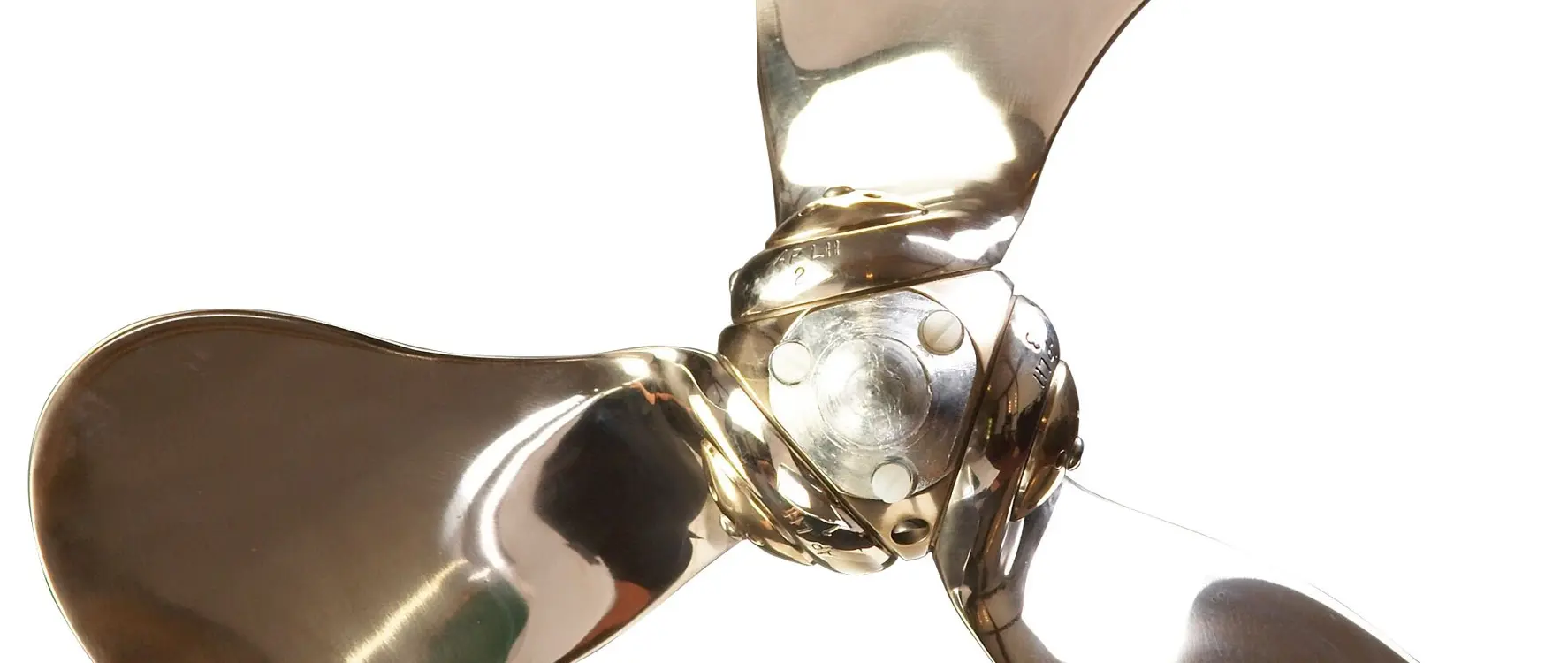
An official catalogue photograph of the Autoprop family accompanies this report as an illustration of the manufacturer's feathering propeller design. It does not depict a disassembled bearing or establish the precise construction of every compatible APS or EcoStar variant.
Electric and hybrid applications
The inclusion of corresponding EcoStar products is also noteworthy for designers considering alternatives to conventional diesel auxiliary propulsion. A propeller specified for an electric drive needs to fit the operating characteristics of that drive as well as those of the hull. Bruntons has previously described its EcoStar range as intended for electric and hybrid applications.
The latest release does not claim that the revised bearing arrangement changes the operating characteristics of those electric motors. Its relevance is instead the potential to renew the bearing components of the compatible propeller. In a hybrid yacht, the long-term ownership assessment should include every part of the propulsion system, not simply the energy store or the headline output of the motor.
For owners comparing a new propulsion system with continued operation of existing equipment, the cost and availability of repair can be a useful consideration. A well-supported mechanical assembly may offer an attractive ownership proposition when it is correctly sized and maintained. That assessment should be made alongside the intended vessel performance and the service arrangements available in its cruising region.
Practical implications for the industry
Bruntons is discussing the revised design at stand 03.410 in Amsterdam, with members of its technical and sales team available to explain the components. The company intends the new arrangement to be standard on relevant new models while offering an upgrade route for compatible equipment already in service.
For yacht builders, the development highlights the importance of designing propulsion assemblies around the service requirements anticipated over the vessel's working life. For charter fleets, it provides a specific subject to discuss with the engineering teams responsible for scheduled maintenance. For private owners, it is an opportunity to establish whether existing equipment can be supported through future repairs.
The reported improvement is fundamentally about repairability. It should be judged through the documented service procedure, compatibility, spare-parts availability and practical experience rather than interpreted as a universal extension of bearing life or a guarantee of lower fuel consumption.
Sources and image
Primary and technical sources: current announcement, technical background, manufacturer product catalogue. Lead image: Bruntons Autoprop — official manufacturer catalogue photograph, illustrative of the propeller family, not of the new internal bearings. Supplied by the manufacturer via its official METSTRADE product catalogue. Copyright remains with the rights holder; resized for editorial publication.