Aquila reports a production landmark
Aquila Catamarans says it has passed 1,250 boats built since the brand began in 2012, an important cumulative production milestone for a manufacturer whose range now spans sport boats, cruising power catamarans and sailing models. The figure was released in a builder-authored statement following the 2026 Fort Lauderdale International Boat Show, which ran from 28 October to 1 November. It should be described precisely: more than 1,250 is the company’s reported all-time build total, not the number of yachts delivered in 2026 and not a figure restricted to the 12–23.99-metre luxury-yacht market. The announcement is of interest to mid-size yacht buyers because the catalogue includes substantial models such as the 46, 50 and 54 Yacht lines and the 70 Luxury. But each of those products has its own history, technical specification and buyer audience. A production milestone is evidence of scale, not a shortcut to judging the quality of a particular boat.
What happened at Fort Lauderdale
The builder says its Fort Lauderdale presentation generated more than 1,000 visitor enquiries over five days, a rise of 15% compared with the previous year, and that the display attracted customers from the United States, Caribbean and Latin America. Aquila also describes orders across several ranges and says other negotiations continued after the show. These are company-reported commercial indicators, not an audited sales conversion rate. An enquiry can include a casual visitor, a customer considering several models or a serious prospective buyer. Nor should the number be described as 1,000 sales or confirmed contracts. The useful signal is that the company generated measurable interest across its product families while using a large physical display to let buyers compare boats. For a prospective owner, a show visit remains a chance to inspect circulation, cabin arrangements and equipment fit, but it cannot replace sea trials or an independent survey of the particular hull ultimately under consideration.
The 50 Yacht was the most requested model
Aquila identifies its 50 Yacht as the model attracting the greatest number of requests at the Fort Lauderdale display. That is more specific than a claim that it won the most orders; the source does not give a ranked list of contracts by model. The 50 is part of the manufacturer’s mid-size cruising proposition, pairing the interior volume associated with a catamaran with a length that remains within Luxury Yacht Guide’s editorial remit. Buyers interested in the model should compare the actual layout, cabin privacy, bridge access and running characteristics rather than assume a popular display is automatically the best choice for their use. A power catamaran brings different proportions and berthing demands from a monohull of similar length, particularly because beam becomes a significant part of marina planning. A comprehensive quote also needs to specify engines, domestic systems, options, commissioning and after-sales support.
Orders for the 46 and 50 models
The builder reports more than 100 orders for the second-generation explorer-style 46 Yacht and 50 Yacht combined since their introduction. That gives owners a measure of interest in two related models without allowing an assumption about how those orders are divided between them. It would be misleading to treat a combined order count as a delivery figure or to assign half the number to each boat. The design brief for this category includes comfortable guest accommodation, a usable flybridge and a plan suitable for coastal cruising or longer holidays. A buyer should still examine the layout and equipment on the exact version being offered, since option lists and production revisions can change features that appear standard in promotional images. The builder’s volume makes support and production consistency important questions. A substantial order book may mean an established production process, but individual quality, availability and maintenance cost require separate evidence.
The 54 Yacht as a more substantial cruising choice
Aquila says more than 100 examples of its 54 Yacht have been ordered over four years since the model entered the range. For this publication, that is a particularly relevant category: a yacht of this size can deliver meaningful interior space without moving into the very large-yacht sector. Prospective owners may be attracted by the prospect of generous guest accommodation and deck areas, yet the more important inspection questions involve how the boat works in everyday service. Look at machinery access, electrical loads, freshwater capacity, air-conditioning, tender arrangements and the separation between guest and working spaces. The 54’s order milestone is not a guarantee that all ordered boats have been delivered, nor does it disclose the average selling price, the extent of customisation or the location of each owner. Those are separate facts. What the statement establishes is commercial interest in a mature mid-size power-catamaran model.
Aquila 70 Luxury and the upper end of LYG
Aquila’s current model catalogue extends to the 70 Luxury, which is approximately 21 metres overall and therefore also falls within this site’s 12–23.99-metre definition. That upper-end product demonstrates how far a builder originally associated with smaller power cats can extend into a more demanding ownership category. A vessel of this scale brings different berth, crewing, maintenance and insurance requirements from a 12-metre cruiser, even when both carry the same manufacturer name. Prospective buyers should not generalise from one model to another. The 70 Luxury’s accommodation plan, machinery specification, certified capacities and actual displacement must be established from the contract documents for the particular yacht. The production milestone is a reason to examine the builder’s range, but it does not establish comparative performance or operating economies across the fleet. Owners should make decisions from current technical specifications and realistic annual budgets.
A past success that is no longer in production
The brand also highlights more than 200 deliveries of its earlier Aquila 44 Yacht before production was discontinued. That is an important distinction from the order figures for newer models. The 44 has an identifiable past-delivery count, while the newer 46/50 and 54 figures are described as orders. Mixing those categories into one table without explanation would create a false impression of comparable achievement. For buyers considering used Aquilas, the discontinued model may remain a relevant option if the right example is on the market. Yet availability, maintenance history, equipment upgrades and resale pricing are matters for individual vessel inspection. A successful older model also does not prove that a later model will have the same service profile or residual value. The value of the builder’s account is that it shows an evolving portfolio rather than a single boat repeated unchanged over time.
Why the production location matters
Aquila states that its boats are manufactured at Sino Eagle’s factory in Hangzhou, China, where the company describes substantial vertically integrated production. Its communications say that major components, including much stainless-steel hardware and elements of interiors, are made in-house. This approach can provide greater control over parts of the manufacturing process, but it is not by itself proof of consistent workmanship or easy international warranty service. Buyers should understand where a particular boat is assembled, which major systems are sourced externally and who is accountable for work carried out by dealers and authorised service providers. Delivery inspection should cover hull and deck finish, electrical installation, engines, plumbing and the operation of equipment shown on the specification. A large factory can be an advantage when processes are well documented. The owner still needs competent inspection and a clear after-sales point of contact near the intended cruising area.
What Aquila says about construction and foils
The builder points to vacuum-infused composite construction and its Hydro Glide foiling system as elements of its engineering offer. It says select foiling installations can lower drag and improve fuel efficiency, citing a potential reduction of up to 40%. That figure is a manufacturer claim and depends on the boat, conditions and comparison being made; it is not a verified fuel saving for every Aquila model. Foil technology can introduce additional components and maintenance considerations, so owners should ask which hulls actually carry the system, what protection and inspection routines apply and how performance was measured. Design features should be assessed in the context of weight, load distribution, serviceability and the intended cruising pattern. A yacht that performs attractively during a demonstration may operate quite differently when loaded for a full holiday. The right comparison includes actual sea-trial data from the specified vessel rather than just the most persuasive headline percentage.
Sailing catamarans broaden the group
Aquila’s recent show activity also included the 45 Sail and 50 Sail, marking a broader offer than the original power-catamaran business. The builder says its 45 Sail appeared at Cannes and then in North America at Annapolis, with award nominations to follow. For a luxury-yacht owner, these models involve a different decision from choosing a motor catamaran. Sailing systems, mast and rigging maintenance, performance under different wind angles and crew experience become central. The larger accommodation envelope that attracts some buyers to cats should not obscure their handling and berth requirements. A sailing model may fit an owner’s preferred cruising rhythm, but the decision needs sea trials and a realistic assessment of passages planned under sail and under auxiliary power. As with the power models, product descriptions and award nominations should not be mistaken for independent reliability or value rankings.
How to interpret a milestone when buying a yacht
The company’s figures are best read as three separate indicators: cumulative build volume above 1,250; reported interest and enquiries at a particular boat show; and model-specific orders or deliveries disclosed for several product families. None of these automatically establishes how long a buyer will wait, what their final price will be or how an individual vessel will perform. Useful due diligence begins with the contract specification, warranty terms, class or certification requirements, realistic cruising programme and the location of service facilities. On a 12–24-metre yacht, the buyer’s expectations can range from owner-operated coastal use to a professionally crewed programme. The correct boat for one family may be wrong for another. The important development is that Aquila now has a wider catalogue and substantial builder-reported production history to investigate, rather than a single untested new concept.
What to watch next and original sources
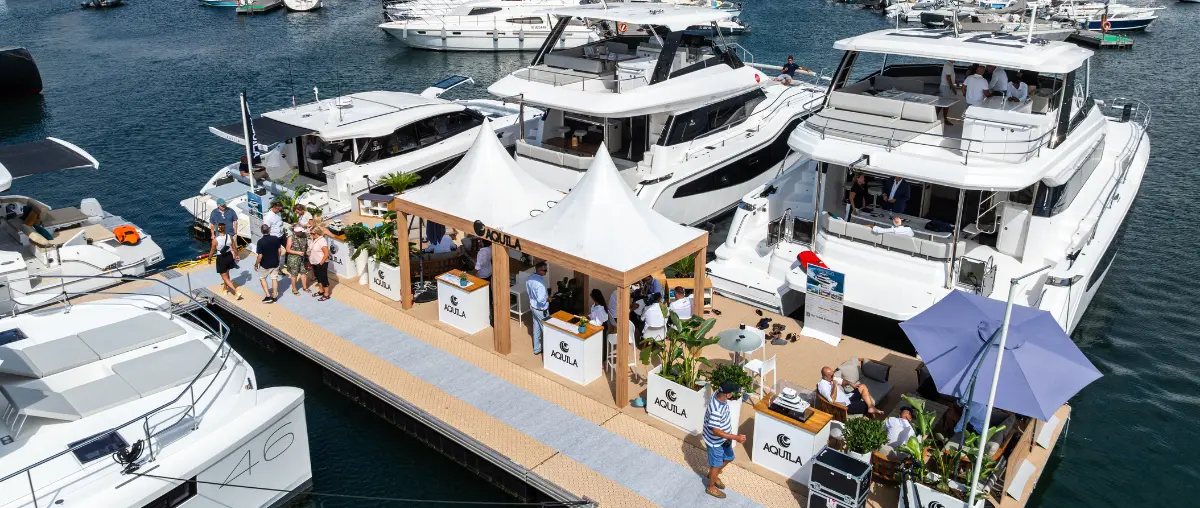
Further useful reporting would include individual deliveries, new model specifications, detailed sea-trial information and independently established market results. At this point, the milestone itself comes from Aquila’s builder-authored 10 November statement distributed through Sail-World. The official Aquila model catalogue lists the current product families, while the company’s Fort Lauderdale preview provides background on its display. The hero is an official Aquila photograph used previously for Luxury Yacht Guide’s 2026 Fort Lauderdale coverage, illustrating the builder’s actual show fleet. It is not a photograph documenting the cumulative 1,250th hull. All numeric claims about orders, deliveries and enquiries are attributed to the manufacturer.