A closer look at a revised ocean cruising yacht
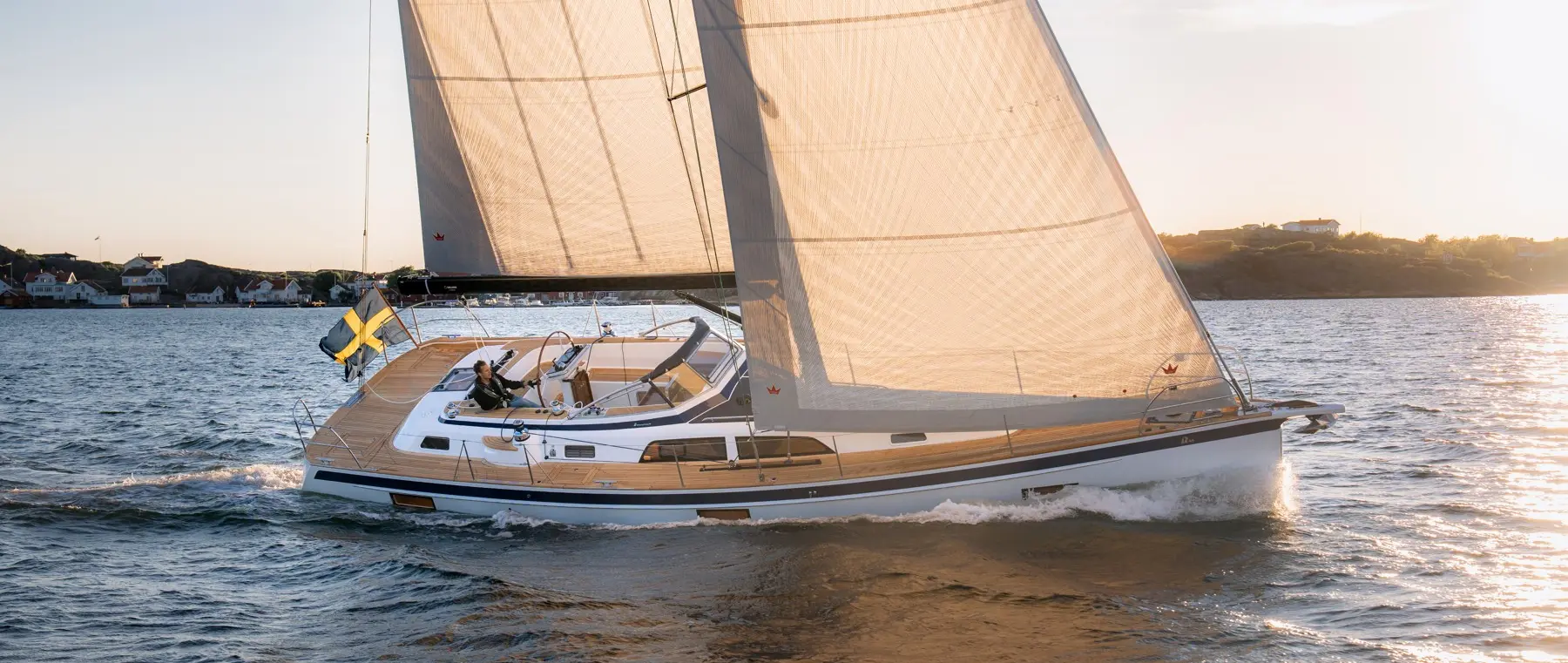
Hallberg-Rassy has released a new fifty-minute film of its 44 Mk II, giving prospective owners an extended opportunity to examine the Swedish yard's model-year 2027 cruising yacht rather than relying on a short exhibition presentation. The 16 November announcement identifies Jonas Zelleroth and Magnus Rassy as the participants in the tour, with filming and aerial footage by Anton Bylund. The manufacturer says the programme includes sailing, deck and accommodation sequences as well as a look at the yacht at anchor.
This is a presentation of the revised 44, rather than an announcement of a separate model. Hallberg-Rassy describes thirty changes to its predecessor. The release is particularly relevant for buyers who cannot travel to Sweden or spend sufficient time aboard at a boat show. It also offers a useful occasion to examine the published changes as a coherent design package. The manufacturer's film and technical documents are promotional and technical resources, not independent test results.
A yacht whose dimensions merit careful reading
The builder's data sheet distinguishes a hull length of 13.68 metres from a maximum length of 14.45 metres. That difference is important to owners who need to arrange a berth, transport the yacht or understand charges that use overall length rather than model designation. Beam is 4.20 metres and the standard empty-boat draught is 2.10 metres. The declared empty standard displacement is 13.3 tonnes.
Germán Frers is the credited designer. The standard lead bulb keel weighs 5.3 tonnes, while the alternative shallow-draught version reduces draught by 35 centimetres and adds 610 kilograms according to the yard. Neither figure describes a fully loaded cruising yacht. Cruising stores, optional equipment, fuel and water change the weight and distribution of mass. The published waterline of 12.88 metres and standard sail area of 106.5 square metres provide useful reference points, but they should be considered in the context of the actual specification a buyer intends to order.
Exterior glazing and life below deck
Larger saloon windows and hull portlights are among the most visible changes identified by the shipyard. The revised hull openings use tempered glass, and the forward accommodation gains additional portlights on both sides. The aim is to bring more daylight into areas where an offshore cruising yacht's enclosed structure can otherwise limit the sense of space.
A practical inspection should look beyond the amount of glazing. At sea, the quality of the view from a seated position, the distribution of daylight in changing weather and the possibility of managing glare all matter. At anchor, the same windows affect privacy and solar heat gain. Owners intending to cruise in warmer waters may wish to investigate ventilation and the provision of blinds. The glazing improvements should therefore be evaluated in conjunction with the rest of the accommodation, rather than treated as a substitute for adequate airflow or weather protection.
Changes around the stern
The yard identifies a revised swimming platform, a more comfortable aft edge and improvements to the swim ladder. The ladder incorporates handholds that rise above the platform when deployed. An updated aft-cabin deck hatch is also among the changes.
A useful platform on a cruising yacht serves more purposes than occasional swimming. It can be the interface between the yacht and a tender, a place to wash equipment and a point of access for crew after time in the water. These different situations require different precautions, and no single ladder arrangement guarantees recovery in difficult sea conditions. Owners should examine the manufacturer's operating instructions and make sure that their equipment and crew procedures are appropriate for the use they anticipate. The physical relationship between the platform, the cockpit and the deck becomes particularly important when the crew needs to move around the stern while securing the boat.
A deck organised around sail handling
The updated yacht can be specified with carbon in-mast furling and an electric under-deck furler for a light-weather sail. These are options rather than features guaranteed on every vessel. Hallberg-Rassy also identifies dedicated locker space for storing that sail when it is not in use.
For a cruising owner, the significance of a sail handling system lies in its relationship to the yacht's ordinary sailing routine. An installation that helps a small crew deploy and retrieve sails readily can make a difference during frequent changes of wind strength or direction. The equipment selected must nevertheless be compatible with the rig and the intended sail inventory. A prospective buyer should ask how the equipment is serviced, what procedures apply if electrical assistance is unavailable and how the sails can be inspected and maintained. The published standard and optimised sail areas differ; the yard supplies sail-plan documents for more detailed assessment.
The helm remains a working space
The redesigned windscreen uses less visually intrusive supports between its tempered panes. The manufacturer also describes additional instrument space, changes to the pedestal and a revised handrail around its upper surface. An optional carbon steering wheel is available, and the pedestal top uses Corian.
Each of these features can be judged in relation to actual crew movement. Reach to controls, the line of sight from a normal steering position and the ability to support oneself while moving around the cockpit are more informative than a description of individual component finishes. The instrument arrangement should account for the way a skipper monitors information during a passage. A buyer who uses electronic charts extensively may have different display requirements from one who prefers a simpler arrangement supported by separate instruments. Direct examination and a trial sail remain the appropriate ways of establishing whether the layout suits the individual.
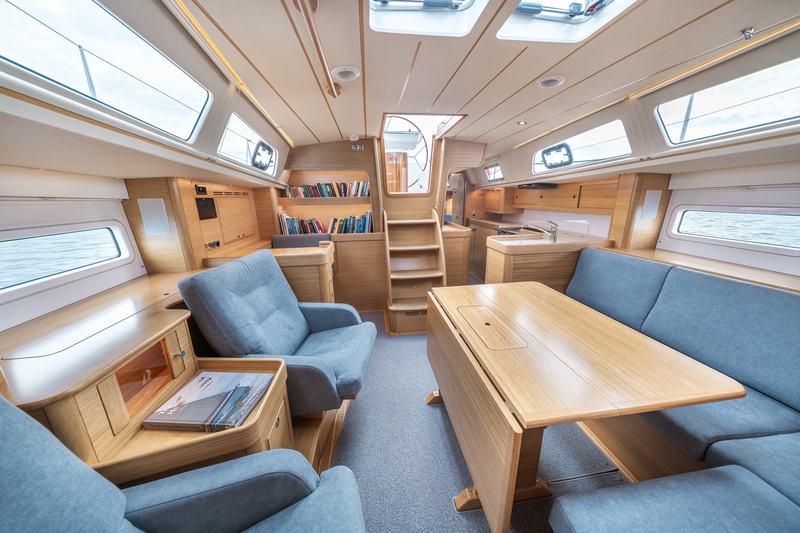
The Hallberg-Rassy 44 Mk II saloon. Photo Anton Bylund, Hallberg-Rassy.
A different treatment of the saloon
Hallberg-Rassy has revised the interior visual language as well as its practical details. Horizontal wood grain is intended to strengthen the impression of width. Lowered divisions between the saloon and adjacent galley and work areas create a more open visual connection. Optional indirect lighting can give the saloon ceiling a floating effect, while sleeping cabins receive white-painted wooden hull panels.
The result is an interesting comparison with the visual priorities often associated with contemporary cruising catamarans. On a monohull of this size, usable space must be arranged within a narrower hull and around the structural and mechanical requirements of an ocean-going yacht. Apparent spaciousness is valuable, but it is not equivalent to additional physical volume. A buyer should still compare seating dimensions, access to lockers, the space needed to work at the galley and the availability of suitable supports when the yacht is heeled.
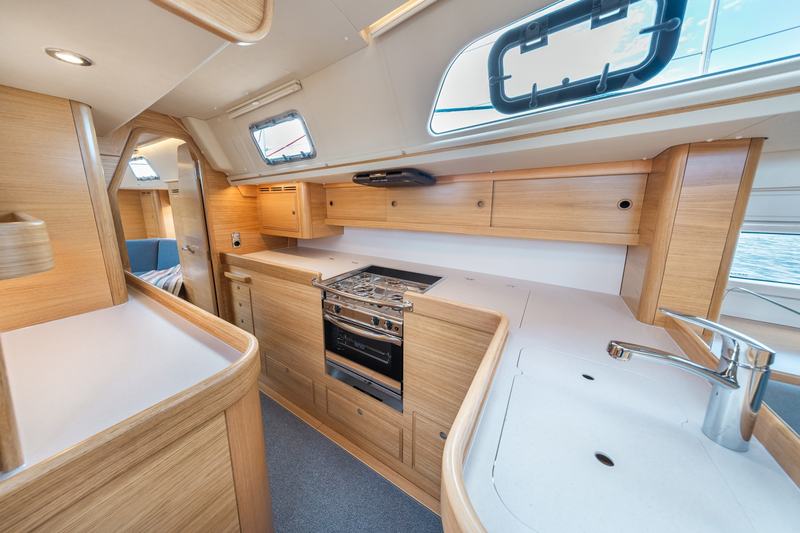
The Hallberg-Rassy 44 Mk II galley. Photo Anton Bylund, Hallberg-Rassy.
Storage and access for maintenance
The new interior specification incorporates soft-closing drawers, changes to locker access and improved access to storage below the galley sole and within the starboard-side accommodation. The yard also describes hidden technical panels at the work table. Its selective use of lightweight marine plywood is intended to improve weight and stiffness characteristics.
These less immediately visible revisions deserve attention in a long-distance cruising yacht. Access to equipment can determine how quickly a fault is investigated, and good locker organisation can make stores easier to locate during a passage. The priority is not simply the total number of compartments. It is whether access remains practical with the yacht loaded and in motion. Prospective owners can use the builder's interior drawings to establish the relationship between accommodation, storage and systems before finalising their specification.
Power and cruising autonomy
The specified auxiliary engine is a Volvo Penta D2-75, delivering 55 kilowatts at the crankshaft and driving a shaft through a hydraulic transmission. Published diesel tank capacity is 420 litres, while freshwater tanks hold 745 litres.
These figures are useful when comparing bluewater cruising yachts, but they are not promises of motoring range or days of autonomy. Actual consumption depends on engine load, speed, sea conditions and the use of other onboard systems. Water requirements depend on crew size and habits, while any watermaker installation changes the practical water-management plan. The manufacturer supplies fuel-consumption information for an optional propeller arrangement, which owners can discuss with the yard when considering their anticipated cruising pattern.
What the new film adds
The extended format makes it possible for the manufacturer to explain decisions that are difficult to communicate in a short brochure. Owners can use the release to prepare more detailed questions ahead of a shipyard visit, including those concerning the revised helm, accommodation access, deck arrangements and optional sail handling equipment.
The programme does not itself establish measured comparative performance or the long-term experience of independent owners. A prospective buyer should combine it with the builder's published technical drawings, a survey of the proposed specification and a trial. The new Hallberg-Rassy film is useful precisely because it gives the viewer more material from which to formulate those questions. For the 14-metre cruising-yacht market, the underlying story is one of incremental development across many parts of an established design, rather than a single headline innovation.
Official sources and photographs
Reporting based on the 16 November film announcement and the manufacturer’s model data and specifications. All photographs: Anton Bylund / Hallberg-Rassy, supplied through the official press gallery for journalistic editorial use. Resized for publication; copyright remains with the rights holder.