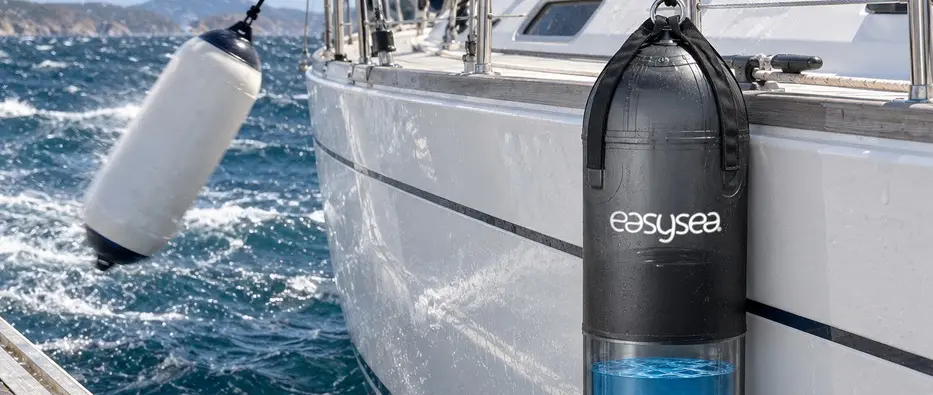
A different approach to fender behaviour
Italian deck-equipment developer Easysea is presenting its new water-ballasted inflatable fender at METSTRADE, which concludes in Amsterdam on 19 November. The product has received a Special Mention in the 2026 DAME Design Awards. The recognition focuses attention on a familiar problem for cruising crews: a lightweight inflatable fender can be displaced from the part of the hull it is supposed to protect when conditions become unsettled.
Easysea addresses this by giving the bottom of the fender a separate compartment that accepts water ballast. Its proposed outcome is a more stable hanging position without sacrificing the compact storage associated with an inflatable product. The company identifies the design as part of its 2027 range. The award should not be confused with an announcement that every size is already available from stock, or with independent certification of its protective performance.
What is distinctive about the construction
The manufacturer's exhibition catalogue identifies two sizes, FDW-101 and FDW-102. Both have a nominal diameter of 30 centimetres; their lengths are 74 and 106 centimetres respectively. The ballast compartment can hold up to five litres of water, independently of the inflatable section above it. The company says the assembly remains buoyant even when the water compartment is filled.
Those dimensions offer a useful starting point for boatbuilders and chandlers, but they are not a specification for every yacht. Vessel displacement, freeboard, the shape of the topsides and the characteristics of a berth all influence the size of fender that is needed. An owner considering the system for a yacht approaching 24 metres should seek the supplier's guidance rather than extrapolating from its suitability for lighter craft.
The mechanics behind the idea
In ordinary service a hanging fender has a suspension point and a centre of mass below that point. Adding mass near its base generally changes the dynamics of its movement. The effect is analogous to weighting the lower portion of a hanging object: under some conditions, a greater restoring moment can resist the rotation caused by a sideways disturbance. The air-filled part remains responsible for providing the compliant space between two hard surfaces.
Five litres of fresh water has a mass of approximately five kilograms, although the actual amount carried will depend on how completely the chamber is filled. This is a meaningful change to the handling weight of an otherwise light inflatable accessory. A crew should be aware that the trade-off is not simply improved behaviour for no additional cost. The intended benefit needs to outweigh the effort of filling, lifting and emptying the product in the circumstances in which it will be used.
Where the concept might be valuable
A marina that receives wash from passing vessels or has a prevailing crosswind can demand frequent attention to mooring arrangements. If a fender moves above its intended contact zone, the yacht may be exposed to a hard surface even though the crew has seemingly provided adequate protection. A fender that is less susceptible to swinging may reduce the time spent repositioning individual pieces of equipment.
A similar question arises when two boats of different heights are moored alongside one another. Their contact surfaces may not coincide with the midpoint of a conventional fender. The lower portion of a hanging cylinder can become particularly important when one boat rolls relative to the other. On a sailing yacht with considerable flare, or a motor cruiser with an irregularly shaped rubbing strake, a crew needs to observe the exact contact points rather than assume that a heavier fender automatically solves the geometric problem.
The storage and handling calculation
Space is valuable aboard a yacht in the Luxury Yacht Guide size range. A large rigid fender can consume much of an otherwise useful cockpit locker. A deflatable alternative can offer room for additional equipment, while a water-ballast system does not require the crew to store a permanent heavy weight. This is a genuine potential advantage for a yacht whose berth arrangements vary substantially during a cruising season.
However, the equipment will need to be prepared before it is required. In a rapid berth change, a crew may prefer a fender that can be deployed immediately. For a family crew, the practical question is how inflation and ballast filling fit into its normal approach routine. The useful comparison is therefore between a set of fenders ready for use, not between their dimensions in a showroom package. Find out what valves, pump and filling accessories are supplied and how easily they can be used from within the protected deck area.
Choosing the right fender for the yacht
A wider or longer fender is not necessarily better if it cannot be suspended at the appropriate point. The fender must sit across the anticipated contact surface while the yacht moves with tide, surge and changes in loading. The relevant height may differ at the bow and stern. Designers should examine the geometry of the yacht's hull and its planned berth environment rather than specify a uniform size entirely on the basis of overall vessel length.
For an existing yacht, begin with the fender arrangement that has worked successfully to date. Record where the current units are suspended, what they protect and whether there are recurrent difficulties with movement or storage. Discuss those difficulties with the equipment supplier. Ask about the recommended inflation range and working compression, attachment-point loading and any test data supporting the product's application to heavier craft.
What the award does not establish
The DAME jury's Special Mention gives the concept an independent design accolade. It does not provide the kind of vessel-specific engineering data that would justify using a particular device in a berth exposed to exceptional loads. The product listing does not supply a complete compression curve, quantified impact-energy rating or a comparative test across different wind speeds and vessel displacements.
That distinction matters because collision protection depends on more than keeping a fender upright. Mooring lines, their leads, attachment points, allowable range of vessel movement and the characteristics of the neighbouring structure all form part of the protective arrangement. A ballast chamber does not change the need to use appropriate line arrangements or to supervise a berth in changing weather. Owners should continue to use the recommendations of their vessel builder and competent marine professionals when specifying equipment for demanding conditions.
Questions of materials and service life
Two separate chambers introduce distinct maintenance considerations. A buyer should establish how to inspect the valves, how to rinse and dry the equipment and whether the water reservoir can be serviced separately. The answers will be particularly relevant for yachts that alternate between salt water and inland facilities or are laid up for extended periods. A compact fender only delivers lasting storage benefits when it can be cleaned and packed without trapping moisture or damaging its materials.
Owners should ask whether covers are offered, which cleaning agents are compatible with the outer surface, and how repairs or replacement components will be handled. A high-gloss painted hull or a dark gelcoat may require specific attention to surface compatibility. The announcement does not establish that the fender is suitable for every coating, nor that it can operate indefinitely without inspection.
Looking ahead to the next cruising season
Easysea is showing the product at stand 03.134, alongside its Fold bimini, which was separately nominated in the design awards. The company's 2026/27 catalogue identifies the inflatable as a new product for the coming season. That timing makes the show a useful opportunity for yards and distributors to discuss the equipment before winter refit decisions are finalised. Pricing, regional delivery and the precise retail availability should be confirmed directly rather than inferred from the award.
For owners, the best evidence will be a demonstration using a boat of comparable displacement and hull geometry, followed by documented operating instructions and experience in ordinary marina conditions. The innovation addresses a narrow but persistent problem, and its merit ultimately depends on how consistently it functions within the complete mooring arrangement. The DAME recognition is a reason to investigate that proposition; it is not a reason to discard proven protective equipment before an appropriate replacement has been assessed.
The wider lesson for yacht design is that improvements in everyday usability are often achieved through apparently modest pieces of equipment. Better storage, less unnecessary handling and more predictable behaviour can matter considerably to an owner-operated cruiser. Easysea's new fender gives the industry a specific and testable proposition for the 2027 season, with its benefits and practical limitations worth examining together.
Sources and image
Primary sources: Easysea official METSTRADE product listing and Easysea exhibition announcement. Award status independently corroborated by the DAME Design Awards Special Mentions list. Lead image: Easysea official exhibitor product visual illustrating the water reservoir, not an independent sea trial; supplied via the official METSTRADE exhibitor catalogue and reproduced for editorial coverage. Copyright remains with its rights holder. Re-encoded for web display.