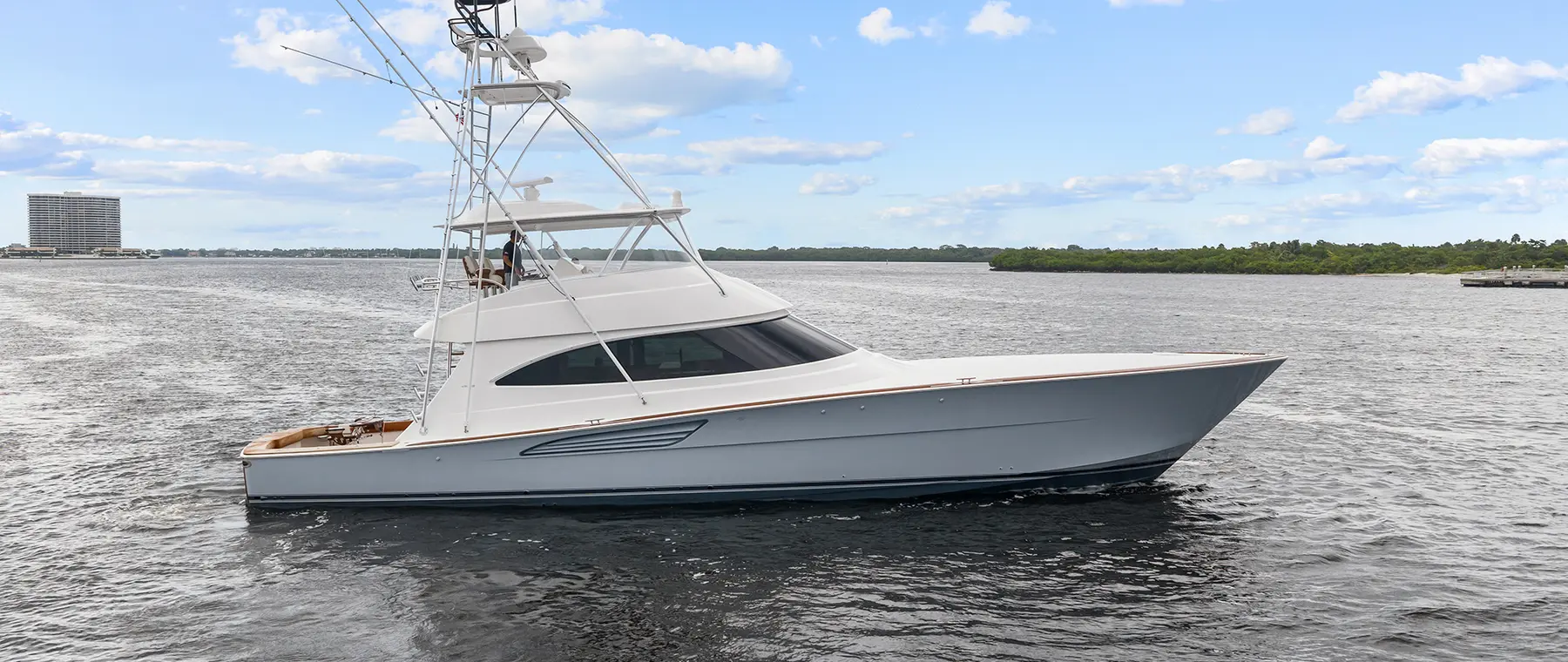
Viking’s new figures arrive after the Fort Lauderdale debut
Viking Yacht Company has reported that 18 examples of its second-generation 70 Convertible have been sold and that the first hull reached 42 knots during testing. The figures appeared in the New Jersey builder’s 10 November 2026 update, following the model’s public introduction at the Fort Lauderdale International Boat Show. They add a measurable commercial and performance dimension to a yacht already covered in the earlier launch cycle. The reporting distinction is important: Viking is the source of both numbers, and a sales claim is not an independently audited delivery count. Equally, a speed recorded on the first hull is a builder-reported test result, not a standardised trial for every configuration. Those qualifications do not make the announcement less interesting. For owners considering a 21.59-metre sportfishing yacht, it provides an unusually specific insight into initial demand and how the first example has behaved under test conditions.
What eighteen sales tell prospective owners
The builder’s statement that 18 boats have been sold suggests a meaningful early order book for a new high-value model. It does not identify the contract dates, prices, hull numbers beyond the first unit, or the balance between open and enclosed helm configurations. Nor does the announcement state that 18 yachts have entered service. These are distinctions a brokerage report should retain, especially when buyers use sales figures as a proxy for model acceptance or later resale liquidity. A signed order may support demand without proving the timing of production, delivery or future owner satisfaction. For an interested buyer, the useful follow-up is to ask the authorised sales team about build slots, the specification of available hulls and the scope of contractual customisation. A busy order book can influence planning, but it does not by itself demonstrate the value of any particular example or guarantee that used-yacht prices will follow a specific direction.
The 21.59-metre position in the luxury-yacht market
Viking’s model specification gives a length overall of 70 feet 10 inches, or 21.59 metres, with a beam of 5.77 metres and a published draft of 1.68 metres. That puts the yacht squarely inside Luxury Yacht Guide’s 12.00–23.99-metre remit. It is large enough to provide a substantial cockpit, multiple sleeping cabins and significant machinery, while remaining below the 24-metre threshold that usually drives editorial classification into the superyacht market. The name 70 is not a precise length in metres, and the builder’s own dimensional table should take priority over any shorthand used in conversation. The length, beam and draft also have practical implications for berth selection, storage and maintenance facilities. Buyers should confirm the specific hull’s as-built measurements, particularly if optional equipment or appendages affect overall dimensions, rather than relying on nominal model designation when making marina arrangements.
Forty-two knots is a trial number, not a cruising guarantee
The reported 42-knot speed on hull No. 1 is notable for a yacht built to carry extended-cruising accommodation and demanding offshore fishing equipment. Viking’s accompanying update says its research and development team is continuing to seek further speed. That makes the number a snapshot of a programme still being refined, rather than evidence of a final published specification for all production boats. Hull loading, propulsion choice, sea state, fuel and water levels, fishing equipment and hull condition can all affect maximum speed. Most owners will spend much more time at economical passages or manoeuvring speeds than at a top-speed peak. An independent sea trial for a prospective purchase should therefore examine handling, fuel use and noise across the operating range, not just ask whether a lightly loaded example once achieved a particular number. The builder’s speed figure is useful evidence, but its conditions should be requested.
Propulsion questions still require model-specific answers
The public 70 Convertible product page lists principal dimensions and tank capacities but has not supplied a detailed power table in the material reviewed for this article. That is a good reason not to invent engine horsepower, consumption, endurance or emissions figures. Buyers comparing this boat with another 21-metre model need a precise engine package, gear ratio, propeller specification and trial data for the actual hull. Questions should include maintenance access, cooling arrangements, stabilisation equipment, redundancy of critical systems and the availability of technical support in the cruising regions being considered. Even where a builder has considerable experience with high-performance sportfishing hulls, new installations deserve careful scrutiny. An attractive top-speed number should initiate a technical discussion rather than close it. The most useful document is the dated as-built specification and test report, not a general statement about the model’s performance potential.
Cockpit design remains central to the 70 Convertible
Viking highlights a 194-square-foot cockpit on the new 70, reinforcing that this remains a serious sportfishing design rather than a conventional European flybridge cruiser with fishing equipment added as an afterthought. That working space is important for moving around a gamefish, rigging and equipment storage, but its layout also affects the way guests use the yacht at anchor and alongside. The owner’s requirements will determine whether fishability or social seating receives more emphasis. Attention should be given to cockpit drainage, deck hardware, access to fish boxes, any livewell arrangement and the distance between the working area and guest circulation routes. A vessel can host comfortable family cruising without ceasing to be designed primarily for offshore fishing. During an inspection, an owner should ask the crew to demonstrate how the cockpit is prepared for both modes and what must be stowed or reconfigured between them.
Four cabins, five heads and the longer voyage
The builder describes four staterooms and five heads in the new model, giving families and fishing parties substantial accommodation for a yacht of this length. The number of cabins is only the beginning of the habitability question. A buyer planning a week aboard should understand how cabins are separated, how storage is distributed and which spaces remain comfortable with all berths occupied. The location of the galley and main saloon also influences the practicality of feeding a full party during a long offshore passage. Separate crew arrangements and any owner-operated assumptions should be checked against the exact general arrangement, since an advertised cabin count does not itself explain how a professional crew would be accommodated. For a mixed-use sportfisher, the transition between an early-morning fishing departure and a relaxed family evening is a meaningful design test. It involves service, noise, safety and privacy as much as interior finish.
Open, enclosed and sky-bridge choices
Viking markets the 70 platform in open-bridge, enclosed-bridge and sky-bridge forms. Each creates a different relationship between the helm, weather protection, visibility and guest spaces. The open bridge is closely associated with the direct situational awareness needed in sportfishing; an enclosed bridge offers more shelter and a climate-controlled upper environment; the sky-bridge concept combines different helm experiences. Those are functional choices that can affect weight, operational complexity and how the yacht feels in hot or exposed conditions. An owner should compare the actual sight lines at the helm, access during rough weather, communication with the cockpit and the ease of moving between stations. It is not enough to choose by profile alone. Equipment, furniture and enclosure options can also affect the particular arrangement, so the official general arrangement drawings and the selected build specification remain essential.
Fuel capacity matters more than a theoretical range
Viking’s published specification lists a standard fuel capacity of 2,027 US gallons, approximately 7,673 litres, with an optional capacity of 2,530 US gallons, approximately 9,577 litres. The corresponding water capacity is 345 US gallons, about 1,306 litres. These figures are useful for understanding the basic scale of the vessel’s systems, but they do not provide an independently verified passage range. Consumption changes enormously with speed, loads and conditions; additional tankage also affects displacement and available space. A prudent owner or captain should build an operational fuel plan from real consumption curves and sensible reserve policy, rather than dividing tank capacity by a guessed burn rate. The same applies to freshwater needs, generator use and equipment loads when several guests are aboard. A meaningful long-distance cruising comparison must consider the whole operating profile, not a single tank number.
Where an owner should concentrate the next inspection
With the first hull now tested and a reported 18 orders, the next practical step for buyers is to examine real production and operational evidence. The checklist should include confirmed speed trials under documented conditions, machinery access, helm ergonomics, visibility at low speed, the quality of the ride at intended cruise speeds and the usability of every guest cabin. For a sportfishing owner, livewell arrangements, tackle storage and cockpit safety deserve specialist attention. For a family cruiser, noise, guest privacy and the transition to comfortable evenings aboard may be more important. Both groups will need clear maintenance plans and access to appropriate service yards. The best comparison is between fully specified boats under similar conditions, not between isolated advertising headlines. If a prospective owner is considering a resale example of the earlier generation, the structural and arrangement differences should be assessed rather than inferred from the shared model name.
A new development without overstating the result
The 10 November announcement should be understood as two new builder-reported facts: early sales activity and a first-hull speed result. It does not warrant calling the boat the fastest in its class, claiming that every production yacht will reach 42 knots or suggesting that all 18 have been delivered. Those claims would require evidence not present in the official update. What can be said is that Viking has taken its second-generation 70 Convertible from announcement and first public display into initial production testing, while reporting an order book that gives the programme commercial momentum. That makes the story suitable for continued coverage, especially if the yard subsequently publishes fuller test curves, named deliveries or technical updates. Luxury Yacht Guide will keep those future developments distinct from the initial figures and from the builder’s existing model brochure.
Original builder sources and photograph
The commercial and speed announcement comes from Viking Yacht Company’s official 10 November 2026 news update. The dimensions, accommodation, variants and tank capacities are taken from the official Viking 70 Convertible model page. The accompanying photograph is a Viking Yacht Company model-gallery image of the actual second-generation 70 Convertible, sourced from the manufacturer’s site for this editorial report. Manufacturer information is distinguished throughout from independently established performance or delivery data.