Three linked announcements for close-quarters handling
Quick Group's 2026 manoeuvring-system programme combines an expanded QSY electric-thruster line, a Pacific series of helm control interfaces and a networking framework called QCentric. The Italian equipment group announced the package ahead of the September Cannes Yachting Festival and subsequently promoted it through the autumn boat-show circuit. It is relevant to Luxury Yacht Guide because the manufacturer explicitly describes suitability from smaller recreational craft through yachts up to around 30 metres.
Owners of 12–23.99 metre vessels often spend much more time worrying about a crosswind in a marina than about headline top speed. A bow or stern thruster cannot replace sound handling skills, but appropriately specified thrust can help a small crew position a high-sided yacht at low speed. Quick's announcement is therefore worth examining for what it says about control, electrical architecture and the range of boat sizes intended.
A broader spread of thrust and tunnel sizes
According to Quick's official statement, the QSY family uses synchronous brushless electric motors and now includes additional units and a 215-millimetre tunnel. That intermediate tunnel diameter is designed to fill a gap between existing 185-millimetre and 250-millimetre options. The supplier says the range runs from a 12-volt BT QSY 140-50 offering 50 kilogram-force of thrust to a 48-volt BT QSY 300-350 delivering up to 350 kilogram-force.
Those are examples from the portfolio, not an endorsement of either end for a particular 18-metre motor yacht. Tunnel diameter, hull geometry, displacement, windage and electrical supply all govern selection. A model with a larger thrust number may be inappropriate if structural room is unavailable or if the boat's electrical installation cannot support it. The practical benefit of a wider size matrix is more opportunity to specify the correct engineering fit rather than forcing a compromise.
Why brushless technology draws interest
Quick attributes precise proportional response, reduced noise and lower energy consumption to its QSY brushless technology, which uses integrated inverters. The company also presents immediate torque response and reduced maintenance as product advantages. These are manufacturer statements; there is no independent comparison in the cited announcement establishing identical savings for every yacht, and actual sound at the helm depends heavily on the hull and installation.
For an owner who often manoeuvres beside concrete walls or tightly packed pontoons, control feel may be as valuable as raw force. Proportional operation can allow more measured corrections instead of a binary on-off response. But that degree of finesse needs to be demonstrated with the exact controller, propeller, tunnel and supply voltage proposed. The thrust available at low battery voltage or during sustained duty should also be discussed.
Pacific changes the controller conversation
The new Pacific control series includes T1, T1XL and T2XL models, according to the group's announcement. Quick says the interfaces are intended to suit different thruster arrangements and yacht sizes and to make more of QSY's proportional control and diagnostic capabilities. One useful packaging detail is the supplier's claim that T1XL and T2XL share the same console footprint, which may simplify a later move from one control arrangement to another.
Helm ergonomics cannot be judged solely from a product photograph. Owners should sit at the console and check whether the control is easy to identify, reach and operate while looking outside. A joystick near engine controls must not cause confusion about the device being commanded. On a 12–24 metre owner-driven yacht, clarity is a safety consideration: the skipper may be controlling the boat while a second person handles lines, without a professional bridge team.
QCentric is a system architecture, not a magic switch
Quick describes QCentric as a CAN bus-based platform designed to connect products, functions and data in a more unified environment. The group says its approach supports NMEA 2000 and gateways for other systems, and that Pacific controllers can integrate with some established third-party manoeuvring systems. This points towards a more modular approach in which equipment can share information instead of relying on several isolated controls.
However, a network protocol does not guarantee plug-and-play compatibility with every existing vessel. A yard must verify the supported gateways, wiring, software, safety interlocks and fault behaviour. It must also establish whether additional controls are required for an existing stern thruster, hydraulic system or original builder arrangement. 'Open and scalable' is the manufacturer's architectural description; owners still need a written integration plan with named components.
What a 12–23.99m retrofit might require
The first engineering visit should focus on the underwater structure. A tunnel thruster needs a location that preserves hull strength and offers useful immersion at operating trim. The installer must consider bulkheads, tanks, access for maintenance, fairing and the intended dry-dock window. An existing tunnel's diameter may limit upgrade choices, even when a new electric motor would otherwise be attractive.
The electrical assessment is equally important. Thruster circuits can involve high currents, short heavy cables, dedicated batteries and protection devices. A builder who designed the original system around one voltage may need more than a new switch to use a different QSY model. If the yacht already has a thruster, establish whether retaining its tunnel, wiring and control architecture is safe and economical. Modernisation should reduce complexity only when designed as a complete system.
Manoeuvring gains have operating limits
Thrusters can create valuable sideways force at the bow or stern, but their effect changes with water flow and vessel speed. Most close-quarters use occurs at low speed, and an exposed berth may demand more authority than the device can deliver for long periods. Wind, tidal stream and adjacent traffic remain dominant influences on docking decisions. No control upgrade makes it sensible to attempt a berth when environmental limits have clearly been exceeded.
A sea trial should examine response in both directions, the smoothness of proportional control, warnings and any thermal or battery-related restrictions. Consider whether an assistant skipper can understand the system without lengthy explanation. The best result is a predictable device that supports an established manoeuvring plan. The worst outcome would be a modern-looking control that makes it difficult to recognise whether power is available at the moment it is needed.
Where integration could reduce helm clutter
The emerging appeal of QCentric lies partly in the possibility of coordinated controls on a bridge with limited panel area. A modern yacht may already carry independent systems for thrusters, navigation, anchor handling, trim and stabilisation. If future equipment can share a well-documented framework, builders may be able to make the interface more consistent, and owners may find upgrades less disruptive. This is a plausible longer-term benefit rather than an installed result proven by the September announcement.
Quick mentions an ambition to integrate more of its equipment families and other compatible systems over time. A prudent purchaser should distinguish functions available at the time of quotation from those listed on a product roadmap. Ask which exact integration features are shipping now, which require separate gateways and which are under development. A compelling vision is not sufficient reason to remove reliable existing equipment.
The financial case needs more than a brochure comparison
Equipment price is one part of the total project. Haul-out, structural work, installation labour, electrical upgrades, control-panel modification, commissioning and later maintenance can be substantial. Owners should compare the expected manoeuvring improvement and downtime against the condition of the existing system. If the yacht already docks comfortably and reliably, the value of replacement may be lower than for a vessel whose current thruster is undersized or difficult to maintain.
Quick's public announcement does not publish installed prices or a universal maintenance saving for the new range. It is therefore not possible to calculate a defensible payback period from the announcement alone. A better approach is to obtain a written engineering specification, compare compatible options and ask for references from similarly sized yachts. The decision should rest on handling needs and life-cycle support rather than selecting the highest available thrust figure.
What has changed and what remains to prove
The 2026 product announcement supports the expanded QSY portfolio, new 215-millimetre tunnel, Pacific T1/T1XL/T2XL controls and QCentric architecture. It also establishes the manufacturer-stated 7-to-30-metre application range and the upper model's rated thrust. These details offer genuine substance for owners assessing a new build or refit. They do not establish universal compatibility, an independent noise reduction figure or a guarantee of safe handling in every wind condition.
For the Luxury Yacht Guide reader, this is a story about pairing mechanical force with more considered control and integration. The sensible next step is a yacht-specific assessment of displacement, windage, thruster location, power supply and helmsman ergonomics. If the resulting system can be commissioned and demonstrated to perform predictably, the broader QSY range could become a useful option for a crowded and demanding part of yacht operation.
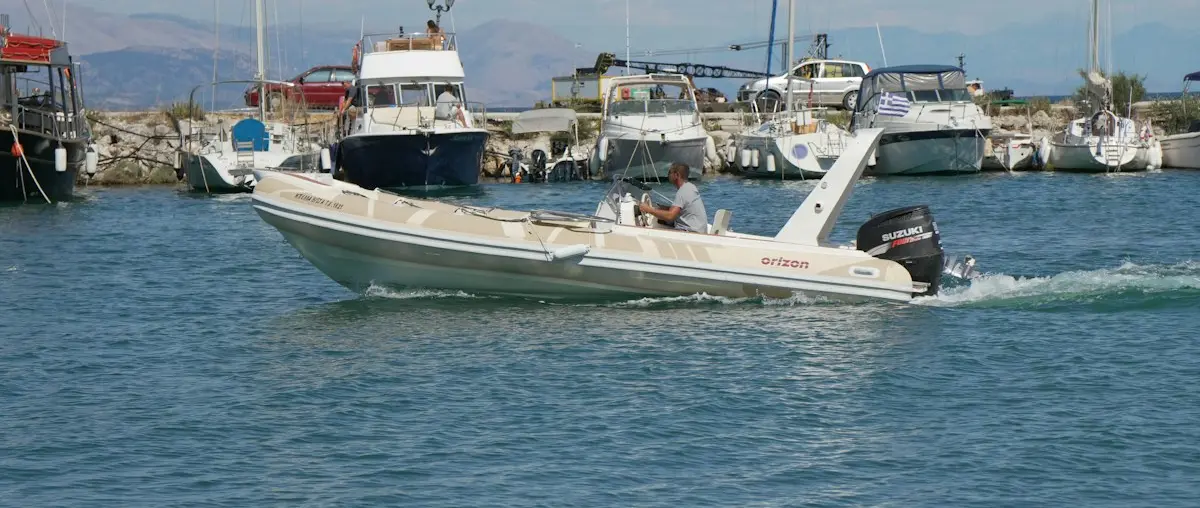
Image credit: Motorboat manoeuvring, photographed by Julian Gojani. Original photograph, used under the Unsplash License. The lead photograph is illustrative and does not depict an unverified product or berth.