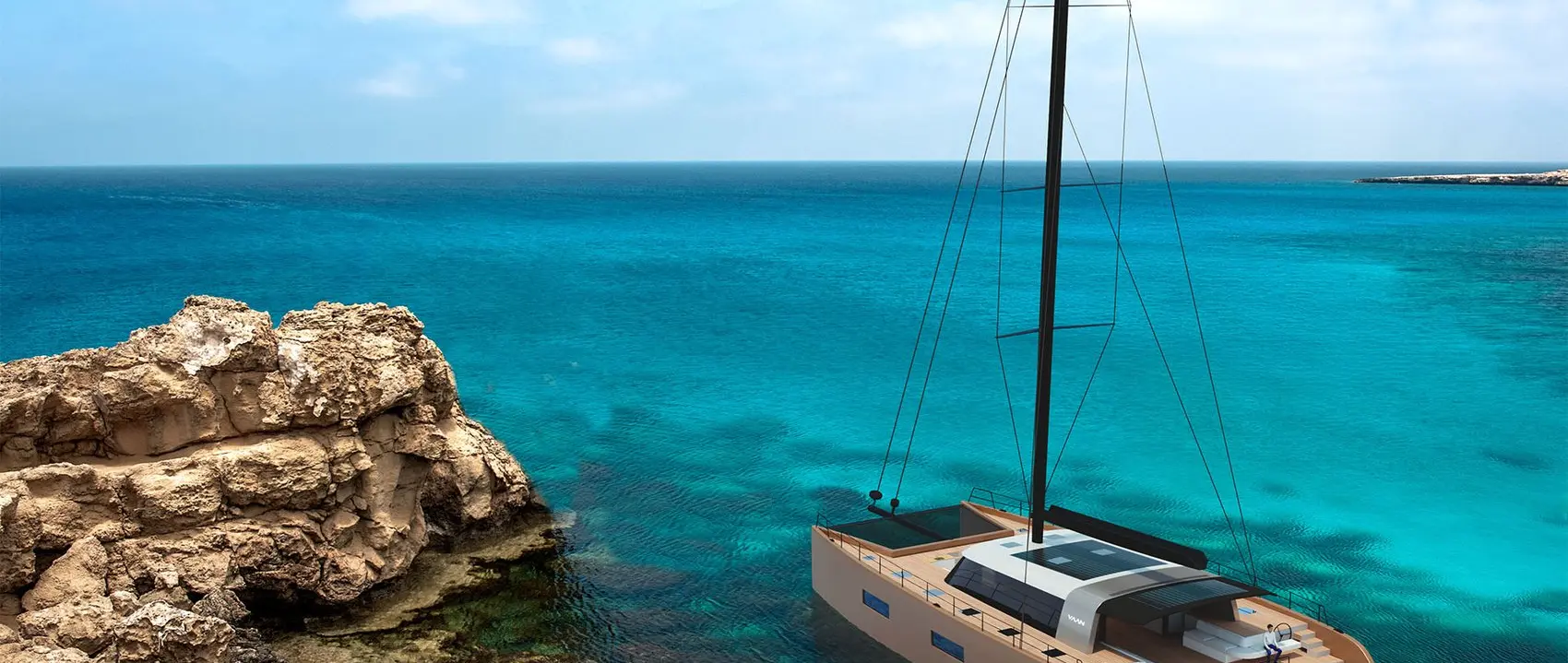
A larger yacht in the Dutch builder's range
Dutch yachtbuilder Vaan has introduced a private Belvedere side-terrace option for its 23.80-metre R8 sailing catamaran, part of its published 2026 design updates. The opening owner-side deck is intended to provide a personal waterside retreat while the larger R8 retains the company's approach to aluminium construction, electric propulsion and owner-specific accommodation. The official model page specifies an eleven-metre beam, approximately 150 square metres of combined living space and layouts accommodating five, six or seven cabins.
The R8 is presented as a model with configurable arrangements, rather than an independently confirmed delivery of a named vessel in November 2026. Its first-party imagery illustrates the intended architecture and should not be mistaken for evidence that every promoted option has been fitted to a finished customer yacht. The manufacturer's specifications are a starting point for understanding the project.
The 2026 Belvedere design update
Vaan's 7 March 2026 factory update describes a new opening side deck for the R6 and R8, named the Belvedere. The owner-hull side unfolds outward to create a private terrace immediately above the water. The company presents it as an optional space for quiet time and easier connection with the sea while anchored in suitable conditions.
The upgrade adds another distinction to the R8's choice of forward and aft social areas. The side opening requires a structural and mechanical solution integrated into the hull, so an owner should confirm how access, locking, water-tight integrity and permissible sea conditions are managed. The announcement does not establish that every R8 has received the feature or that it has been installed on a newly delivered hull.
Length and beam make a different proposition
At 78 feet overall, the R8 falls within the upper end of the premium production-yacht category. The published beam of eleven metres gives it a notably broad platform compared with a monohull of similar length. That space can support generous accommodation and outdoor areas, but it also affects where the yacht can berth and how manoeuvres must be planned.
A buyer should assess the dimensions alongside the locations in which the yacht will normally operate. Marina berth availability, entrance width and the suitability of lift facilities may create practical limits even if the yacht's shallow-draft sailing arrangement would be attractive in the open water.
A large living area across the platform
Vaan says the R8 provides close to 150 square metres of living space, counting interior areas and cockpits. The arrangement creates an open visual relationship from the aft cockpit through the main saloon to a forward cockpit. The design aims to make the social spaces feel connected without forcing all guests into one part of the yacht.
An owner should distinguish the manufacturer's aggregate area figure from the floor area of any single room. Exterior spaces are affected by weather, shade and movement, and not every part of the platform can be used in every condition. The final layout is the useful basis for evaluating how a family or group will actually move aboard.
Five cabins are only one of the layouts
The R8's official presentation highlights a five-cabin arrangement but advertises five-, six- and seven-cabin possibilities. That flexibility can help owners balance privacy, guest numbers and the need for a professional crew. It does not mean every version delivers identical storage, cabin sizes or service routes.
The manufacturer describes an alternative with two large aft owner-style cabins, additional guest accommodation and a cabin forward for crew or children. Buyers should study the complete general arrangement for the option they prefer, including available bathrooms and access to each hull.
Separate crew spaces support different ways of ownership
A yacht this large may be operated with professional crew, but some experienced owners may prefer to sail shorthanded. Vaan discusses both possibilities. A dedicated crew area, separate galley and direct access to the bridge could allow staff to work with greater discretion when a professionally managed programme is chosen.
That is an accommodation and design proposition, not a legal assurance that the vessel can be run with any selected crew count. Actual safe manning depends on flag rules, intended use, equipment, qualifications and the owner's competence. The manufacturer should provide operational documentation relevant to the final yacht.
The forward cockpit gives a second social centre
The saloon leads directly to a forward cockpit, creating a distinctive area for relaxing away from the main aft seating. On a sailing catamaran, this can provide useful variety when the wind or sun makes one part of the deck more pleasant than another. Guests may also appreciate the ability to enjoy a view forward while remaining near the interior living spaces.
The forward deck remains part of an operating sailing vessel. Movement, access and seating while underway must follow the crew's instructions. Promotional pictures of relaxed outdoor use should not be interpreted as permission to remain anywhere on deck in difficult conditions.
Low boom and helming arrangements
Vaan places emphasis on a relatively low boom and aft helm positions, retaining a sailing-focused profile rather than building a tall accommodation block topped by a conventional flybridge. This decision affects both visual appearance and the handling philosophy of the yacht.
The builder also describes an interior helm bridge for protected control and navigation. Buyers should examine visibility, instrument layout and the relationship between internal and external steering stations. Good access to the right information and appropriate sightlines are essential regardless of how sophisticated the electronic systems may be.
Different uses of the aft deck
The R8 can be configured with aft helms, aft benches or a combination of arrangements. That choice has a real effect on how the owner interacts with guests while manoeuvring and sailing. Some crews may favour a working area separated from the main social space, while others enjoy a more integrated outdoor experience.
Choices about benches, steering stations and circulation routes should be settled through detailed plans and a practical discussion with the builder. Furniture changes cannot always be made without affecting service access, equipment location or the working positions required by the sailing crew.
A transom designed for the water
The manufacturer illustrates options including a lifting platform, an integrated crane and a side opening. These features could make tender handling and swimming more convenient when the yacht is at a suitable anchorage. They also introduce structural and mechanical requirements that should be reviewed with the intended equipment in mind.
A tender is not only a lifestyle accessory. Its weight, dimensions and launch sequence affect the yacht's balance and operations. Owners should specify the tender early enough for the builder to confirm handling systems and the available deck space.
Electric propulsion is part of the specification
The R8 lists twin electric propulsion motors supported by a diesel backup generator. This describes an electrical drivetrain with backup energy generation, not a promise that the yacht operates without fuel under every condition. Its sailing capability can reduce reliance on propulsion when the wind is suitable, but the entire energy budget must still be managed.
The official page does not publish a universal electric range or a measured consumption table for all layouts. Owners should ask about battery capacity, regeneration, charging and the operational conditions under which the backup generator is required.
Solar generation needs practical expectations
The full roof is presented as a useful surface for solar panels. On a large sailing catamaran, the available area may be attractive for producing electrical energy during periods of sunlight, particularly for some onboard service loads.
However, the actual output depends on the installed array, weather, shading, temperature and the loads aboard. A photovoltaic roof does not by itself demonstrate energy independence. The builder should supply realistic energy modelling for each intended operating pattern before the owner makes decisions about equipment.
Sailing remains the primary identity
Vaan describes the R8 as a boat designed first for sailing, despite the size of its living spaces. A low boom, self-tacking jib and the option of a Code-0 or gennaker fit that proposition. A sailing catamaran's performance depends on rig setup, sail condition, loading and the quality of decisions made on the water.
The maker's presentation is not an independently verified sailing test. It does not establish a universal speed or exact upwind ability under all sea states. Those questions should be addressed through detailed specifications and, when available, demonstrations aboard a completed yacht.
Aluminium construction is a defining choice
The builder's wider philosophy emphasises aluminium as a durable structural material for ocean-going yachts. The R8 extends that identity into a larger format. Aluminium has particular properties and can be attractive for long-term service and repairability, provided the yacht is designed and maintained correctly.
Material selection alone does not prove sustainability or low maintenance. Protective systems, galvanic isolation, fittings and inspection remain important. A buyer should understand the actual hull structure and the builder's maintenance instructions, not rely on a broad environmental label.
Interior freedom can create complexity
Vaan offers substantial customisation of furniture and interior arrangements. For some owners, that will be central to commissioning a yacht that suits longer voyages or blended family use. But additional options also require careful consideration of weight, access to technical equipment and the time required to complete the build.
An attractive bespoke feature can cause inconvenience if it obstructs maintenance or makes passage through the vessel less practical. Designers, engineers and experienced crew should review important choices together before the build programme is fixed.
Privacy between guests and service
A yacht with several cabins and expansive social areas may accommodate groups with very different routines. One part of the party might want quiet time in a hull cabin while others use outdoor seating or dining spaces. Good circulation and noise management help these activities coexist.
If professional crew is carried, private access to working spaces can improve the sense of discretion. The R8's stated design aims to support this separation, but the final layout should be examined for the precise arrangement ordered by the owner.
The value of a sheltered interior steering position
An indoor helm can be particularly attractive on an ocean-capable cruising yacht, where weather may make prolonged exposure uncomfortable. It offers another option for navigation and watchkeeping, subject to adequate visibility and access to the controls.
A sheltered helm does not remove the need for a lookout or professional judgement. Radar, cameras and instruments can assist, but the crew must understand their limitations. The owner should ask for clear operating procedures for transitions between interior and exterior control positions.
Considerations for charter operators
The range of cabin layouts could attract owners who expect to offer charters, but a commercial arrangement brings separate requirements. Cabins, escape routes, safety equipment, insurance and crew training must meet the applicable rules for the flag and operating area.
The manufacturer's model page does not identify a commercially certified R8 hull, a first charter season or a confirmed revenue projection. The flexibility of the design makes it a potential candidate for consideration, not a guaranteed charter business.
Images document the concept, not every milestone
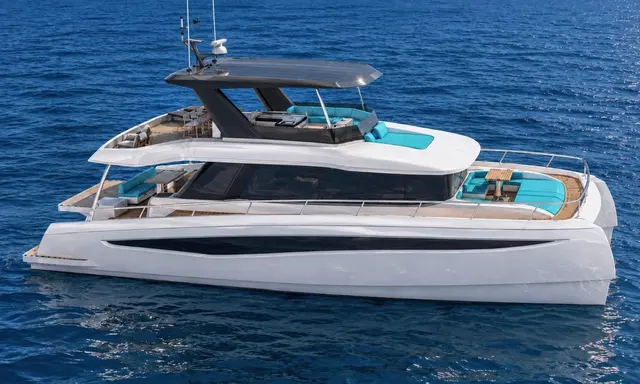
The R8's official gallery includes detailed exterior and interior visuals. The lead illustration accompanying this report comes directly from Vaan's model materials. It is credited as manufacturer design imagery and does not imply that a yacht photographed at anchor was delivered in November 2026.
This distinction allows buyers to enjoy the visualisation while keeping construction milestones clear. A future launch or handover report should rely on a dated announcement about a particular completed hull rather than on a gallery that may have been available for an earlier period.
What a buyer should ask next
A prospective R8 owner should request an up-to-date construction schedule, final specification, cabin configuration, rig and sail plan, electrical operating data and documentation for the intended flag. The relative merits of owner-operation and professional crew should be addressed honestly against experience and the proposed cruising programme.
The yacht's scale means mooring, maintenance and technical support need the same attention as the interior design. The key is to commission a vessel that works for the way it will be used, rather than selecting options only because they look appealing in a rendering.
A bigger expression of Vaan's approach
The R8 gives the Dutch builder a substantial 23.8-metre sailing catamaran proposition defined by aluminium construction, electric propulsion, varied helm positions and unusually large living spaces. Its official specifications create a clear picture of intended capability without supplying a completed-yacht performance record.
The next meaningful news will be a verified build, launch, sea-trial or delivery milestone. Until then, the R8 should be understood as an owner-configurable luxury sailing model whose operational details depend on the final yacht commissioned.
Primary source and image credit
Verified editorial source: https://www.vaan.yachts/the-new-2026-design-updates/. © Vaan Yachts / original design team. Official R8 manufacturer model visual, not proof of a delivered 2026 yacht. The source image has been screened against previously used SYG, LYG and LBG lead media. This is manufacturer design imagery; it is not represented as a photograph of a delivered yacht.
Additional first-party builder specification: https://www.vaan.yachts/r8/. Model performance and equipment details remain subject to confirmation by the builder.