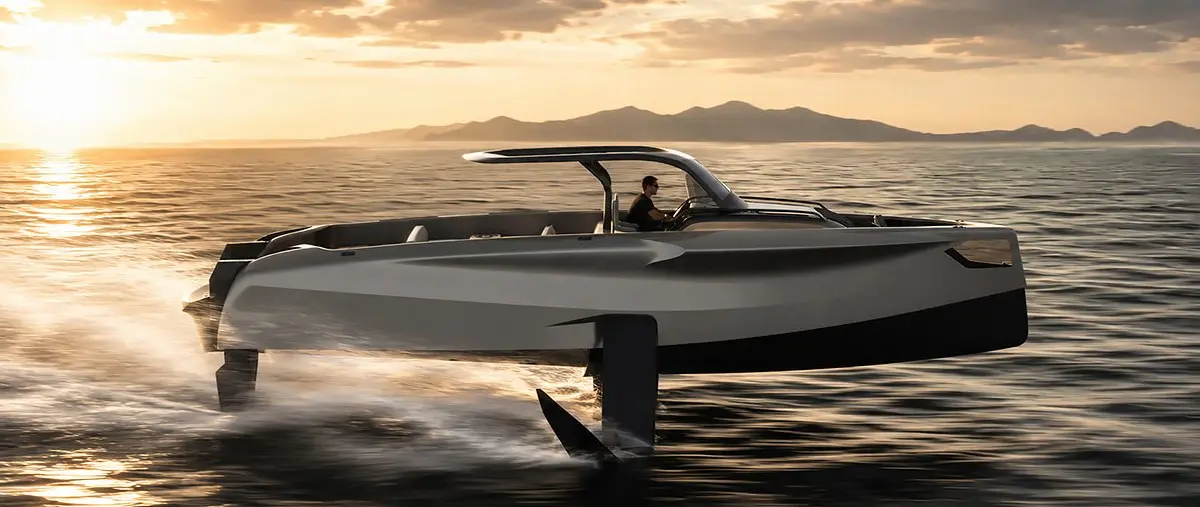
A new luxury flying-yacht concept is unveiled
UAE-based FOILER has introduced SHADOW, a 13.5-metre luxury hydrofoil design presented during the 2026 Abu Dhabi International Boat Show. Developed with engineering and manufacturing input from ENATA Marine and design by Bozca Limitless Design, the project continues the brand's exploration of recreational vessels that rise clear of the water on retractable foils.
The official specifications promise up to 45 knots, eight-passenger capacity and operation as much as two metres above the waves. These are the manufacturer's published performance goals, not an independently witnessed test report for a delivered customer yacht. The news is the launch of a defined new model, with future production and deliveries requiring separate confirmation.
Three operating configurations change the dimensions
FOILER describes garage, conventional displacement and flying modes. The garage arrangement measures approximately 14.3 metres overall, while the vessel's published operating length is 13.5 metres. The distinction reflects how the equipment is positioned rather than a change in the underlying hull.
In flight configuration, the foils create a reported wingspan of 13.3 metres, very different from the hull's own width of 5.2 metres. A prospective owner must plan berthing, launching and storage around the appropriate dimensions instead of assuming that a 13.5-metre day yacht behaves like a conventional boat in every situation.
Two metres above the water
The project's defining feature is the ability to raise the hull around two metres clear of the surface when foiling. Reducing direct hull contact may change the sensation of riding through waves, with benefits and limitations that depend on conditions and the system's actual operating envelope.
This is not the same as promising a completely motionless journey. A hydrofoil vessel has different dynamic responses from a displacement craft, and passenger comfort depends on control systems, sea state, speed and handling. Experience aboard a demonstrator is more informative than relying on the word 'flying' alone.
A substantial diesel-powered arrangement
SHADOW's official specification lists three turbo-diesel V12 engines, rated at 600 horsepower each. The combined installed rating points to the energy required to operate a substantial high-performance foiling design. It also makes clear that SHADOW is not being marketed as a purely battery-electric yacht.
Hydrofoils can potentially reduce resistance in suitable conditions, but the source does not provide a verified comparison against an identical hull without foils. Owners should request documented fuel consumption across different speeds and modes rather than treating lower resistance as an automatic percentage saving.
The quoted range needs its context
FOILER publishes a potential 300-nautical-mile range at 25 knots with a 1,000-litre fuel capacity. That is a useful starting point for understanding the intended operating pattern, including longer coastal passages. It should not be treated as an unconditional promise to travel 300 miles in every weather condition.
Loading, sea state, reserve requirements, engine operation and the time spent transitioning between modes can influence endurance. A captain should plan fuel and alternatives conservatively, especially on passages where safe refuelling points are limited.
A vessel for eight passengers
The stated capacity is eight people, positioning SHADOW as a luxury day boat, specialised owner craft or high-performance tender rather than a conventional multi-cabin charter yacht. Its public profile emphasises social deck space, comfort and personalisation more than overnight accommodation for a large party.
The manufacturer identifies around 320 square feet of open deck space and about 100 square feet of interior area. Those measurements help explain how space is prioritised, but the suitability of the layout still depends on the final furniture, storage and equipment chosen by the owner.
BOZCA provides the design language
The collaboration with Bozca Limitless Design brings sculpted exterior lines and a more architectural treatment of the interior. The model is intended to look distinctive even before its foiling technology is considered. The visual identity supports a luxury position rather than presenting the craft as a utilitarian test platform.
Design images are useful for assessing the intended appearance but do not prove that every finish or spatial detail has been delivered. The photographs and illustrations distributed on the official page are manufacturer material; the relevant distinction between a constructed vessel and a visualisation should be preserved when reporting development.
ENATA contributes specialist engineering
FOILER identifies ENATA Marine as the engineering and manufacturing partner. The relationship matters because a hydrofoil system brings together structures, hydrodynamics, actuation and electronic control. These disciplines must function as a coordinated whole for the boat to rise, maintain flight and return safely to the water.
A sophisticated foil does not operate independently of the hull. Loads have to be transmitted into the structure, and mechanical equipment must remain inspectable and maintainable. Public specifications cannot replace the technical documentation necessary for safe operation.
The wing arrangement affects marina planning
A flying-mode wingspan wider than the hull makes equipment deployment a central operational question. Owners need to understand where the foils can be extended, how they are secured and which limits apply when approaching harbours or moving at low speed.
A 13.3-metre span should not be treated as the necessary berth width in every configuration, but neither can it be ignored. The garage arrangement is specifically described by the builder, indicating recognition that practical handling and storage are part of the ownership proposition.
Certification claims must be read precisely
The manufacturer's model page lists CE Category B certification as part of the specification. A buyer should establish whether that applies to a particular completed production craft, a planned certification target or a current approved design configuration. A category label is not proof of unrestricted operation in any sea conditions.
Local laws, commercial rules and equipment requirements may differ according to intended use and registration. A craft operated as a private day yacht may face different obligations from one regularly carrying paying charter guests.
The helm must manage more than steering
Foiling adds an additional dimension to what the operator needs to understand. In addition to heading and speed, the control system must manage the relationship between the hull, waves and submerged surfaces. Displays and alerts need to make operating modes clear to the person responsible for the vessel.
The official site does not publish the complete control algorithm, so it would be inappropriate to describe specific automated responses as established facts. Owners should seek a training package, operating handbook and clear procedures for degraded conditions and manual intervention.
An open deck with a private retreat
The model has substantial deck space for social use alongside a compact interior cabin and bathroom. The balance reflects a day-cruising priority: guests can move between sheltered and open areas while enjoying privacy when required. The builder also presents a variety of possible materials and colours.
A sophisticated interior does not change the weather limits of open-deck use. Deck fittings, handholds and seating remain important when a boat can accelerate rapidly. Guests should follow operating instructions rather than interpret the yacht's elegant presentation as a promise of unrestricted movement while underway.
Personalisation can alter the technical brief
FOILER promotes exposed carbon-fibre finishes, custom lighting, teak treatments and paint-to-sample colours. These options may help an owner establish a distinctive visual identity. In a weight-sensitive hydrofoil yacht, however, choices of materials and equipment should be assessed against the vessel's structural and balance requirements.
The scope of a bespoke specification is consequently not unlimited in practice. Each alteration should be confirmed by the builder and integrated into the engineering and certification process. Visual freedom and technical discipline have to develop together.
Carbon construction warrants careful inspection
The model's carbon-fibre detailing draws attention to the material's potential in high-performance applications. Carbon composites can provide useful strength-to-weight properties when properly designed and manufactured. But the presence of carbon in decorative elements does not establish the construction method of every load-bearing component.
Owners should request details of the hull and foil structure, inspection procedures and repair arrangements. In service, a technically advanced material is only valuable if competent technicians can maintain it and diagnose possible damage.
A new arrival on the UAE marine scene
The Abu Dhabi introduction reflects growing interest in high-value marine technology within the Gulf. The project brings together a UAE-based industrial group and a specialist designer, positioning the region as more than a destination where imported yachts are displayed.
A boat-show unveiling does not by itself prove that production volumes are established or deliveries have begun. The organisation's plans for build capacity, servicing and training will become clearer through later announcements and completed customer projects.
How SHADOW differs from a conventional 13m yacht
A traditional sports cruiser uses hull shape, engine power and trim systems to find an effective speed and ride. SHADOW adds a separate foiling system capable of altering how much of the craft remains immersed. The advantages and complexities are therefore different from a simple engine-upgrade comparison.
For prospective owners, the decision should begin with actual use: frequency of long passages, usual sea states, berthing constraints and the availability of specialist service. A foiling craft may be attractive for some cruising programmes without being the best choice for every buyer.
The importance of real demonstration data
The official performance figures and images present a compelling design proposition, but final judgement will depend on tests under documented conditions. A useful sea-trial programme would show transitions between modes, behaviour in waves, fuel use and the crew workload involved.
This report does not claim those tests have been completed for every marketed configuration. Where a manufacturer later publishes measured results, they should be identified with date, conditions and the actual vessel tested.
What the launch establishes
SHADOW is an identifiable 13.5-metre luxury hydrofoil project with a published technical outline, named design and engineering partners, and an official debut linked to the November 2026 Abu Dhabi boat show. Its high-speed and long-range ambitions are specific enough to assess without treating them as guaranteed operational results.
The next substantive milestones are construction progress, certification evidence, owner handover and independent operation. Until then, SHADOW is best described as a distinctive new hydrofoil proposition whose real-world capabilities must be demonstrated on the water.
Primary source and image credit
Verified editorial source: https://foiler.com/page/shadow. © FOILER / ENATA Marine and original design studio. Official SHADOW model promotional design visual; performance remains manufacturer-stated. The source image has been screened against previously used SYG, LYG and LBG lead media. This is manufacturer design imagery; it is not represented as a photograph of a delivered yacht.