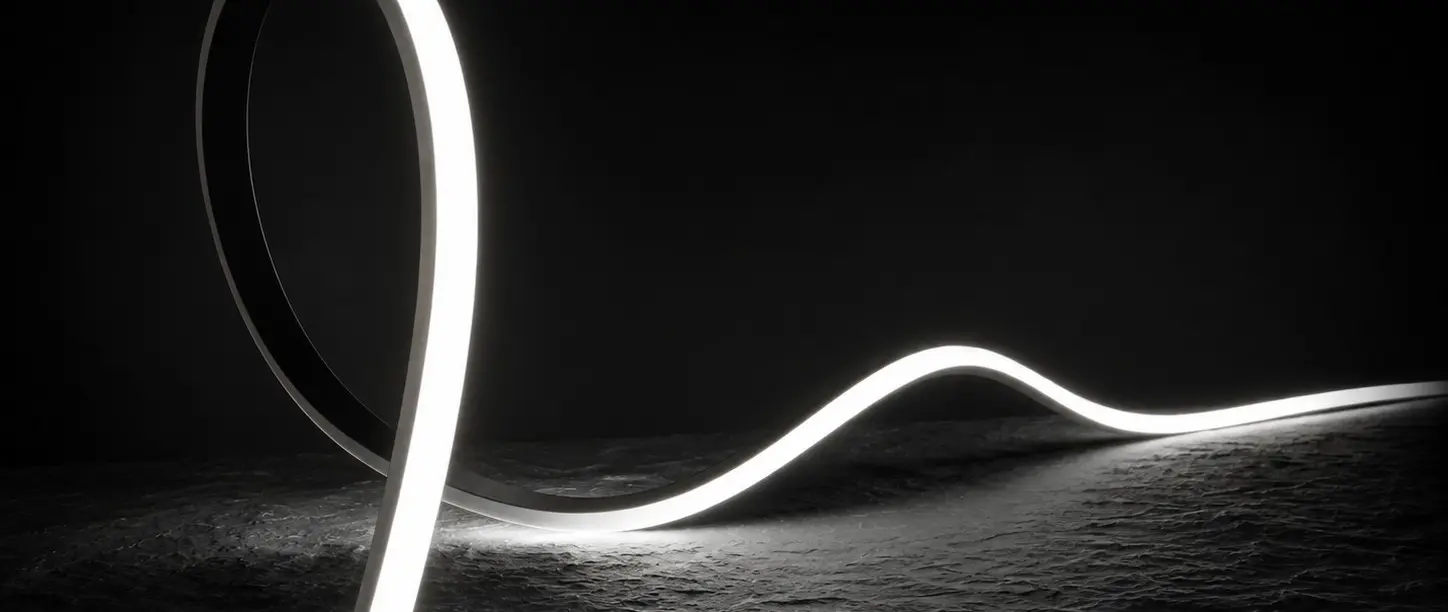
An award for lighting that follows yacht architecture
Dutch marine lighting supplier Totallux has received a Special Mention in the 2026 DAME Design Awards for its TLX 3D Flexline Series. Announced during the exhibition in Amsterdam, the distinction recognises a continuous LED lighting system conceived to accommodate curves in more than one direction. Totallux's catalogue identifies the product as having been released in January 2026, so the current development is the award rather than a completely new November launch.
The design is relevant to luxury yacht interiors because joinery and architectural surfaces frequently change direction along a single feature. Conventional linear lighting can work well on a flat or gently curved panel, but the relationship between the light source and the supporting material becomes more complicated when a surface also twists. Totallux proposes a way to handle that geometry with a single flexible lighting element. The award provides an opportunity to examine what that means for designers and installers working on yachts in the twelve-to-twenty-three-metre market.
Moving beyond a single bending plane
Totallux describes the Flexline as able to bend both horizontally and vertically and also to twist. In practical design terms, that distinguishes the product from linear lighting whose flexible circuit and protective housing are intended to deform primarily in one plane. A light line that follows the edge of a piece of furniture, for example, may encounter a vertical transition as that piece turns around a curved partition.
A designer working with constrained interior volume cannot necessarily choose the easiest possible path for a light fitting. The underlying structure, ceiling height, mechanical systems and access to equipment may determine the shape of the surrounding architecture. A more adaptable fitting can help preserve the intended geometry without introducing several separate lighting elements. Whether a particular path is achievable remains dependent on the product's minimum bending and twisting limits, which must be obtained from the technical documentation. The public award and exhibition information do not specify those limits.
What the segmented circuit contributes
The manufacturer identifies a segmented printed circuit board as an important part of the construction. A segmented arrangement can allow motion to be distributed between sections instead of forcing the entire assembly to respond as a single rigid element. In a flexible lighting product, the design challenge includes preserving electrical continuity and supporting the light-emitting components while the protective exterior changes shape.
Totallux says its construction improves resilience during installation and movement. The published announcement provides no comparative fatigue test, so that statement should be understood as the manufacturer's description of the design objective. The value for a yacht builder is principally the possibility of specifying a continuous feature around complex contours and avoiding some of the interruptions that may otherwise be required.
For a refit installer, the distinction between flexibility during fitting and flexibility during ordinary service is important. An installed lighting element may experience temperature cycling, vibration or minor movement of its supporting furniture. A system intended to be bent into shape does not necessarily have unlimited resistance to repeated mechanical movement. The appropriate mounting method and permitted service conditions should be confirmed before installation.
Accommodating tolerances without cutting the enclosure
Another specific claim in the exhibition catalogue is that the Flexline provides approximately one per cent elastic length adjustment. The manufacturer describes this as a means of accommodating small discrepancies between the intended channel length and the actual installation, without having to cut the product and disturb its factory seal.
For illustration, one per cent of a three-metre run is thirty millimetres. That is not an instruction to stretch every installation by that amount; it simply shows the scale of the adjustment described by the company. A designer should establish the permitted conditions, direction and amount of adjustment for the particular product version.
This capability addresses a real issue in bespoke joinery. Measurements taken before a curved panel is finished can change slightly after the panel is fitted, and small differences can be especially noticeable when a lighting line approaches a visible joint. Cutting and re-terminating an electrical lighting assembly may introduce additional labour and require specific sealing measures. Preserving the original enclosure could reduce that work where the installation is within the permitted tolerances. It does not remove the need to inspect terminations and adhere to the manufacturer's instructions.
Applying the idea to a saloon or accommodation area
Consider an interior in which a continuous lighting line is intended to follow the edge of curved cabinetry and continue towards a ceiling feature. A conventional approach might split the line into sections, with each section fitted to its own channel. That can be a satisfactory solution when the junctions are inconspicuous or when individual sections need to be independently controlled.
The proposed alternative is to follow the changing geometry with a continuous flexible unit. For a designer, this could reduce the number of visible transitions and support a more consistent visual relationship between the illuminated feature and the surrounding material. The relevant comparison is not merely how many bends a product can make, but whether the finished appearance is suitable when viewed from normal seated and standing positions.
In a compact saloon, a bright visible light source can be distracting at night. An indirect installation may be more comfortable, particularly when reflected light is distributed across several different surfaces. The geometry of the lighting channel, choice of finishes and ability to control brightness need to be assessed together. The Flexline's ability to follow a complex path is independent of whether a particular arrangement delivers comfortable or effective illumination.
Working with materials and colour
A modern luxury yacht may combine polished surfaces, matt timber, textiles, stone-effect materials and painted components in a relatively small area. Each surface responds differently to illumination. A glossy surface can reflect the light source sharply while an adjacent matt surface produces a more diffuse effect. An apparently uniform lighting element can therefore create very different visual results across the same room.
The installer should evaluate representative samples before committing to a detailed interior specification. Colour rendering, colour temperature, dimming performance and consistency across different runs of lighting all influence the outcome. These performance characteristics are not established by the fact that a lighting product can twist in three dimensions. The available configurations should be confirmed with Totallux for the particular project.
Owners undertaking significant interior work can benefit from discussing lighting during the early material-selection stage. A useful sample installation allows the owner to evaluate both daylight and evening appearance and permits the designer to establish the space required for mounting and maintenance.
Integrating the electrical installation
Flexible lighting remains an electrical system. A new installation must account for its power supply, control electronics, connection points, protection arrangements and accessibility. The voltage, permissible run lengths, dimming compatibility and operating environment are specific technical matters that should be checked against the product documentation.
The public exhibition listing does not establish a particular ingress-protection rating or approval for exterior exposure. A yacht builder should therefore not automatically specify the same unit for a wet exterior area and a dry accommodation space. A preserved factory seal may be useful, but it is not evidence that an assembly is suitable for every marine environment. Heat dissipation, exposure to cleaning products and the ability to remove the installation without damaging adjacent joinery may also affect the choice.
These considerations are particularly relevant in yachts that undergo successive interior upgrades. Owners should retain the electrical drawings and part numbers for installed lighting and know where power supplies and controllers can be accessed.
Judging the significance of the DAME recognition
The Special Mention is an independent design distinction, not a certificate of marine electrical installation suitability. The DAME listing highlights the multidirectional bending and segmented construction. It does not establish the lifetime of the product, the reliability of an individual installation or measured energy consumption compared with alternative systems.
For the luxury yacht sector, the interesting development is the attention being given to how lighting interfaces with the physical form of the interior. A successful installation requires the electrical product, joinery and optical design to work together. Flexibility can expand the range of practical solutions, especially where changing surfaces would otherwise require awkward junctions.
Totallux exhibited at stand 08.523 during METSTRADE. Designers can use the award as a starting point for a technical discussion with the supplier, including installation limits, available specifications and longer-term service arrangements. The distinction points to a specific contribution to yacht design rather than a general claim that a single lighting product can resolve every architectural or electrical challenge.
Sources and image
Primary source: Totallux official METSTRADE product listing. Award confirmed by the DAME Design Awards Special Mentions list. Lead image: Totallux B.V., official exhibitor product visual showing the flexible light line, supplied via the official exhibitor catalogue in the editorial context of the METSTRADE virtual press room. Copyright remains with the rights holder. Re-encoded for web display.