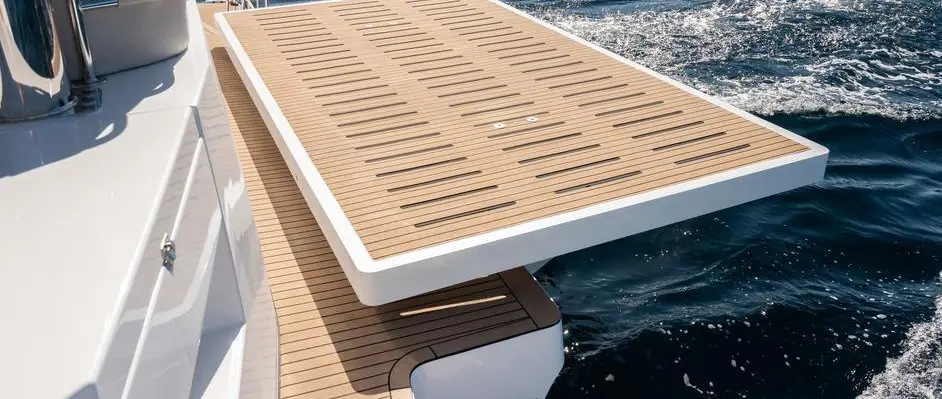
An update to the platform rather than a new yacht
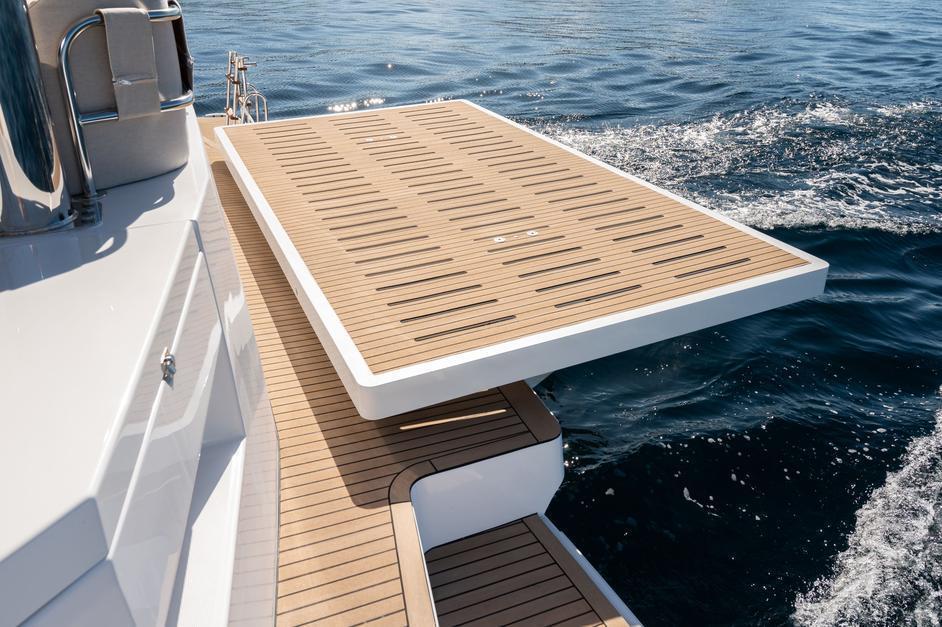
French marine-equipment specialist Tenderlift Group has updated its hydraulic-platform range with Vertical and Expand movement arrangements aimed at vessels with vertical aft boards. The company's METSTRADE 2026 exhibitor description explicitly identifies the expansion as a 2026 development, while its original general platform product listing has an older catalogue date. That distinction matters: the current story is the addition of new platform kinematics to an established line, not the invention of hydraulic tender lifting this November. For cruising catamarans and other luxury yachts in the 12-to-23.99-metre range, stern access and tender handling can affect far more than convenience. A platform may act as a boarding area, a low terrace beside the water or the mechanism through which a tender is safely moved between transport and use. The design must therefore balance comfort with loads, machinery access, drainage and safe operation. The manufacturer's description is a useful starting point, not a substitute for yacht-specific engineering approval.
Why the shape of the transom matters
A hydraulic platform has to work with the geometry of the hull on which it is installed. On a catamaran, the distance between the aft hull sections, the height of the stern steps and the relationship between the bridgedeck and water can vary substantially between models. A vertical aft board imposes different attachment and movement constraints from a sloping or stepped arrangement. Tenderlift says its 2026 Vertical and Expand variants were developed with that kind of vessel geometry in mind. The public product description does not give a universal set of installation dimensions, lifting capacities or details of every available motion path. Buyers should not infer that a named system can be bolted directly onto any yacht with a squared-off stern. A naval architect or qualified installation partner needs to assess structural loads, hydraulic routing, mounting points and clearances on the exact vessel before recommending a configuration.
Tender storage and living space can conflict
Owners often want a stern platform to serve two purposes. At sea, it may need to support the tender securely; at anchor, the same surface may be lowered to create an attractive bathing or waterside area. Those uses are not always compatible without careful planning. A tender takes up space and adds concentrated weight, while a leisure platform should ideally offer unobstructed movement, safe edges and convenient access from the cockpit. Tenderlift's established product description notes the ability of its platforms to act as cockpit extensions, additional decks and swimming surfaces. Each role creates a different operating condition. Designers should explain what the platform is permitted to carry, which positions are approved for passengers and whether the system may be operated with people or equipment aboard. A promotional image showing easy access to the water cannot by itself establish a manufacturer's safe working procedure.
Understanding movement without guessing at performance
The word kinematics refers to how a mechanism moves. In a hydraulic lift, the relative position of pivots, arms and cylinders determines the path that a platform follows. A different movement arrangement may allow a system to work where a conventional geometry would conflict with the hull or where a particular stern layout needs additional freedom of positioning. That is a useful design possibility for modern catamarans, especially those using full-beam aft steps or strongly vertical transom forms. However, the manufacturer has not supplied a complete engineering comparison in the concise METSTRADE entry. It would be inappropriate to claim that Vertical or Expand necessarily lifts faster, travels farther or uses less energy than earlier configurations. Those are questions to put to Tenderlift alongside loading charts, installation drawings and the duty cycle for the specific yacht.
Engineering for more than the tender's weight
A platform load is not defined by the tender's brochure weight alone. Its engine, fuel, batteries, equipment and any water retained in the hull may materially increase the mass handled by the lift. The centre of gravity and distribution of that mass also affect structural loading. Movement on a pitching boat and the forces involved when the platform reaches a stop create additional considerations. An engineer must check what loads reach the hull attachments, how they are distributed and whether the underlying structure requires reinforcement. The safest approach is to use an approved tender configuration and a clearly documented maximum load, rather than assuming that any craft of approximately the same length can be carried. Owners should be shown the manufacturer’s actual operating limits and should understand the difference between stationary storage, lifting and passenger use of the platform.
Hydraulics in a saltwater environment
Hydraulic equipment is well established in yacht engineering, but marine service brings particular challenges. Salt, moisture, vibration and periods of inactivity can affect exposed fittings and moving joints. Hoses and cylinder seals require inspection; control components should be accessible without dismantling large sections of furniture or deck. A properly designed system should also address how the platform is secured for a passage and what procedures apply if hydraulic pressure or electrical power is lost. Those provisions must come from the manufacturer and installer, not from improvised owner assumptions. When selecting a new platform, the yard should request an inspection schedule, fault information, authorised servicing procedures and details of the support network. A pleasant waterside feature becomes much less valuable when it is difficult to maintain or immobilises the tender during a cruise.
The importance of tender launching at anchor
Tender handling is often a daily routine rather than an occasional event. Guests may want a trip ashore, the crew may need to carry stores or divers may be using the tender between excursions. A well-planned platform can make that process orderly, but it does not remove the need for training and good conditions. The boat's propeller, platform mechanisms and adjacent hull structure create hazards if people enter the operating area without clear communication. Operators should account for changing swell, wind and tender movement. The location of control panels should allow the operator to observe the full movement of the lift. A suitable emergency-stop arrangement and unambiguous instructions can matter more than sophisticated styling. Designers should therefore view the platform as deck machinery with a leisure function, not simply as another piece of outdoor furniture.
Why catamaran owners might be interested
Many cruising catamarans in the LYG size range seek to create a continuous connection between the aft cockpit and the sea. A movable platform can change the usable relationship between these spaces, particularly when the vessel is at rest. It may also give owners a method of transporting a tender without permanently occupying cockpit seating. Tenderlift's catalogue says its hydraulic platforms have been fitted to more than 2,000 catamarans, a manufacturer-reported figure illustrating the scale of its experience. That claim should not be treated as an independent assessment of every installation. Owners should ask how a proposed Vertical or Expand unit has been adapted to the design of their yacht, whether suitable reference installations exist and who will be responsible for the final acceptance test. Their own transom shape and cruising programme are more important than a headline installation count.
A careful refit is different from a new build
On a new yacht, the platform can be considered alongside hull structure, machinery arrangements and the tender specification from the beginning. A refit presents more constraints. The existing transom may not have been designed to accept concentrated hydraulic-platform loads, and there may be limited space for hoses, power equipment and supporting structure. The additional weight can influence trim and available payload. If a yacht already carries its tender on davits, the change may also affect deck operations and sightlines from the helm. A refit feasibility study should examine the structural design, stability implications and the practical route for servicing the equipment. Owners need a quotation that includes all engineering, finishing and testing work, not only the published price of the lift. A complete installation is more important than whether a catalogue photograph looks compatible with the boat.
Making the bathing area safe and useful
When a platform is lowered near the water, its usefulness depends on more than the ability to move. Surfaces need appropriate grip, edges and access should be understandable, and the operator must know which positions are suitable for boarding or swimming. Nearby propellers, hull openings and mechanical parts have to be considered. Conditions can change quickly even in a sheltered anchorage, so any operational guidance should define when the platform must be stowed. Children and less mobile passengers may require particular assistance. A crew briefing should make clear that the equipment is not an amusement ride and that movement should take place only under the prescribed procedures. These are fundamental seamanship issues, and no change in hydraulic kinematics removes them. The yacht's owner may enjoy a more attractive deck experience, but safe operation is what makes that experience repeatable.
Questions for a builder or equipment supplier
A buyer considering Tenderlift's updated range can ask which yacht models have been assessed for the new movement systems and what documentation is provided for integration. The request should include structural interface drawings, permitted loads, platform dimensions, electrical and hydraulic demands, emergency arrangements and maintenance access. It is also worth clarifying the warranty boundary between the lift supplier and the boatbuilder. If a problem arises in service, owners should know whether the hydraulic mechanism, mounting structure or control electronics fall under different responsibilities. The supplier should state how spare parts can be obtained internationally and what training the operator requires. A useful specification is one that answers these questions before an expensive stern structure is modified, not one that leaves the details until the vessel is nearly ready to sail.
What the 2026 addition signifies
Tenderlift's description of its new Vertical and Expand kinematics suggests continued adaptation of established tender-lift technology to changing yacht architecture. Catamarans and other luxury craft increasingly combine stern leisure areas with practical tender storage, creating packaging problems that cannot be solved by a single generic mechanism. The company has identified vertical aft boards as a particular design case and has added movement options accordingly. The current public source supports that development and its intended application, but not unsupported claims about universal compatibility, lifting speed or financial savings. The next step is for builders and owners to match the revised equipment to actual vessels, document the engineering and demonstrate safe daily use. For readers choosing a 12-to-23.99-metre yacht, the lesson is that a stern platform's quality is revealed not only in how it looks at anchor, but also in how it is specified, maintained and operated through years of cruising.
Sources and image credits
Reporting based on Tenderlift Group official METSTRADE 2026 catalogue describing Vertical and Expand hydraulic-platform configurations.
Lead photograph: Tenderlift Adds Vertical and Expand Platforms for Luxury Cruising Catamarans — original manufacturer photograph. © Tenderlift Group Original official image source.