A compact climate-control option in the current marine catalogue
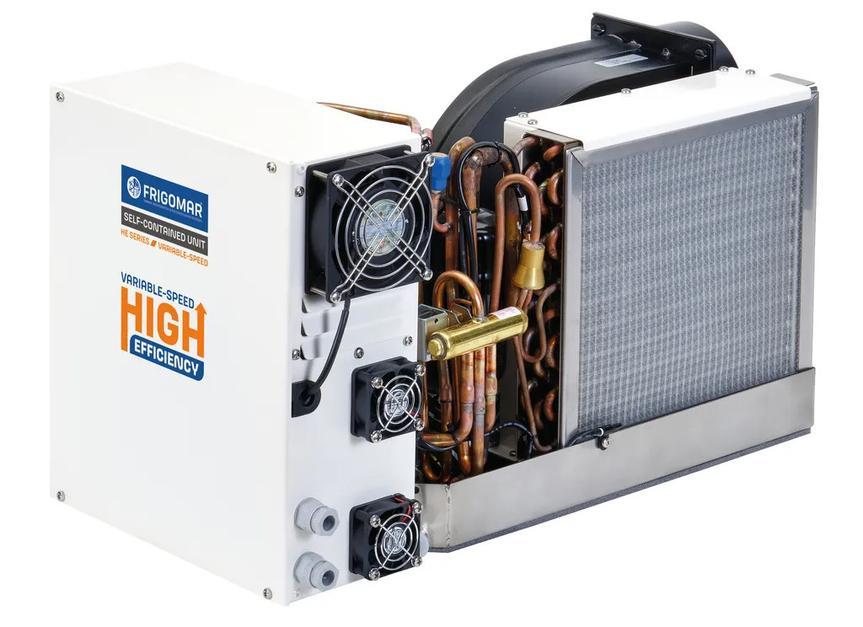
Italian marine climate-control supplier Frigomar has listed its SCU HE DC series among the equipment presented through its METSTRADE catalogue. The manufacturer describes a new high-performance, self-contained range built around brushless direct-current inverter technology, with versions for 12-, 24- and 48-volt systems. In a yacht market increasingly interested in battery-powered domestic services, this range deserves examination because air conditioning is often one of the major electrical loads when the vessel is at anchor. The official catalogue description confirms the voltage options and the inverter-BLDC concept, but does not provide a complete set of model-by-model cooling outputs, independent efficiency measurements or an installation on a named yacht. For owners of luxury vessels between 12 and 23.99 metres, the relevant news is that the supplier is offering another route to climate-control integration, not that every boat can now cool its cabins for a particular number of hours without a generator.
What self-contained means in practice
A self-contained air-conditioning unit typically brings several components of a cooling system into one package rather than distributing them around the vessel as part of a central plant. Such an arrangement can appeal to boatbuilders where cabin layouts and equipment compartments are tightly constrained. It may also reduce some of the installation work compared with a system relying on a larger central chiller and multiple secondary circuits, although this depends on the exact design. Frigomar identifies the SCU HE DC products as self-contained inverter BLDC units. Buyers should ask for the actual piping, ventilation, electrical and seawater connection requirements, because 'self-contained' should not be interpreted as completely independent of the boat. It must still reject heat somewhere, draw electrical power and provide appropriate access for filters, drains and servicing. A responsible specification starts with the manufacturer's diagrams for the selected unit rather than assumptions carried over from a different air-conditioning brand.
Why the three voltage options are notable
Marine electrical installations commonly include 12- and 24-volt direct-current services, while some builders are moving toward 48-volt architectures for larger domestic loads. The availability of different electrical versions can make it easier to consider a cooling installation alongside the rest of the energy system. However, a product offered in several voltages should not be assumed to have identical currents, cable sizes or performance at each rating. A 12-volt installation delivering substantial cooling power can require high current, making conductor sizing, protection and cable length especially important. Higher-voltage alternatives may change those design constraints but introduce their own equipment and integration requirements. Before choosing the unit, the naval architect and electrical engineer should decide how it fits with chargers, batteries, inverter arrangements and other hotel loads. The voltage printed on the product listing is only the beginning of that design discussion.
Brushless inverter technology and operating conditions
The manufacturer's reference to inverter BLDC technology indicates an electronically controlled brushless motor approach rather than a simple fixed-speed compressor drive. Variable or controlled operation can offer benefits when cooling demand changes, but the size of any saving depends on the equipment design and the environment in which it operates. A cabin starting at high temperature on a sunny afternoon may demand much more cooling than one maintained at a stable temperature overnight. A yacht's insulation, glazing, shading, number of occupants and ventilation all affect the result. Frigomar's short listing does not provide an independently verified comparison with an older fixed-speed installation, so no precise percentage reduction should be claimed. A buyer should request laboratory performance curves, sound measurements and electrical consumption at different operating points. Those figures make it possible to compare equipment honestly, rather than assigning value to the word 'inverter' alone.
The cooling load begins with the yacht's architecture
Air-conditioning capacity is ultimately an architectural question as much as a machinery question. Large glazed saloons, exposed decks and cabins directly beneath the sun can gain heat rapidly. Poorly insulated partitions and frequent movement between indoor and outdoor areas add to the challenge. A yachtbuilder should calculate the expected loads for each zone using realistic climate assumptions and operating patterns. The owner may want a comfortable night in the Mediterranean without running the generator continuously, but that goal cannot be assessed until the actual heat load and the available stored energy are known. A system that is too small may run constantly and fail to maintain the desired temperature, while an oversized installation may be expensive, heavy or difficult to manage. The Frigomar range gives designers more component options, but it does not eliminate the need for a vessel-specific thermal analysis.
Battery capacity is not the same as overnight comfort
An air-conditioning unit advertised for direct-current operation may sound attractive to a yacht owner seeking quiet time at anchor. Yet battery endurance depends on the complete system: energy storage, the actual cooling load, compressor duty cycle, seawater pumps, ventilation fans and other domestic equipment all consume power. A simple calculation using nominal battery capacity can overstate practical endurance if it ignores reserve energy or losses. The manufacturer has not stated that its HE DC units provide a guaranteed overnight cooling period on a particular yacht. Owners should therefore ask for several operating scenarios, including the warmest expected nights and full guest occupancy. They should also understand how charging will occur the following day, whether through shore power, engine alternators, solar generation or another source. Cooling efficiency is valuable, but the yacht's total energy plan determines the guest experience.
Freshwater, seawater and drainage considerations
Marine climate control often depends on water circuits that are exposed to scale, biological growth and corrosion-related maintenance challenges. Depending on the exact unit, seawater pumping, heat exchange, condensate drainage and suitable pipe routing may all be required. The official catalogue page does not fully describe the SCU HE DC installation, so details should be confirmed in the relevant manual. The designer needs to ensure that drains cannot allow water to accumulate in furniture, that pumps are accessible and that service operations do not create avoidable flooding risks. The crew also needs procedures for checking strainers and identifying reduced flow. A unit that performs well when new may become inefficient or unreliable if water circuits are not maintained. These practical matters should be included in a complete equipment proposal, particularly for boats kept in warm marinas where growth and debris can affect inlets.
Quiet cabins depend on the whole installation
Comfort is not measured by temperature alone. Noise from compressors, pumps, airflow and vibrating panels can disturb guests, especially at night. A controlled-speed motor may help manage certain sources of noise, but it does not guarantee that the completed installation will be silent. Isolation mounts, duct layout, intake positions and furniture construction remain important. A self-contained unit positioned close to an occupied berth may demand additional acoustic treatment compared with equipment placed in a separate machinery space. Owners should request a meaningful noise specification and ask whether measurements were taken on the unit alone or in an installed yacht. The distinction matters because a laboratory rating cannot capture the sound of a poorly supported duct or a pump attached to an uninsulated bulkhead. Good climate control combines thermal performance with careful mechanical and architectural integration.
Refit suitability must be verified, not assumed
Many owners first consider a new DC air-conditioning product when an older yacht's cooling system becomes expensive to maintain. Retrofitting can be appealing if the replacement fits existing spaces and uses electrical equipment already aboard. In practice, the project may require changes to cables, protective switching, piping, ventilation, furniture and seawater connections. A higher-capacity battery or different charging arrangement may also be necessary. The important first step is a survey of the existing installation and a comparison with the current manual for the exact Frigomar model. A supplier should establish whether the existing through-hull arrangements, power distribution and drainage can safely support the replacement. Owners should not approve a conversion on the basis of voltage compatibility alone. A realistic budget includes removal, installation, commissioning, testing and any changes needed to meet the vessel's applicable requirements.
Service access matters for long-term ownership
Air-conditioning equipment typically requires attention after it has been installed, even if an operator rarely sees it while the yacht is in use. Filters, electrical connections, condensate routes, water circuits and other service points should remain accessible. Poor placement can turn a routine inspection into an expensive interior dismantling exercise. The chosen installation should also provide enough room for tools and replacement components without forcing a technician to work in an unsafe position. Owners planning long cruises should establish where qualified service is available and whether necessary parts can be obtained outside the home port. A new catalogue listing may describe the technology, but it is the supplier and installer's long-term support arrangements that make the system practical. In a 12-to-23.99-metre yacht, where machinery spaces compete with accommodation, these considerations are particularly significant.
Comparing a self-contained unit with a central plant
A yacht may be able to use several small units, one larger central cooling plant or a combination of arrangements. The best choice depends on cabin count, acoustic goals, maintenance access, available electrical power and whether different areas need independent control. Self-contained units can simplify some aspects of zoning and installation, but they may also create more distributed service points. A central plant can concentrate machinery and use secondary distribution circuits, with different benefits and costs. The SCU HE DC range should be evaluated within this wider set of alternatives, not treated as an automatic improvement over every existing layout. A useful comparison records equipment mass, installed cost, energy consumption, service access and guest comfort under a defined test scenario. A builder should be able to explain why one architecture has been selected for the specific boat.
The next evidence to seek
Frigomar's current METSTRADE product entry establishes that its new HE DC self-contained series is offered in 12-, 24- and 48-volt configurations and uses inverter BLDC technology. It does not, by itself, establish a particular reduction in energy bills, an exact installed cabin noise level or the endurance of a named vessel. Those are outcomes for detailed engineering and sea trials to demonstrate. The range deserves attention because it addresses a real design problem: how to provide reliable climate control in luxury yacht accommodation while managing electricity, noise and limited machinery space. Future evaluation should focus on full model specifications, compatible control systems, installation experience and measured performance. For owners and builders, the responsible purchasing decision is the one that matches the cooling duty, available power and maintenance plan rather than the most persuasive product label.
Sources and image credits
Reporting based on Frigomar original METSTRADE catalogue specification for SCU HE DC self-contained inverter air-conditioning units.
Lead photograph: Frigomar Shows SCU HE DC Climate Units for 12V, 24V and 48V Yacht Systems — original manufacturer photograph. © Frigomar S.r.l. Original official image source.