Brand ID presents combined cushioning and lighting
Finnish marine-surface supplier Brand ID is presenting Smartdeck EDGE LED, a protective padded profile with integrated LED lighting, in the METSTRADE 2026 trade programme. The company’s own product page describes a solution designed to follow the upper inner edges of a boat, where passengers may lean or rest against the structure. It combines cushioning, impact protection and discreet downward-facing light in one custom-shaped element. The presentation is associated with the Amsterdam exhibition held 17–19 November, but the manufacturer published its concept earlier in September. That distinction matters: the November news is the trade-show introduction and availability discussion, not a claim that the technology was conceived overnight.
An ordinary deck edge can serve two purposes
On many cruising yachts, the inside of the bulwark, cockpit coaming or hard boarding edge is a place people touch frequently. Guests may steady themselves against it when standing up, moving towards a gate or waiting for a tender to come alongside. A softer surface at an appropriate height can make that contact more comfortable and reduce the risk of scuffing certain equipment. Lighting those same areas after dark can also help passengers see where the deck ends. Smartdeck EDGE LED combines the two functions, although the benefit to an individual yacht depends on how and where it is installed rather than simply on the presence of a soft illuminated strip.
The official manufacturer's design approach
Brand ID says it developed EDGE LED for boatbuilders, with the shape, dimensions, colour and light arrangement adapted to the geometry of each application. It is therefore not necessarily a single universal profile that every owner can buy by the metre and attach to any yacht. An original equipment manufacturer can specify the component while a model is being engineered, coordinating its support structure and wiring with the rest of the boat. For owners contemplating a refit, it would be important to confirm whether the same level of customisation and service is offered, and whether the existing surfaces have adequate space and suitable mounting points.
Downward light can help without becoming decorative glare
The product's integrated LEDs are described as downward-facing to illuminate nearby deck surfaces rather than shining into passengers' eyes. This is a sensible objective for a yacht used after sunset, especially around access routes where bright light may be uncomfortable. However, the angle of the LEDs is only one factor in determining glare. Highly polished deck finishes, stainless fittings and glass doors can produce unwanted reflections. A lighting designer should verify the actual result from seated and standing positions, including the helm where external visibility matters. An illuminated edge may improve local orientation, but it does not replace the vessel's certified navigation lights or required emergency lighting.
Where an integrated profile may fit a luxury yacht
A 12-to-23.99-metre motor yacht might have an exposed aft cockpit, a side-deck boarding gate or a low bulwark near a seating area where cushioning and orientation lighting would be helpful. A sailing yacht could present different requirements because of sheet leads, winches, lifelines and the movement of people under sail. The product should never be placed where it interferes with running rigging, drainage or the safe operation of deck fittings. Its most appropriate location may be limited to a protected seating or access zone. A good installation begins with a drawing of the vessel's circulation routes and known contact points rather than a desire to illuminate every edge.
A demonstration image is not a universal installation proof
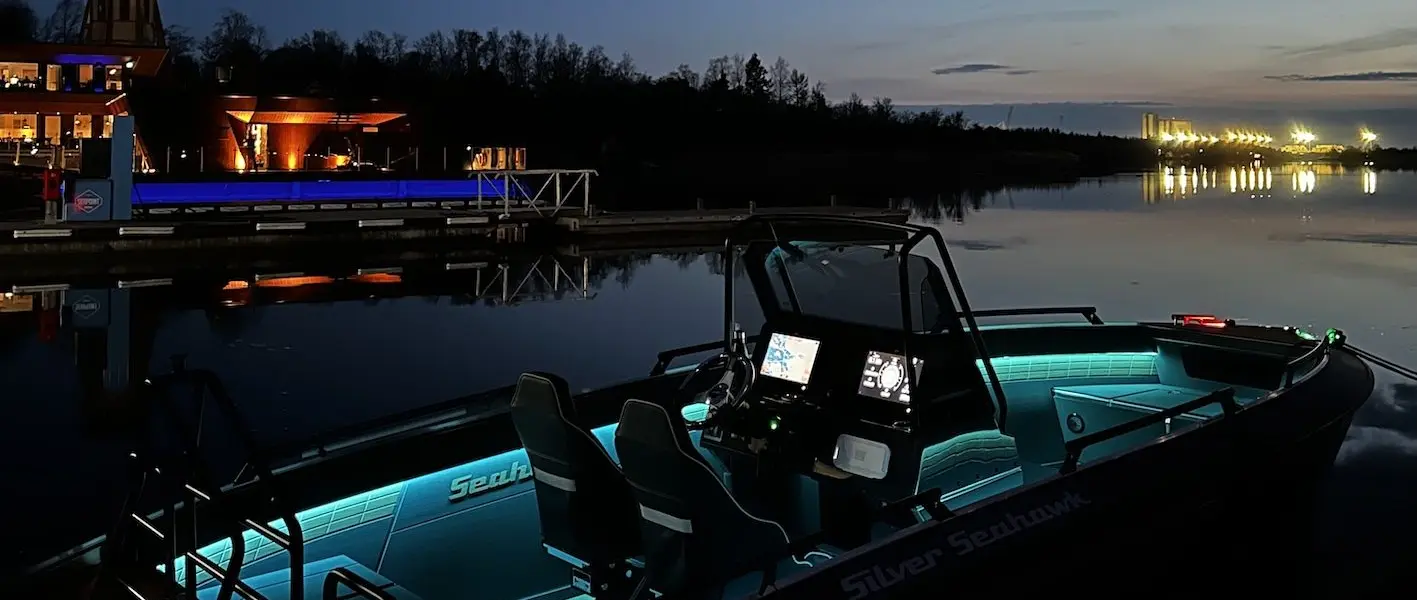
The manufacturer illustrates Smartdeck EDGE LED installed on a Silver Seahawk boat at dusk. This is useful first-party evidence of the concept's appearance and lighting direction in an actual marine setting. The demonstration craft is not presented as a 20-metre luxury yacht, and the image does not show how the profile would behave along every type of bulwark or superstructure. For Luxury Yacht Guide readers, the photograph should be understood as a maker's example of the component. A refit decision still requires a physical sample or mock-up on the yacht concerned, with its true dimensions and environmental exposure assessed.
Cushioning and impact protection require realistic limits
A padded profile can reduce discomfort when someone leans against a hard surface and may protect against light routine contact. It cannot be assumed to make a dangerous collision harmless or to replace a properly engineered fender system. The manufacturer describes protective cushioning, but its general page does not present a complete energy-absorption test schedule for all possible thicknesses and installations. Owners should distinguish a comfort element from protection designed to withstand a tender striking a yacht or a heavily loaded mooring line. If a proposed application involves dynamic impact, the builder or a competent engineer should establish the expected force and select appropriate structural protection.
The electrical design matters as much as the foam
Integrated lighting adds wiring, connections and control hardware to what would otherwise be a passive protective surface. A shipyard needs to know the specified supply voltage, current draw, circuit protection, suitable cable route and method of replacing a failed LED element. A cosmetic installation that cannot be opened for service could become expensive to maintain after only a few seasons. Brand ID's exhibitor information mentions a single power cable leading to a controller and says serviceable LED components can be incorporated during original construction or added later. Those are useful design claims, but exact installation procedures and compatibility still need confirmation for the selected variant.
App control creates convenience and a fallback question
Finnboat's presentation of the product describes app-controlled colours that can be adjusted for atmosphere or to complement the boatbuilder's design. Such customisation can be enjoyable around a cockpit or evening dining area. Yet a yacht should not require a particular smartphone, cloud account or working wireless link for passengers to obtain useful basic illumination. Owners should ask whether local switching is possible, how the system behaves after a power interruption and whether control settings can be restored without extensive troubleshooting. If a profile is expected to improve access safety, dependable operation must come before elaborate colour effects.
Colour should be chosen for use, not merely spectacle
A yacht with subtle deck lighting can feel comfortable and spacious at night, but strong saturated colours or constantly changing patterns may be distracting. The illumination should help crew identify walking surfaces, steps and boarding routes without confusing other vessels about the yacht's position or lights. Exterior decorative lighting may be subject to restrictions in particular operating circumstances and should never interfere with mandatory navigation signals. The best scene for entertaining at anchor may be different from one used when boarding guests in a marina. A sensible specification includes dimmable settings, clear controls and consideration of the yacht's normal nighttime operating procedures.
Materials must suit a demanding marine environment
The wider Smartdeck range uses closed-cell polyethylene foam, according to Finnboat's description of Brand ID's product family. The manufacturer presents it as resistant to water and ultraviolet exposure, with a variety of colours and patterns available. However, the exact composition and performance of the EDGE LED assembly should be verified separately from general decking specifications. The integrated lighting, adhesives, seals and cable entries may have their own environmental limits. Owners should request information on exposure to saltwater, cleaning agents, sunscreen, temperature and repeated physical pressure. The ability to rinse and inspect a profile without damaging its electrical components is an important practical criterion.
Retrofitting around existing yacht equipment
An existing yacht may have grab rails, cleats, covers, lockers or tender fittings installed near the very edge a designer wants to protect. A new padded strip should be fitted only after checking access to those systems. It may also need carefully planned termination points so that passengers cannot trip on or catch clothing against a loose end. For a wiring retrofit, the yard should avoid unnecessary penetrations in a weather-exposed deck structure. Where holes are unavoidable, correct sealing and cable management become part of the job. The installed element should permit future repairs without requiring extensive dismantling of adjacent expensive surfaces.
Why the original-equipment focus matters
Brand ID describes EDGE LED as intended particularly for boatbuilder integration. That approach can reduce the compromises involved in trying to fit an afterthought into a finished yacht. A builder can make the design fit its chosen mouldings and place cable conduits before the interior is closed. It can also define a consistent appearance across an entire model range. Owners ordering a new yacht could raise the concept during the options and technical-specification stage, then request confirmation of which components are standard, which are custom and which can be replaced years later. A builder's adoption of a new surface is not proof that it has been independently tested in every yacht configuration.
Maintenance and replacement should be considered early
A profile near a boarding route may experience frequent contact from shoes, bags, ropes and cleaning equipment. Its surface could become worn or dirty well before the LEDs themselves fail. Conversely, a sound outer covering may need to be opened to replace a light or connector. The owner should therefore understand how the two functions are serviced independently. A clear product schedule, identified spare parts and access to the original drawings can limit disruption when the yacht is away from its home yard. Crew can include the profile in a normal deck inspection, checking adhesion, seams, lighting operation and areas where water may accumulate.
The role of comfort on smaller luxury yachts
Mid-size luxury yachts are often required to serve family cruising, swimming, guest entertaining and occasional professional crewing within a relatively compact footprint. The same edge may be encountered dozens of times during a busy day. Improving tactile comfort and providing restrained low-level illumination could enhance that experience without adding a bulky separate railing or visible downlight. But an integrated component should not reduce the clear width of a walkway or discourage owners from fitting a properly designed handhold. Physical protection, safe footing and adequate rail height remain essential. A soft edge can complement good deck design; it cannot correct fundamentally unsafe geometry.
What the November 2026 announcement actually verifies
The company and Finnish industry federation confirm that Smartdeck EDGE LED joins protective marine edging with app-controlled, downward-facing lighting and is being promoted at METSTRADE 2026. Brand ID's detailed page describes OEM-focused customisation and shows the component on a Silver Seahawk demonstration craft. The listing does not supply an independently verified glare reduction figure, a fixed price applicable to every yacht or published installations aboard named vessels in Luxury Yacht Guide's size range. These are boundaries of the available evidence, not criticisms of the product. Owners evaluating the concept should obtain project-specific drawings, electrical specifications, sample material and servicing arrangements.
A focused question for yacht designers
Smartdeck EDGE LED illustrates a wider design direction in which several small onboard functions are combined into a single carefully placed component. Its potential attraction is the reduction of visible clutter around social and access areas while adding comfort and controlled light. A useful design brief would ask exactly which edge needs protection, how people move around it, how much light is necessary and what happens when either the cushioning or the LEDs require replacement. The verified manufacturer information is a good starting point. Whether this becomes a compelling feature of a 12–23.99-metre yacht will depend on real installation quality and crew feedback rather than on exhibition attention alone.
Source and image: Primary product data: https://www.brandid.fi/marine/smartdeck_edge_led/. Photo: Brand ID official product photograph of the Silver Seahawk demonstration craft showing EDGE LED at dusk; not portrayed as a 12–23.99m yacht. Original media URL: https://www.brandid.fi/wp-content/uploads/2026/09/IMG_4987.pienikokoJPG.jpg.