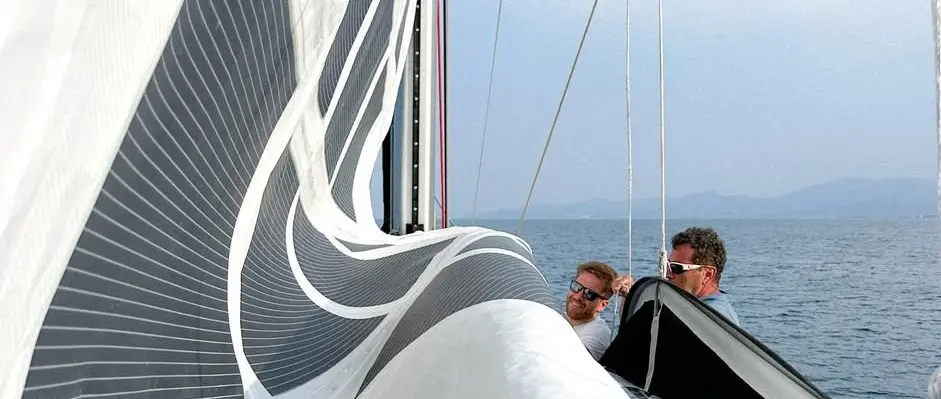
Photovoltaics move from deck panels into the sail itself
OneSails International has placed HeOne in its METSTRADE 2026 catalogue, describing a marine sail construction that incorporates organic photovoltaic cells inside the sail membrane. The collaboration joins the sailmaker with HEOLE, a specialist in organic photovoltaics, and Flexon Composites for lamination expertise. The company lists the product as released in September 2026, so the November exhibition is a showcase rather than proof of a first launch this week. The significant development is the attempt to turn a large sail surface into a source of electrical power while keeping its primary aerodynamic and structural function intact. The available material does not establish independent energy yield or fleet-wide adoption.
Why putting solar material in a sail is technically difficult
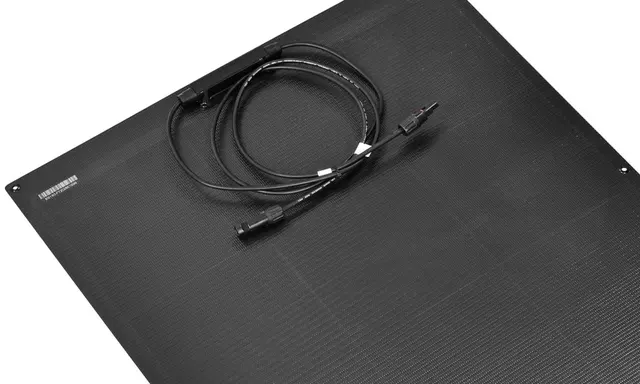
A sail is an unusually demanding platform for a photovoltaic device. It changes shape under aerodynamic load, flogs during manoeuvres, may be folded or rolled for storage and is exposed to ultraviolet light, seawater and abrasion. Conventional rigid solar modules have no obvious place on most sails because weight and stiffness would compromise their handling. HeOne instead uses organic photovoltaic material laminated within a composite membrane, according to the manufacturer's description. That design direction deserves attention, but potential owners should not assume that integrating the cells removes all of the mechanical, electrical and repair challenges associated with making electricity on a moving fabric structure.
The difference between embedded and attached solar
A panel attached to an existing sail adds layers, fixing points and potential snagging surfaces. A component incorporated into the membrane from the manufacturing stage can offer a cleaner structure and avoid some exposed attachments. The collaboration's description emphasises this integrated approach, contrasting it with earlier externally attached experiments. Yet integration brings its own questions: damaged cells may be difficult to replace independently, and electrical conductors have to survive repeated flexing. A sailmaker would need to account for power-collecting areas when designing loads and seams. The economic choice is different from simply buying a standard sail and later deciding to fit an accessory.
How much energy can a sailing yacht realistically obtain?
The prospect of producing electricity while sailing is attractive, particularly for a 12-to-23.99-metre bluewater yacht using navigation electronics, refrigeration and communications throughout a passage. But sail area is not equivalent to solar-module area, and the available sunlight changes with the sail's orientation, trim and shadows. The boat may be sailing under cloud, at night or with the relevant sail furled. The public HeOne listing does not supply a universally applicable hourly output, rated system voltage or independent voyage production record. The appropriate approach is to obtain the exact configuration's performance data and estimate the energy yield across a planned passage rather than multiplying nominal sail dimensions by a rooftop solar figure.
Energy storage remains essential
Electricity produced by a photovoltaic sail would still need suitable electrical conversion, protective devices, cabling and a storage or load-management strategy. A yacht's batteries cannot necessarily accept every charging source directly. Voltage regulation and equipment compatibility must be checked with the battery-management system and other charging equipment, especially where solar panels, hydrogenerators, alternators and shore chargers already operate together. If the solar sail is damaged or taken down, the yacht must also remain capable of meeting its essential electrical loads. This makes HeOne potentially one component of a broader renewable-energy installation, not a substitute for a carefully designed onboard power system.
Sail shape cannot be sacrificed for electricity
A performance cruising sail must retain its aerodynamic profile and required structural characteristics. Altering local flexibility or weight could affect how a sail twists, loads its rigging or reacts in changing wind conditions. HeOne's embedded approach may offer a route to integration, but independent comparative racing or cruising data have not been established by the brief exhibitor listing. A prospective customer should ask the sailmaker how the photovoltaic areas change laminate selection, cloth handling and the recommended trimming and reefing limits. Solar generation is a secondary benefit; the yacht still needs a sail that can be used safely in the conditions for which it is specified.
Reefing, furling and storage raise maintenance questions
Most long-distance sailing yachts alter sail area regularly to accommodate wind changes. An integrated photovoltaic circuit therefore has to tolerate the bending and pressure created by the chosen reefing or furling method. Storage is equally important, as folding or tightly rolling a membrane can introduce repeated stresses at seams and electrical interfaces. The source material does not provide universal guarantees for every sail configuration. Owners should obtain the manufacturer's method of folding, reefing, inspecting and washing the finished sail. They should also ask whether damage to a power-producing section affects only electricity generation or could compromise the sail's primary structural role.
Safety of electrical connections in the rig
Electrical generation on a moving rig requires reliable routing of conductors and connectors through an environment already crowded with halyards, sheets and attachment hardware. Conductors should not create snagging points or interfere with normal sail changes. Protection against abrasion, water ingress and strain is particularly important where a flexible membrane meets a comparatively rigid fitting. A competent yacht electrician and sailmaker must agree how the output reaches its controller and how the circuit is isolated for maintenance. A skipper should not be expected to troubleshoot improvised wiring at sea. A well-engineered installation needs documentation and clear fault procedures.
The value of a low-profile energy source
For yachts with limited roof space, solar generation often involves fitting modules over a bimini, hardtop or arch. Those installations can affect shading, aesthetics, windage and the routing of deck equipment. A sail-integrated system is interesting precisely because it explores another substantial surface already present during many passages. It does not eliminate the appeal of conventional panels: a roof module may generate electricity while the yacht is anchored with all sails stowed, whereas a sail system may be useful only in an appropriate deployed configuration. An owner may ultimately want both, with the charging strategy designed around when each source is genuinely available.
Repairability matters more than a demonstration photograph
A yacht sail can be repaired at a local loft when normal material is damaged. Adding photovoltaic cells and conductors may require different materials, testing or technical support that is not available at every cruising destination. Before ordering, an owner should establish whether a tear in the laminate can be repaired without compromising electrical insulation, whether replacement sections can be supplied and what happens if the sail needs recutting after several seasons. These questions have direct implications for a yacht undertaking an ocean passage. A show photograph is evidence of the manufacturer's concept, not a completed lifecycle evaluation of repairs in remote sailing areas.
A new supply chain for sailmakers and electrical specialists
The collaboration between OneSails, HEOLE and Flexon Composites illustrates how yacht equipment increasingly crosses traditional supplier boundaries. Sail designers understand aerodynamic loads and membrane construction; photovoltaic developers understand conversion materials; electrical engineers understand integration with a vessel's batteries and distribution systems. For a commercial product, each must agree responsibilities, testing standards, commissioning and warranty coverage. If a yacht has a problem with the power circuit, the owner should not have to negotiate indefinitely between the sail loft and an unrelated electronics installer. A coherent supply chain is as important as the material innovation itself.
Claims of sustainability need measured evidence
Renewable electricity can reduce the need to run a generator or propulsion engine solely for battery charging, but the scale of that benefit depends on actual energy output and the yacht's load profile. The environmental effects of manufacturing the embedded photovoltaic membrane, replacing damaged sections and disposing of the sail at end of life also belong in the assessment. The product's trade-show description does not supply a complete independently verified lifecycle analysis. It would therefore be misleading to advertise a universal fuel-saving percentage for HeOne or assume that every solar-producing sail is automatically an environmentally superior purchase. Operators should measure electrical production in service.
What an interested owner should request
A meaningful technical proposal should identify the sail model, expected operating conditions, photovoltaic area, output characteristics, electrical interfaces, protection devices and recommended maintenance. It should also specify the sail's structural performance, weight, reefing arrangements, service life assumptions and the extent of the warranty. If an existing yacht needs alterations to accommodate the charging equipment, those costs should be included in the project. A 15-metre cruising yacht may have very different requirements from a 23-metre performance sailing yacht. In each case the correct question is whether an integrated sail can improve the voyage's electrical balance without compromising sailhandling.
What is verified and what remains to be demonstrated
The manufacturer's first-party METSTRADE entry establishes the HeOne product name and the stated partnership of OneSails, HEOLE and Flexon Composites, including the integrated organic-photovoltaic membrane principle. It does not establish independently measured output, mass-market pricing, confirmed installations aboard named yachts or a fixed suitability for every rig. The accompanying original product media should be read as manufacturer publicity rather than a photograph of a verified specific owner's yacht. The project is a credible subject for 2026 yacht-technology reporting because it addresses a real design trade-off, but the engineering and performance evidence for any purchase must be supplied at the model and installation level.
The direction of luxury sailing design
HeOne points toward an emerging ambition to make the existing structures of a sailing yacht contribute to energy supply instead of adding separate devices wherever space permits. For owners of 12-to-23.99-metre sailing yachts, that can be an appealing prospect: electricity is needed continuously, while roof and deck area is scarce. The most useful conclusion is not that sails will replace solar arrays or engine charging immediately. It is that the partnership has described an integrated photovoltaic route worth evaluating through independent trials, realistic voyage energy budgets and careful sailing performance assessments. The November 2026 trade-show appearance gives buyers a reason to ask detailed questions rather than assume the challenge has already been solved.
Source and image: Primary product data: https://www.metstrade.com/exhibiting/superyacht-zone/onesails-international/products/heone. Photo: OneSails International's official HeOne product media in its METSTRADE 2026 listing. Original media URL: https://stpsprodwe.blob.core.windows.net/media-blobs/977b86a003f580aa7e40a1696f1fc61d.jpg.