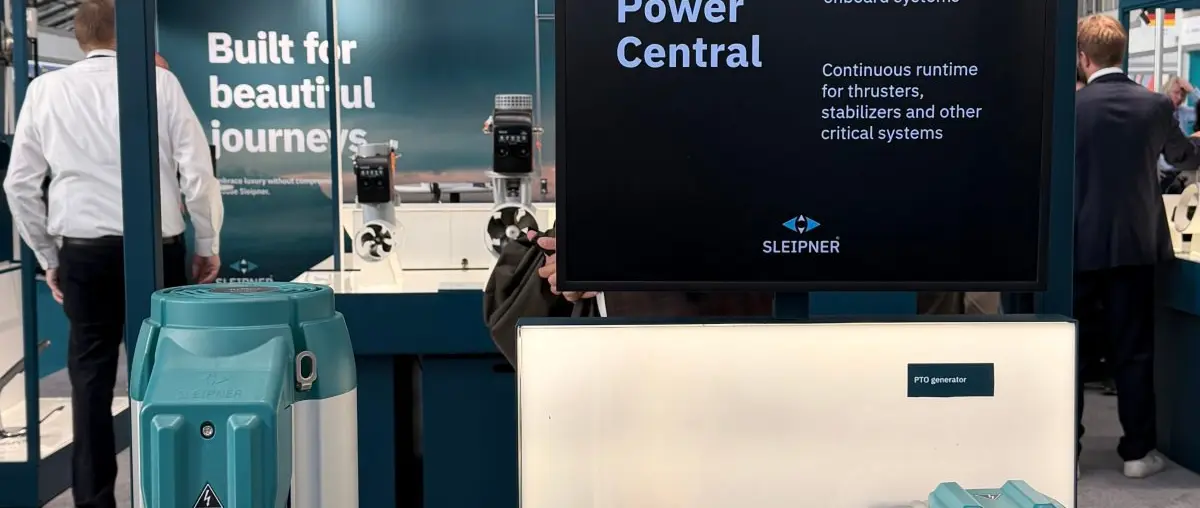
Rethinking the yacht's onboard electrical architecture
Sleipner is presenting its Hybrid Power Center as an integrated way to manage electrical demand on modern yachts. Instead of treating the main-engine power take-off, battery installation and equipment loads as separate islands, the Norwegian marine technology supplier describes a coordinated system bringing these elements together through intelligent control. Its official product explanation identifies PTO generation, battery power and dynamic load prioritisation as the three central functions. This is a systems announcement rather than a claim that a battery alone makes a yacht hybrid or that any particular vessel can automatically eliminate its generators.
The distinction is relevant to luxury motor yachts whose electrical consumption changes markedly during a day. Bow and stern thrusters create intense, relatively brief demands; hotel systems operate for many hours; air-conditioning compressors and galley equipment introduce additional peaks. A power architecture designed for one steady demand often handles those differences inefficiently. Sleipner argues that combining available engine-driven generation with stored electrical energy and intelligent distribution can reduce the need to run generators simply to make electricity when the yacht would otherwise be quiet.
The role of engine-driven PTO generation
When the yacht is cruising under its main engines, a power take-off arrangement can use available mechanical capacity to generate electricity. Sleipner states that its system can employ PTO generators delivering up to 25 kW each, allowing batteries to recharge while under way. The word 'up to' matters because output depends on the specific machinery, installation and operating conditions. The source does not demonstrate that every yacht can obtain this electrical capacity without constraints or that the arrangement is compatible with every main-engine and gearbox combination.
For builders, this is an opportunity to study the whole propulsion and hotel-energy picture. A PTO generator may reduce the reasons to start a separate genset during a passage, but engineers must still respect the main engine's permitted load and operating envelope. Coupling electrical generation to machinery also adds controls that must be documented and understood by the crew. The benefit is therefore not simply another source of power; it is the ability to coordinate when and how power is generated without compromising propulsion duties.
Battery power when the engines stop
At anchor, a conventional generator may run to support refrigeration, lighting, electronics, accommodation loads and numerous small appliances. Some of those demands are constant and some intermittent, making generator operation at a low fraction of rated capacity potentially unattractive. Sleipner's Hybrid Power Center is designed to support battery-powered operation during such periods, so that suitable onboard systems can continue without a generator running continuously. The manufacturer emphasises quiet anchoring and overnight comfort, with less engine noise and exhaust around guests using the exterior decks.
The achievable silent period depends on the battery bank, usable capacity, ambient temperature and load profile. Sleipner expressly identifies the battery bank as outside the components it supplies as part of the Hybrid Power Center package, while stating that the controller is designed to integrate with large lithium iron phosphate systems. Owners should not confuse the availability of battery operation with a guaranteed number of hours of silence. That figure needs an energy budget prepared for the actual yacht and the habits of its passengers and crew.
How load prioritisation changes the discussion
Electrical systems must do more than deliver sufficient total energy. They must handle sudden peaks without allowing important equipment to lose power. Sleipner's intelligent load-management concept distributes electricity dynamically and prioritises critical demands when consumption rises. The manufacturer associates this with reduced reliance on oversized generators and better utilisation of available energy. For a builder, the underlying question becomes which loads can be delayed or curtailed temporarily, which must be sustained and how those rules are communicated to the person on watch.
There is a substantial difference between automatically shedding a comfort load for a brief period and interrupting a system that contributes to vessel safety. A commissioning schedule should list every controlled circuit, determine its priority and test the expected responses to abnormal demand. Where the yacht has multiple modes, the bridge and engineering controls should make the active mode unmistakable. A sophisticated power controller is useful only if its decisions are predictable, documented and recoverable when something fails.
The attraction of a 48-volt ecosystem
The official Sleipner explanation describes Hybrid Power Center as a future-ready 48V architecture intended to integrate with compatible Sleipner thrusters and stabilisers. For some yachts, a common DC electrical platform can simplify the relationship between energy storage and electrically driven equipment. It may also reduce dependence on a separate hydraulic system installed only to serve short-duration high-power applications. Yet voltage alone is not a complete engineering specification; cable sizing, fault-current protection, isolation, thermal management and approved interfaces remain essential.
A practical installation may still include several voltage levels for other equipment. AC shore power, existing generator circuits, navigation electronics and low-voltage service loads do not disappear because part of the yacht uses 48V. The merit of integration lies in how those systems are joined and controlled. Designers should study the documented boundaries between the Sleipner-supplied controller and switches and the battery, charging interfaces and third-party loads for which other suppliers remain responsible.
Thrusters and the short-duration power problem
Thrusters represent a special challenge because they require substantial power for periods that can be short but operationally critical. Sleipner points to long-runtime DC thrusters and station-keeping applications as areas supported by its Hybrid Power Center concept. In a crowded harbour, a skipper expects control inputs to be followed without unexpected hesitation, while the engineering system must protect batteries, motors and cables against overload. That balance is not achieved by a marketing description; it requires correct matching of equipment, controls and energy capacity.
An owner considering the system should ask for the permitted thruster duty cycle at anticipated temperatures and battery state of charge. The crew also needs to know what happens if another large electrical load starts during close-quarters manoeuvring. A well-designed power priority scheme can help manage these demands, but its limits must be demonstrated. Any station-keeping feature should likewise be evaluated as a specific integrated function, not assumed from the mere presence of a high-capacity battery bank.
Hotel comfort and real operating schedules
Yacht owners may evaluate power systems through the lived experience of guests rather than the electrical diagram. Quiet evenings at anchor, reduced exhaust exposure near swimming platforms and fewer generator starts can improve how a vessel feels to use. Sleipner identifies these benefits as objectives of the Hybrid Power Center. Their importance differs according to a yacht's normal programme: a yacht spending most nights in marinas will have different priorities from one anchoring regularly in warm-water destinations with heavy air-conditioning demand.
The owner and captain should therefore define a typical 24-hour pattern, covering passage, harbour arrival, anchoring, overnight occupation and morning departure. Record the likely hotel loads in each phase and identify the short peaks that affect the required inverter and switchgear capacity. With those assumptions, the engineer can assess how much energy must be stored and when it can realistically be replenished. The aim is a comfortable operating plan that survives an ordinary demanding day, not merely an idealised demonstration.
Installation boundaries for builders and refit yards
Sleipner's public description lists PTO generators, a Hybrid Power Center controller, intelligent power and load switches, user interfaces and compatibility with its 48V thrusters and stabilisers within its scope. It separately identifies batteries and non-Sleipner loads as outside that supplied package. This division is especially important during the design and contracting process. Without a clearly assigned systems integrator, separate components can appear compatible on paper while leaving gaps in responsibility for alarms, testing, cooling or warranty.
For a new-build yacht, the architecture can be incorporated before machinery spaces and cable routes are fixed. A refit may be more difficult, because existing batteries, generator controls, engine couplings and space reservations impose constraints. Owners should seek a complete integration study covering mechanical installation, electrical protection, software interfaces, training and future service access. The amount of disruption involved may determine whether a refit is commercially sensible even when the technical advantages are attractive.
Maintenance, software and crew training
Sleipner highlights firmware-based diagnostics and updates as features supporting installers and service teams. That opens possibilities for more consistent fault identification, but it also places greater importance on version records and change management. A yacht operating for several seasons may accumulate software updates across its bridge, propulsion and energy-management systems. Without documentation, the engineering team can find it difficult to establish whether an unexpected behaviour originates from a component fault, a configuration change or a mismatch in interfaces.
Before delivery, crew training should include manual recovery procedures and a clear description of what the controller will do when capacity falls below a configured threshold. The service plan should identify approved personnel and spare components, record the current settings and describe how the system responds to a failed sensor or communications link. A system intended to simplify onboard power must remain understandable to the people responsible for the yacht away from the building yard.
Evaluating efficiency claims without false certainty
Sleipner presents lower generator hours, improved power quality and more efficient operation among the potential gains. Its description also refers to cleaner electrical power with low total harmonic distortion, an important subject where sensitive electronics share a system with powerful motors and inverters. These are legitimate design objectives, but the public product page does not provide an independent, model-by-model audit of lifetime fuel savings. Every owner's projected benefit should be calculated from the real load schedule, generation efficiency and battery losses of the intended yacht.
The full economic case includes installation, replacement of batteries over time, maintenance, software support and the value that the owner personally places on silent operation. More generator hours saved does not always translate proportionately into fuel savings, and environmental claims should use transparent assumptions. Owners should ask for measured case studies when available and distinguish predicted results from verified experience aboard a comparable vessel.
Where Hybrid Power Center fits in modern yacht design
The product illustrates a wider shift from equipping boats with separate electrical accessories toward making energy flow a deliberate part of the yacht's architecture. The significant idea is coordination: generating when propulsion is already operating, storing energy for quieter periods and protecting priority systems when demand spikes. That is relevant to designers of motor yachts and larger cruising yachts that must balance guest comfort against limited machinery-space volume, weight and service complexity.
Sleipner's 2026 information provides enough detail to identify the system's components and intended operating modes, but not enough to replace a project-specific electrical design. The correct next questions concern compatible engines, proven battery combinations, documented power-quality limits and crew procedures. For owners considering a new yacht or major refit, Hybrid Power Center should be treated as a candidate architecture to test against a disciplined energy model. Its success would be measured in dependable everyday operation, not in the number of separate devices connected to a common controller.
Sources and image credits
Reporting based on Sleipner Group official Hybrid Power Center engineering and product description, Sleipner Group official 2026 METSTRADE supplier product catalogue and integration context.
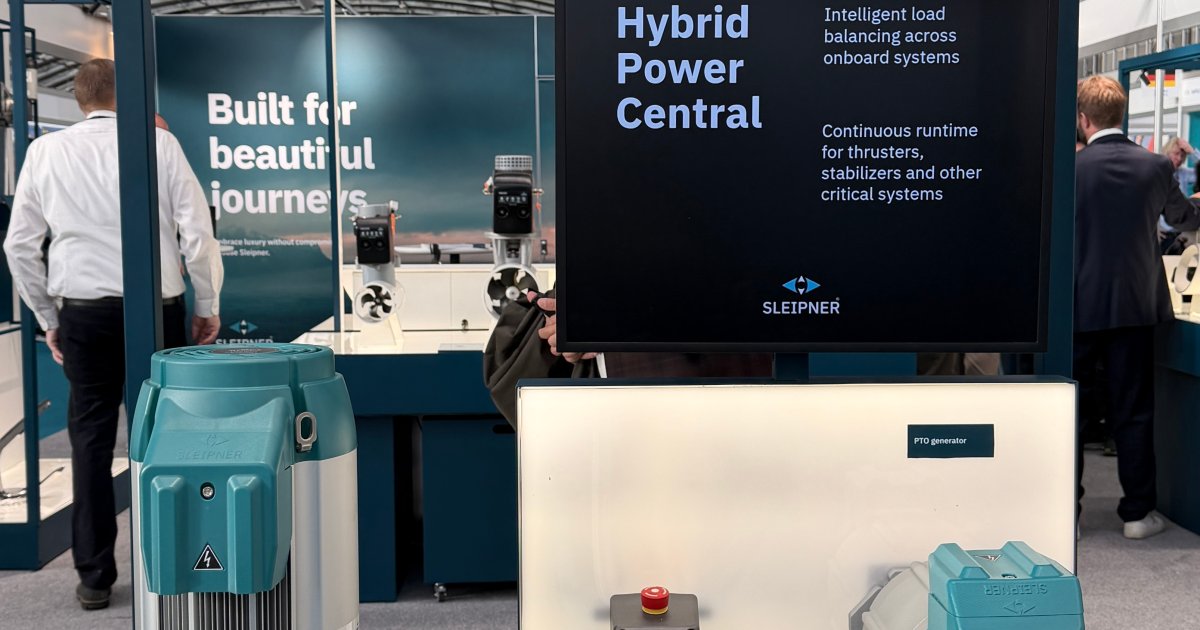
Lead photograph: Sleipner Hybrid Power Center first-party manufacturer display. Sleipner Group official Hybrid Power Center presentation photograph, sourced from the first-party product page. Original official image source.