A different story from the bearing-service announcement
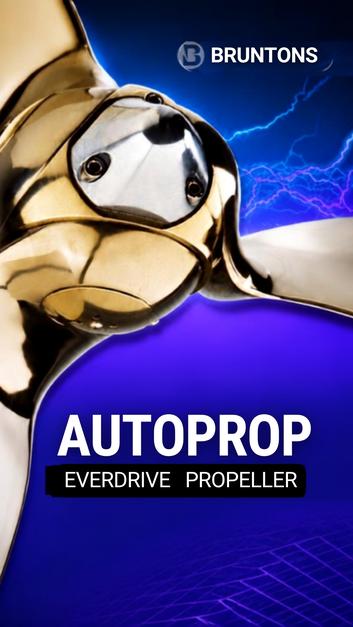
Bruntons Propellers is drawing attention to its Autoprop H5 EverDrive, a revised automatic variable-pitch propeller described in the company's official METSTRADE exhibitor product catalogue. The listing records a 1 September 2026 release and identifies changes to blade profile, geometry and the internal bearing arrangement. Bruntons associates the package with improvements of up to five per cent in performance, up to three per cent in fuel consumption and longer maintenance intervals compared with the standard Autoprop. These are manufacturer claims for the complete EverDrive design, not independent trial results and not a promise that every yacht will obtain the quoted savings.
That distinction matters because Bruntons has also discussed replaceable needle bearings for existing Autoprop H5 and APS assemblies. Both developments concern propellers, but they answer different questions. The servicing story concerns how owners may maintain compatible equipment; EverDrive concerns a revised propeller's hydrodynamics and mechanical arrangement. For a luxury sailing yacht specification, each deserves separate examination rather than treating a redesigned propeller as merely a replacement bearing kit.
What automatic pitch adjustment contributes
A sailing yacht under engine rarely travels in one constant condition. Displacement changes as fuel and water are consumed, wind and waves alter resistance, and a skipper may motor into a head sea or motor-sail with some drive coming from the rig. A fixed-pitch propeller has been selected around a compromise between these operating points. Autoprop's established concept allows blade pitch to respond to the forces acting on the blades, aiming to make engine power more useful across changing loads. That principle is the foundation on which the newly described EverDrive is built.
It does not eliminate the need for proper engine matching. Gearbox ratio, propeller clearance, shaft geometry, engine operating envelope and the boat's actual hull resistance still determine whether an installation is appropriate. A manufacturer catalogue can establish that a product exists and describe intended benefits; only a suitably documented selection and commissioning process can establish whether a particular boat will achieve the expected performance without overloading its engine.
The importance of the revised blade profile
Bruntons says the H5 EverDrive changes blade profile and geometry to improve hydrodynamic efficiency and propulsion. Small changes in the way a blade generates thrust can affect the power demanded at a given speed and the quality of water flow reaching the hull and rudder. On a cruising yacht, the consequence may be noticed not only in a maximum-speed test but in ordinary passages at restrained throttle settings, where owners spend much of their motoring time. The company's comparison with its standard Autoprop gives designers a starting point for asking more specific questions about test conditions.
The words 'up to' are particularly important. A five per cent improvement is not a universal increase in boat speed, and a three per cent reduction in fuel use is not an automatic reduction across an annual operating budget. Loading, weather, fouling, sail assistance and measurement method will influence the result. A meaningful sea trial should record speed through water, engine revolutions, fuel flow, environmental conditions and repeatable headings rather than comparing one favourable passage with an unrelated previous trip.
Bearings, motion and service life
A variable-pitch propeller is a mechanical system operating in seawater under alternating loads. Its blades must be able to react as designed while maintaining appropriate control of their movement. That makes the condition of the bearings and the geometry supporting the blades central to both performance and longevity. Bruntons says the redesigned EverDrive internal bearing system is intended to improve reliability, smooth operation and component durability. The language suggests a system-level improvement, but the public listing does not supply a universal service-life figure or a vessel-independent guarantee.
Owners should distinguish between what a redesigned product includes when supplied new and what can be retrofitted to an older assembly. The availability of separate bearing upgrades does not prove that an existing Autoprop can be transformed into an EverDrive merely by exchanging its internal components. Before authorising a refit, a yard should establish the precise model designation and serial history, inspect the shaft or saildrive and obtain written compatibility advice from the supplier.
Why the sailing yacht market is interested
For a sailboat, propulsion is a secondary but essential operating mode. The propeller is asked to deliver dependable manoeuvring in marinas, effective reverse thrust, economical motoring in calm weather and low drag under sail. A change that benefits one of those duties must not compromise the others. On a luxury cruiser with experienced guests or an owner who sails short-handed, the ability to control a boat predictably in confined water can be as important as modest gains in cruise efficiency. The EverDrive announcement deserves assessment through that broader operating profile.
Propeller drag also deserves separate attention from powered efficiency. The manufacturer's EverDrive listing focuses on performance, fuel consumption and maintenance compared with the standard Autoprop; it does not set out a new, independently demonstrated drag figure for the redesign. Any claims about sailing speed should therefore be tied to product-specific evidence rather than borrowed from another Autoprop generation, a different blade count or the broader category of feathering propellers.
Installation questions for new-build projects
On a new yacht, the propeller decision belongs alongside hull design, auxiliary-engine selection and shaftline engineering. Builders can begin with the intended cruising weight, expected maximum displacement, propeller aperture, rudder clearance and the owner's usage plan. If the vessel is likely to spend considerable time motor-sailing, the designer should ask how the automatic-pitch behaviour is expected to respond when the sail plan contributes thrust. A commissioning plan should also consider manoeuvring astern, propeller walk and access for inspection.
An automatic system should not be treated as an excuse to avoid documentation. Builders and owners need an installation record that includes the selected assembly, approved operating limits, any sacrificial-anode requirements and the recommended inspection intervals. Those details become important when the vessel is sold, transported to another region or placed under new management. Long-term support can be every bit as valuable as the initial hydrodynamic benefit claimed in a product brochure.
Refit choices are necessarily more constrained
Retrofitting a luxury sailing yacht raises different questions from specifying equipment before launch. A yard may have to work within existing shaft diameter, stern-tube position, propeller aperture, gearbox output and clearance to the rudder. Even when a manufacturer can offer a technically suitable replacement, the economic case should include labour, haul-out, lift operations, protective coatings and future service arrangements. A few percentage points of claimed performance improvement should be viewed against the actual number of motoring hours and the value of greater reliability.
The sensible comparison is not limited to initial purchase cost. Retaining a sound existing propeller with a scheduled service may be appropriate for one yacht; a full replacement may be justified for another that is already undertaking substantial drivetrain work. Neither choice is made solely on a show-floor specification. The owner's current fuel logs, complaints about vibration or manoeuvring and the condition of existing equipment provide useful evidence for a technical discussion with Bruntons or its authorised specialists.
Evaluating the percentage claims fairly
Bruntons' catalogue presents the possible improvements as 'up to' five per cent better performance and 'up to' three per cent less fuel consumed compared with the standard Autoprop. Those figures should be carried into the purchasing process with their qualification intact. They are not a verified forecast of range for a named yacht and should not be projected into annual fuel expenses without an agreed duty cycle. A yacht that motors only occasionally may value its propeller chiefly for safe harbour operations and durability; another that makes extended passages under power will pay closer attention to measured efficiency.
For a useful trial, yacht engineers should make the measurement methodology explicit. Compare equivalent loads, clean hull condition, similar sea state and the same engine configuration. Record any changes to vibration, noise, temperature and acceleration as observations rather than unmeasured promises. Where the owner has a digital monitoring system, a carefully maintained log can also help detect gradual deterioration after the propeller has entered service.
The maintenance conversation after delivery
Propellers do not remain in the clean, new condition of an exhibition display indefinitely. Marine growth, impacts, rope entanglement and long periods without movement can affect blade motion and surface finish. A variable-pitch assembly requires the inspection and handling procedures appropriate to its design; generic advice for a fixed-pitch bronze propeller is not automatically sufficient. Owners should obtain the EverDrive-specific instructions rather than assume that a manual for an earlier Autoprop variant covers every detail of the redesign.
A maintenance plan should identify who is permitted to dismantle the assembly, how bearings are assessed and what measurements indicate unacceptable wear. The availability of original parts in the yacht's usual cruising regions is another practical issue. Those questions are not glamorous, but they influence how confidently an owner can make a long passage and how easily a yard can resolve a problem without an extended delay awaiting specialist components.
What buyers should ask Bruntons next
The most valuable next step is a vessel-specific engineering discussion. Buyers should request the exact application range, installation drawings, evidence behind the claimed comparisons and the current service documentation. Owners comparing the new design with an existing Autoprop should be especially clear about which features belong to the new EverDrive assembly and which upgrades are offered for older H5 or APS units. Keeping the two product stories separate avoids an expensive misunderstanding at the quotation stage.
The 2026 METSTRADE listing establishes the H5 EverDrive as a distinct development in the Autoprop family. Its practical significance will be determined by how successfully hydrodynamic claims, predictable handling and future serviceability translate onto real yachts. For designers and owners of performance-minded luxury cruisers, it is a product to investigate carefully, not a shortcut around correct propulsion engineering. The right result is a matched, documented installation that continues working reliably well after the boat-show spotlight has moved on.
Sources and image credits
Reporting based on Bruntons Propellers, supplier-submitted H5 EverDrive product specification at METSTRADE 2026.
Lead photograph: Bruntons Autoprop H5 EverDrive manufacturer-supplied product visual. Bruntons Propellers supplier-submitted Autoprop H5 EverDrive product visual on METSTRADE; unchanged supplier image displayed on a plain editorial matte. Original official image source.