From raw readings to useful questions
Estonian marine technology supplier Purpletail has introduced VoltSense AI Guard, a system designed to interpret an individual boat's electrical behaviour rather than simply display another battery voltage graph. The company's METSTRADE 2026 product submission, released on 17 August, describes nightly analysis that studies weeks of readings from a particular vessel, learns its normal patterns and flags departures that may deserve attention. The proposed examples include charging that falls short, gradual battery decline and an electrical load left running during winter storage. For luxury yacht owners, this is a relevant development in the effort to make electrical monitoring more actionable.
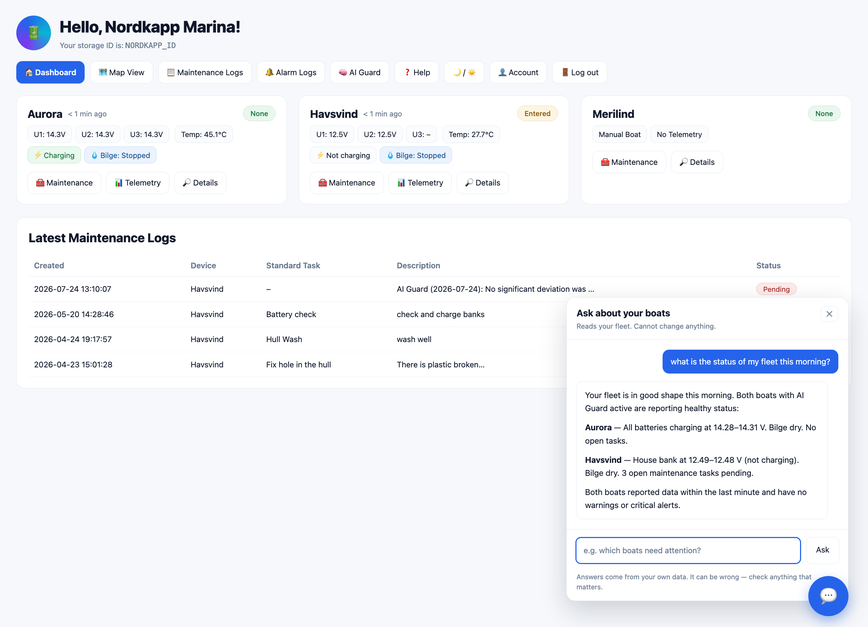
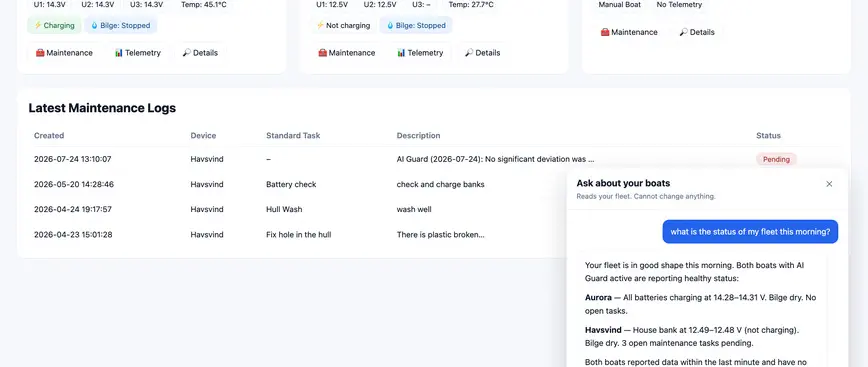
The company also describes a conversational panel in which an operator can ask questions about the monitored fleet. Importantly, its published information says that the assistant is read-only: it cannot change settings or operate equipment and should explain when the available data cannot support an answer. That boundary deserves attention because practical diagnostics and autonomous control are very different responsibilities.
Why a fixed alarm threshold is not always enough
Traditional electrical monitoring can warn when a battery voltage, current or temperature crosses a programmed limit. Such alarms remain essential, but they do not necessarily identify slow changes that develop while readings remain within an accepted range. A charging system that performs a little worse each week could evade a simple threshold until the boat is already difficult to start or a hotel battery is unexpectedly depleted. Trend analysis aims to detect changes in context, using the behaviour of the same boat as a baseline.
That approach carries limitations. A boat used for summer cruising behaves differently from one connected to shore power through winter. Battery chemistry, ambient temperature, electrical modifications and patterns of guest occupation can all alter normal consumption. A sensible monitoring system needs enough observations to distinguish ordinary seasonal variation from a fault. The manufacturer's announcement offers examples of the intended outcome, but it does not publish a universal diagnosis accuracy figure.
Nightly analysis and the importance of context
VoltSense says AI Guard examines weeks of recorded data and prepares findings each night. This timing suggests a monitoring approach focused on maintenance decisions and developing anomalies, rather than replacing the real-time alarm functions of an onboard battery management system. A nightly review could be useful for a captain who wants to see whether batteries recharged properly after the previous day's passage or whether the yacht behaved unusually after guests departed.
A slow analytical cycle is not the correct tool for every emergency. Sudden overheating, a severe electrical fault or a bilge alarm still needs an immediate, appropriately designed safety response. Owners should understand how AI Guard relates to the underlying hardware, how often readings reach the monitoring service and what happens during a loss of network connectivity. An advisory finding is useful, but it should never be mistaken for a certified protection function.
The evidence behind every alert
The supplier states that each finding carries its supporting numbers and dates and stops when the problem has ended. That design choice helps make the difference between a plausible story and an actionable maintenance record. If a yacht is reported to have poor charging performance, an engineer needs to see what measurements changed, when the change began and whether the trend correlates with altered use. A conclusion without accessible evidence would be difficult to trust and even harder to diagnose.
There are still engineering decisions to make. Some anomalies may be caused by a sensor problem, an unexpected configuration change or an interruption in the data feed rather than a real battery issue. The most useful workflow will let the operator examine those alternatives before ordering a replacement component. Owners should ask for sample reports that show both an ordinary successful detection and a case where the system declines to infer a cause.
A fleet question in plain language
VoltSense uses the example of a fleet manager asking which boats need attention that morning. That is a meaningful use case for a yacht management company, charter operator or boatyard responsible for several vessels. Different boats may use different batteries and have different normal consumption patterns. A summary that highlights exceptions without forcing staff to inspect every graph could help prioritise the day's work and direct attention to vessels that are departing soon.
A natural-language interface should not be equated with unlimited understanding. A question such as which yacht has the weakest charging trend depends on the completeness, comparability and freshness of the underlying measurements. If one vessel has been offline for days, its absence must be visible rather than interpreted as healthy. The company's explicit promise to admit uncertainty is therefore as important as the convenience of plain-language questions.
Read-only design limits operational risk
AI Guard's read-only boundary is particularly relevant in marine applications. Adjusting battery chargers, opening relays or changing critical settings on a vessel carries consequences that differ from retrieving historical data. An assistant that merely explains observations can support a technician without taking control of equipment. This also gives owners a clearer responsibility model: the human operator evaluates the evidence and follows established maintenance procedures.
The restriction does not remove all risk. Incorrect or misleading advice could still result in a poor decision, and account access needs to be properly secured. Managers should decide who can view the measurements for each yacht, whether crew members have limited permissions and how sensitive operational data is retained. The product description does not itself establish a full security certification or detailed access-control policy, so those questions belong in the procurement review.
What winter storage could look like
One of the supplier's examples concerns an electrical load left active on a boat through winter. Storage periods are awkward because a vessel may appear healthy for weeks while a modest unexplained load gradually reduces available energy. A remote trend alert could prompt a check before battery condition deteriorates severely. It may also help identify a charging arrangement that has become unreliable while the vessel is unattended.
Still, a yacht in storage requires an appropriate physical inspection regime. Shore-power cables, bilge pumps, ventilation, moisture and fire protection cannot all be assessed through battery data. A remotely generated finding should complement scheduled checks and emergency contacts. The captain or caretaker needs to know when a warning is serious enough to require someone on site and how to distinguish an internet outage from a true electrical failure.
Integrating monitoring with an existing yacht
A central procurement question is what sensor data AI Guard requires and which existing VoltSense devices and software services can provide it. The public product description establishes analytical functions, not a promise that every third-party electrical instrument can feed the service. Boats with complex power systems may have battery management hardware, alternator regulators, inverter-chargers and separate network gateways. The installation plan needs to identify where measurements originate and which readings are reliable enough for longer-term analysis.
Before installation, owners should obtain a list of supported inputs, sample rates, communications requirements and data-retention policies. It is worth asking whether the system can distinguish a house battery from engine-start or thruster batteries and how it handles replacements, additions and battery-bank reconfiguration. Without reliable device identity, a trend can become misleading after ordinary maintenance.
Use on privately owned and professionally managed yachts
A privately operated luxury yacht may need only a concise status summary before the owner boards for a weekend. A captain who lives aboard may prefer detailed diagnostics that support discussions with electricians and equipment manufacturers. Fleet managers, by contrast, need consistent reporting across multiple boats and a practical way to divide responsibility for follow-up. The same monitoring technology can serve these audiences, but the interface, alerts and workflow should reflect their different needs.
Reports should distinguish between observations, suspected causes and confirmed maintenance findings. A change in charging voltage is an observation. A theory that a charger is deteriorating is a hypothesis. Confirmation requires a test of the equipment concerned. Keeping those categories separate prevents an analytical tool from becoming an unsupported authority in a maintenance record.
Ownership costs and continuing service
An AI-assisted monitoring product may be inexpensive to install relative to the machinery it observes, but lifetime costs should still be understood. Communications plans, subscriptions, hardware replacements and technical support can all affect the overall budget. Buyers should ask whether historical data remains accessible when a subscription ends and what happens if the yacht changes owner or management company. It is also important to understand the service's update policy, since analytical software may change over time.
A worthwhile pilot would run alongside a captain's existing battery log, comparing system findings with known charging events, shore-power interruptions and maintenance work. That approach would allow the owner to see whether alerts are timely, understandable and specific enough to influence decisions. The goal is fewer unexplained surprises, not the maximum possible number of automated notifications.
The significance of the 2026 announcement
VoltSense AI Guard is a useful example of how marine electronics suppliers are moving beyond isolated measurements toward interpretable maintenance information. Its defining characteristics are nightly, vessel-specific trend analysis, evidence-linked reports and a read-only conversational interface. These are concrete features described by the supplier in its August 2026 METSTRADE submission, rather than a general claim that artificial intelligence will transform every aspect of yacht operation.
For owners and yacht managers, the test is whether the product makes electrical problems easier to understand and deal with at an early stage. Reliable baseline data, transparent limitations and integration with established safety procedures will matter more than the novelty of conversational software. A careful evaluation could make the system a useful additional layer in modern yacht management while leaving real operational decisions with the people responsible for the vessel.
Sources and image credits
Reporting based on Purpletail OÜ VoltSense first-party AI Guard product entry, released 17 August 2026.
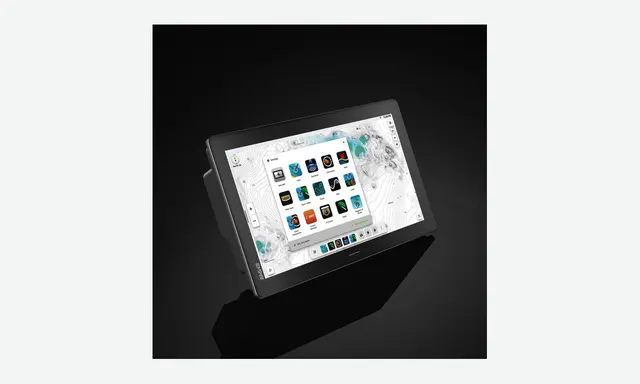
Lead photograph: VoltSense AI Guard original manufacturer equipment image. VoltSense supplier-submitted AI Guard monitoring platform image from the official METSTRADE 2026 product catalogue. Original official image source.