An award for a less visible part of yacht engineering
The Dutch water-treatment specialist Sensiblue has won the Manufacturing, Support Products and Materials category at the 2026 DAME Design Awards with its S4 freshwater disinfection system. The award was presented at the opening of METSTRADE in Amsterdam on 17 November, and the company confirmed the recognition in its own announcement on the same day. The system is designed to obtain the energy required for treatment from the flow of water itself, rather than requiring a separate connection to the vessel's electrical supply.
The significance for the luxury yacht industry lies in a system that rarely receives the same public attention as propulsion or navigation equipment. The freshwater installation influences the daily experience of owners and guests, as well as the work of the people responsible for maintaining the vessel. On a yacht between 12 and 23.99 metres, the space available for equipment and the resources needed to support it may be particularly important considerations.
The award recognises a product design. It does not establish the condition of the water aboard any specific vessel or certify that every possible installation would produce potable water. The manufacturer identifies an inline disinfection process, the performance of which must be considered in relation to the complete freshwater system.
An internal turbine rather than an external power connection
In the company's announcement, Sensiblue describes the operating principle of the S4. Water passing through the equipment drives a small turbine, which produces the electrical energy required by the system. A small portion of the water stream passes through a salt container and an electrolysis cell. The resulting active chlorine is introduced into the water as part of the treatment process.
The significance of the design is that it obtains the necessary electrical energy internally. Although the company's promotional material emphasises the absence of an external electricity requirement, electricity is generated inside the equipment. Likewise, although salt is the consumable supplied to the system, the disinfection process involves the production of an active chemical substance. These distinctions are important to understanding what the product actually does.
The supplier states that the active chlorine concentration produced by the equipment is between 0.2 and 0.4 milligrams per litre. Those are published product figures, rather than measurements made independently aboard a named yacht. Actual drinking-water quality also depends on the characteristics of the incoming water, the condition of the system and the suitability of its installation.
The company's description identifies a light-emitting indicator that displays operating status and indicates when salt needs replenishing. This offers a visible means of checking certain aspects of equipment status, but it is not the same thing as a laboratory analysis of the water coming from a particular tap.
Water storage introduces different considerations from water supply
Freshwater on a cruising yacht may be obtained from shore facilities or generated aboard the vessel using suitable equipment. It is commonly stored before being distributed to the different outlets. The source of the water is therefore only one part of the assessment of its quality when it reaches a user.
Storage conditions, the cleanliness of the tanks and the condition of the plumbing are among the factors that a vessel operator must consider. Water that entered the yacht from a suitable source may still encounter conditions that affect its quality as it passes through the installation. An onboard treatment device is consequently best assessed within the wider maintenance and water-management arrangements of the vessel.
The manufacturer's material refers particularly to biofilm, a term describing communities of microorganisms associated with surfaces. Its stated objective is to use the inline process to address microbial contamination and limit the development of biofilm within the water system. These are applications that require attention to the arrangement of the plumbing and the actual conditions of service.
The S4's operating principle should not be confused with a general-purpose treatment system for all possible contaminants. The presence of an inline disinfectant does not necessarily remove dissolved substances, particulate contamination or other hazards from unsuitable source water. A yacht operator must still determine whether the incoming water and the treatment arrangements meet the applicable requirements for its intended use.
Interpreting the manufacturer's laboratory claims
Sensiblue's November statement refers to laboratory testing by KWR Water Research Institute and reports reductions of more than 99.9 per cent for viruses and 99.99 per cent for bacteria. Its wider product information identifies the use of model organisms in the testing. These results are reported by the manufacturer and should be understood in the context of the relevant test conditions.
A reduction measured during a test is not necessarily the same as the final concentration of microorganisms found in the water supplied aboard a vessel. The initial level of contamination, the properties of the water, the treatment process and conditions after treatment can all influence the result. Without the complete test protocol and details of the vessel installation, a numerical claim should not be extended to circumstances that have not been evaluated.
A distinction is also necessary between the recognition given by an equipment design jury and the evidence required in a drinking-water assessment. A design award can highlight an innovative engineering approach, but is not a substitute for the applicable product documentation, water testing or compliance assessment.
A prospective purchaser should ask for the relevant independent test reports, the specified operating conditions and the manufacturer's instructions. Those documents can inform an assessment by the people responsible for the yacht's freshwater system. They can also help establish the circumstances in which an additional treatment stage or a different water source may be necessary.
Flow capacity and the layout of a luxury yacht
The exhibitor catalogue describes a flow rate of up to 1,000 litres per hour, illustrating the intended application with two showers operating simultaneously. It also refers to an approximate treatment capacity of 55,000 litres between salt replenishments for the medium version. These are supplier specifications, and an owner should confirm the precise performance conditions and version under consideration.
The water demand of a luxury yacht varies according to the number of people aboard, the installed equipment and the pattern of use. Two vessels of similar length can have markedly different freshwater arrangements. One may have a relatively simple system serving a small crew, while another has several guest cabins and a more extensive range of domestic facilities.
A yacht's freshwater installation also needs to accommodate differences between periods of high demand and periods when only a single outlet is in use. The compatibility of an inline treatment device with the existing pumps, plumbing and operating pressure should be assessed using the appropriate documentation.
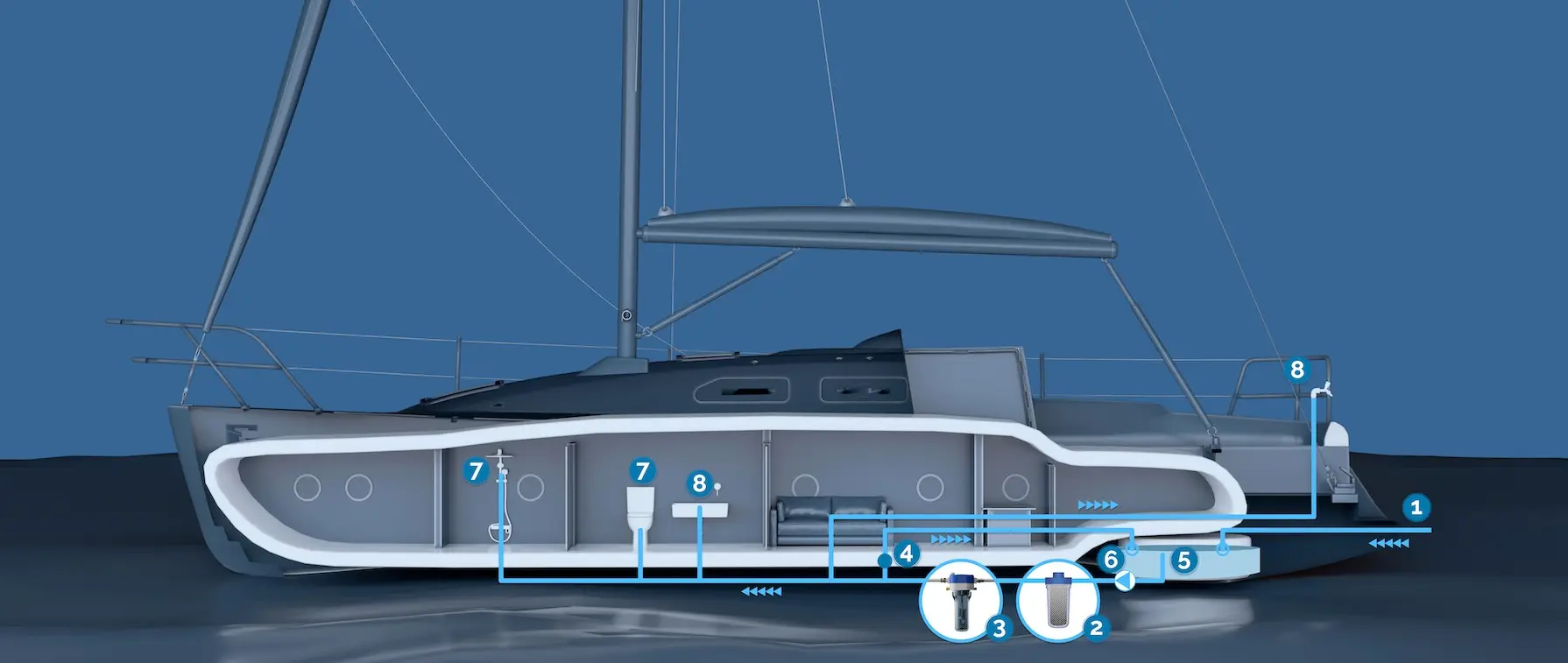
Although an equipment illustration can show where a supplier envisages its device being fitted, the illustration is not a specification for a particular yacht. The image accompanying this article is supplied through the exhibitor catalogue and represents a conceptual yacht installation rather than evidence of a completed project. The physical location, access for servicing and suitability of the equipment must be established for the actual vessel.
Maintenance responsibilities remain with the vessel operator
The manufacturer emphasises salt replenishment as the principal consumable requirement of its device and says it offers a seven-year warranty. Its founder also describes the longevity of an earlier-generation installation. That example is a company-reported experience rather than an independent durability study of all units produced.
A straightforward arrangement for replenishing consumables can be attractive to owners cruising away from their usual service facilities. It does not eliminate the maintenance obligations associated with the remainder of the freshwater installation. Tanks, pumps, filters where fitted and distribution equipment all have their own service requirements. The condition of water at the point of use also remains a matter for appropriate monitoring.
When a yacht is prepared for a period of inactivity, returned to service or transferred between owners, the freshwater arrangements deserve particular attention. A useful equipment specification should identify the responsibilities of the supplier and the vessel operator, as well as the availability of replacement parts and service support in the intended cruising area.
Sensiblue's category award is therefore relevant to luxury yacht builders and refit specialists because it identifies a different approach to powering an onboard treatment device. Its merits in a particular vessel would need to be evaluated with the complete freshwater system and the appropriate water-quality requirements in mind. The November announcement provides no evidence of a new installation in a named luxury yacht and does not demonstrate that treatment performance will be identical under all operating conditions. It provides a documented basis for further technical assessment at the exhibition, where the company is presenting the S4 to the marine industry.
Sources and lead image
Source documentation: https://www.damedesignawards.com/winners, https://www.metstrade.com/exhibitors/sensiblue/products/sensiblue-s4, https://sensiblue.com/en-eu/blogs/news/sensiblue-s4-named-category-winner-at-the-dame-design-awards-2026. Lead image: Official Sensiblue schematic illustration of yacht freshwater installation — Sensiblue, official METSTRADE exhibitor illustration of possible yacht installation; not a photograph of an actual commissioned system.. Issuer-supplied media asset published with the relevant official exhibitor release or product catalogue made available through the official virtual press room for coverage of the announcement; copyright remains with the rights holder.