A different approach to recovering the anchor
French marine hardware manufacturer Wichard is presenting a self-aligning anchor swivel as part of its equipment programme at METSTRADE 2026. The company's exhibitor announcement, dated 2 September, describes a stainless steel connection between the anchor and chain designed to help orient the anchor correctly as it reaches the bow roller. The November exhibition gives builders and equipment specialists an opportunity to examine the product within the wider context of yacht ground tackle.
The design is not being introduced to the market for the first time at this year's show. Wichard's North American business explains in a statement published on 11 May 2026 that the swivel was first revealed at the previous METSTRADE exhibition ahead of its commercial introduction. This week's presentation is therefore a further opportunity to assess an existing product development, rather than evidence that the company has invented a completely new anchoring process.
For luxury sailing and motor yachts between 12 and 23.99 metres, the management of the anchor at the bow can be an important aspect of equipment selection. An installation may require the anchor to travel through a constrained opening or settle into a roller assembly designed around the shape of a particular anchor.
The purpose of the swivel and its protective cover
Wichard describes the product as incorporating a shaped cover intended to encourage the anchor to rotate into the appropriate orientation as it is recovered. If an anchor approaches the roller in an unfavourable position, the manufacturer says the geometry of the connection can help turn it before it enters its resting position.
It is useful to distinguish the proposed orientation function from the broader purpose of a swivel. A swivel is generally used to permit relative rotation between the components it connects. That movement can help address some of the problems arising from twisting within a ground-tackle arrangement. Wichard's particular design adds a shape intended to interact with the anchor recovery process at the bow.
The result depends on more than the design of the swivel alone. Anchors have different configurations, and bow rollers vary in their dimensions, materials and surrounding structures. The direction from which the recovered anchor approaches the roller can also differ with the arrangement of the installation. An equipment supplier's illustration of a successful combination cannot establish that the same behaviour will occur on every yacht.
The September announcement makes strong claims about avoiding jamming. They should be read as the manufacturer's description of its design objectives, rather than an unconditional guarantee that an anchor can never become obstructed. The crew must still supervise the recovery process and follow the procedures applicable to its particular vessel.
Three sizes and the importance of the complete connection
According to the exhibitor statement, Wichard offers three sizes of the swivel covering chain dimensions from six to fourteen millimetres. Its published material also describes the use of 316L stainless steel and claims compatibility with a very large proportion of anchors currently available. Those statements provide a starting point for a purchasing discussion, but chain diameter alone is insufficient to establish the appropriateness of a particular ground-tackle component.
The dimensions and construction of the chain, the anchor's connection geometry and the loads specified for the relevant equipment must be assessed together. A yachtsman replacing a swivel should also account for the fittings that sit on either side of it. Changing the dimensions or arrangement of one connection can affect how it moves through other parts of the system.
Material selection is relevant because these components are exposed to seawater and to a demanding mechanical environment. Stainless steel can offer useful corrosion resistance, but it should not be treated as immune to corrosion, fatigue, wear or damage. The published identification of an alloy is not a substitute for the manufacturer's load specifications, inspection requirements or other relevant documentation.
The existence of three variants does not establish which variant would be suitable for a given yacht. That choice should be made by referring to the appropriate technical data and, where necessary, consulting a knowledgeable marine equipment supplier or the yard responsible for the installation.
A practical question for designers of enclosed bow arrangements
Some contemporary yachts accommodate their anchors within a recess in the hull or beneath deck fittings designed to preserve a clean exterior appearance. Other vessels use a more conventional visible roller arrangement. In both cases the shape of the anchor and the available clearance influence the behaviour of the equipment during recovery.
A naval architect or yacht builder considering a new ground-tackle arrangement may be able to assess the anchor, its connecting components and the roller as a combined system before construction is completed. A refit specialist has a different challenge when existing structural and aesthetic features restrict the options available. Ideally the replacement parts should satisfy the engineering requirements without introducing unforeseen conflicts with the yacht's established configuration.
The physical length of a swivel assembly may influence where the anchor comes to rest when its chain is fully recovered. The position of moving components must also be considered in relation to adjacent hardware and any securing arrangements used for navigation. These are vessel-specific design questions and cannot be answered from the product name or photographs.
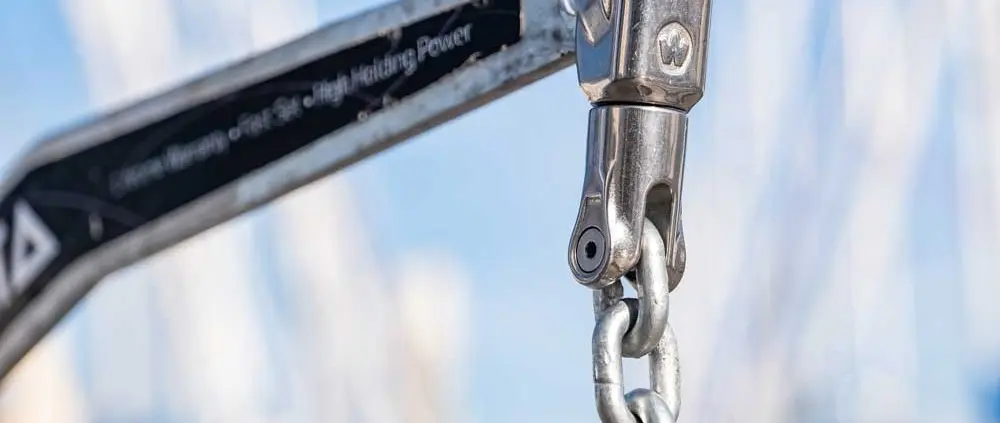
Wichard's exhibitor photograph shows its hardware connected between an anchor and a section of chain. It is an illustration of the proposed connection, not a record of commissioning aboard a specific yacht. The manufacturer has not supplied independent comparative test data in the September press announcement that would quantify recovery performance across different bow configurations.
Maintenance and inspection of a heavily loaded assembly
Ground tackle is unusual among yacht equipment because a component that appears relatively small may form a critical link in a system used to hold the vessel in position. The anchor, chain, connectors and associated equipment operate together. A problem at one point can have consequences that are out of proportion to the cost or dimensions of the individual part.
This makes documentation, accessibility and inspection important aspects of the selection process. An owner should be able to identify the fitted swivel and establish which manufacturer's instructions and limitations apply. When the yacht is maintained by a succession of contractors, a clear equipment record helps reduce uncertainty about the intended configuration.
The behaviour of moving parts can also warrant attention during periodic maintenance. The fact that an assembly has continued to move freely does not necessarily establish that it has retained all of its original properties. Visual examination and any other checks required for the particular equipment should follow the appropriate technical guidance.
Wichard's statements highlight durability and ease of recovery as objectives of the swivel design. They do not remove the need to consider the condition of the complete anchoring system or its continuing suitability for the vessel. The article is not an installation instruction, a load-rating calculation or a recommendation for connecting an unspecified anchor to a particular chain.
Where the development fits in the yacht equipment market
The November exhibition brings together builders, distributors, yards and owners' technical representatives at a time when many businesses are preparing their next production and refit programmes. An equipment supplier can use that opportunity to explain the details of its products and their available variants, while prospective customers can investigate whether the documented characteristics match their requirements.
For a luxury yacht owner, the value of an anchoring component is often expressed through ordinary operation rather than a striking appearance in a showroom. Reliable recovery arrangements can reduce unnecessary complications during a manoeuvre, provided the equipment has been appropriately selected and maintained. The relevant measure of success is the behaviour of the actual installation, not simply the breadth of the supplier's compatibility claim.
Wichard's North American announcement and September exhibitor statement provide a documented account of an anchor swivel that has progressed from its initial exhibition presentation to a defined range of three sizes. Neither source identifies a newly completed luxury-yacht installation or gives an independent comparison of its performance against all competing products. The significance of its 2026 presentation lies in the opportunity to examine the design and discuss its integration with other ground-tackle components.
The broader question for designers and owners is how the anchor is recovered, guided and secured as part of a correctly engineered system. A self-aligning connection is one possible element in that arrangement, which should always be considered in relation to the equipment, structure and documented operating requirements of the individual yacht.
Sources and lead image
Source documentation: https://www.metstrade.com/exhibitors/wichard-groupe/news/anchor-swivel, https://www.wichardgroupe.us/news/post/wichard-anchor-swivel. Lead image: Official Wichard photograph of its anchor swivel connected to an anchor and chain — Wichard, official exhibitor press photograph illustrating the anchor swivel assembly; not an independent test or a photograph of a completed yacht installation.. Issuer-supplied media asset published with the relevant official exhibitor release or product catalogue made available through the official virtual press room for coverage of the announcement; copyright remains with the rights holder.