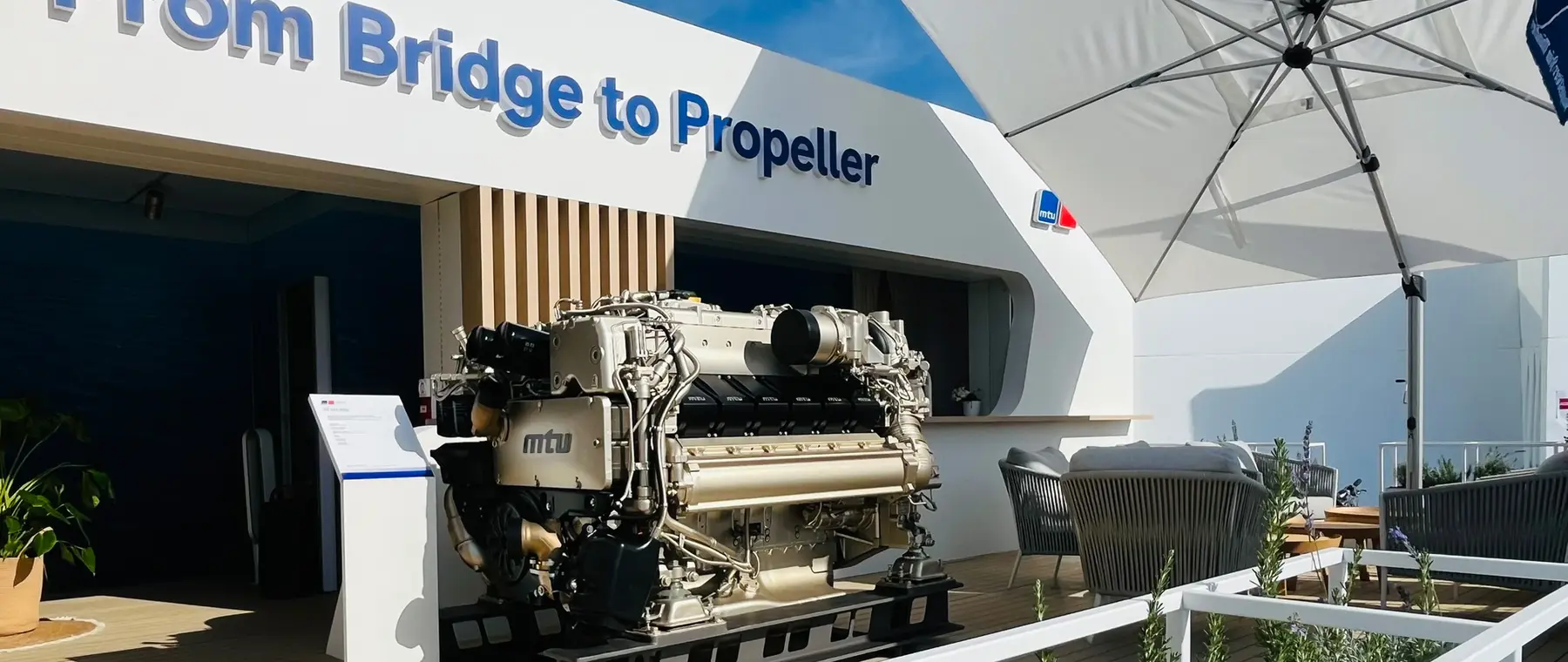
Rolls-Royce is broadening its mtu yacht offering beyond propulsion engines by adding standardised variable-speed generator sets and a new selective catalytic reduction system based around the Series 2000 platform. The company presented the package at the Cannes Yachting Festival as part of a wider bridge-to-propeller approach to machinery integration.
The new equipment addresses two issues that matter increasingly to yacht builders: reducing fuel and noise from onboard electrical generation, and meeting stricter nitrogen-oxide limits in regulated waters. Rolls-Royce says the combined portfolio is also compact enough to support a single-deck engine-room concept in suitable yacht installations.
Variable-speed gensets follow actual electrical demand
Conventional generator sets often run at a fixed engine speed even when the yacht is using only a fraction of their available electrical output. Rolls-Royce says its new standardised mtu Series 2000 gensets can vary engine speed with the actual power requirement, allowing the machinery to operate more efficiently across changing hotel and technical loads.
The company claims fuel consumption and carbon-dioxide emissions can be reduced by up to 15 percent in operation, depending on the load profile. It also quotes a reduction of around 6dB in operating noise, a meaningful figure on a yacht where generators may run for long periods close to guest cabins and living areas.
A new SCR system targets IMO Tier III areas
The second major addition is an exhaust after-treatment system being certified in cooperation with specialist Eminox. Rolls-Royce says the SCR package meets IMO Tier III requirements and can reduce nitrogen-oxide emissions by 75 percent compared with IMO Tier II limits, allowing appropriately configured yachts to operate in emission-controlled areas.
The system is designed for a service life of up to 16,000 operating hours depending on load profile and does not require compressed air for dosing. Rolls-Royce also emphasises installation flexibility, which is important because exhaust after-treatment can consume valuable machinery-space volume and add routing constraints to an already dense engine room.
Series 2000 becomes a broader technical platform
Both the generator and after-treatment developments are based around mtu Series 2000 technology, giving Rolls-Royce a more coherent machinery package for builders already specifying the company’s propulsion engines. Cannes also provided a showcase for the newer Series 2000 M96Z engine, extending the same family across propulsion and electrical-generation roles.
Using related machinery can simplify training, parts strategy and service relationships for a shipyard or yacht-management team. It does not eliminate the need for careful system engineering, but common supplier architecture can reduce the number of interfaces between engines, generators, emissions equipment and monitoring systems.
Compact machinery can return volume to the yacht
Rolls-Royce says the expanded package can support a single-deck engine-room concept because of its compact arrangement. On a yacht, machinery volume competes directly with accommodation, storage, tankage and technical access, so even modest packaging improvements can affect the layout available to designers.
That benefit must be balanced against service clearances and maintainability. A smaller machinery footprint is useful only if filters, pumps, exhaust-treatment components and major service items remain accessible, especially on production yachts where technicians may work through relatively constrained hatches and service corridors.
Efficiency gains depend on the yacht’s real load profile
The quoted fuel-saving figure for variable-speed generation is an upper value rather than a guarantee for every boat. A yacht with large, steady hotel loads may see a different result from one whose electrical demand varies widely between quiet overnight periods, air-conditioning peaks, cooking, battery charging and stabiliser use.
For builders, the important work is therefore load analysis rather than simply selecting the newest generator. Battery capacity, inverter systems, shore-power strategy and the operating schedule of high-demand equipment all determine how often a variable-speed genset can run in its most efficient range.
Cannes shows the shift toward integrated machinery packages
The announcement illustrates how propulsion suppliers are moving toward complete energy and emissions systems rather than selling engines alone. Owners increasingly ask about noise, local emissions, fuel use and electrical resilience, while builders want equipment that can be engineered and supported as a coordinated package.
Rolls-Royce’s bridge-to-propeller strategy fits that direction by linking propulsion, power generation and emissions control under the mtu portfolio. The real measure of the system will come from production installations where the claimed efficiency and packaging advantages can be assessed over normal yacht operating cycles.