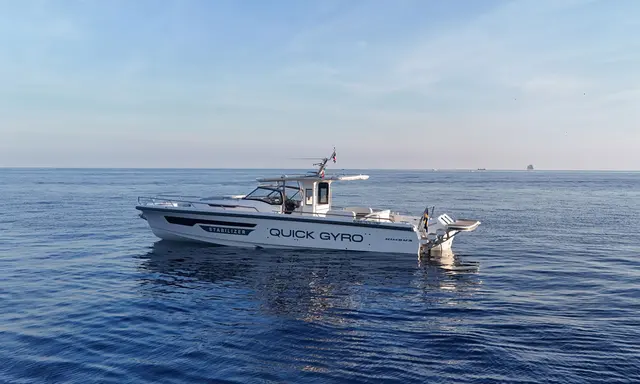
Quick Group is using the Cannes Yachting Festival to present a broader generation of manoeuvring and onboard-integration technology rather than a single new component. The Italian manufacturer has expanded its QSY brushless electric-thruster family, introduced a new Pacific control series and launched QCentric as a shared digital architecture for present and future Quick Group systems.
The combined proposition stretches from dayboats around seven metres to yachts of roughly 30 metres, placing much of the new range directly inside Luxury Yacht Guide territory. Quick says the aim is to give builders proportional thrust, lower noise and energy consumption, easier installation and a common control framework that can also communicate with third-party equipment.
The QSY range now covers more vessel sizes
Quick has added several new thruster units and a 215mm tunnel size to close the gap between its existing 185mm and 250mm installations. The expanded matrix now runs from the 12-volt BT QSY 140-50, rated at 50kgf of thrust, to the 48-volt BT QSY 300-350 with output up to 350kgf.
Dual-voltage options are available on parts of the range, giving builders more flexibility when matching a thruster to an existing DC architecture. Quick says the broader selection allows yards to keep the same brushless technology across different models rather than changing supplier or control philosophy as yacht size increases.
Brushless motors target noise and maintenance
The QSY units use synchronous brushless motors with integrated inverters and native proportional control. Quick says the design provides immediate torque response, reduced energy consumption, lower maintenance requirements and quieter operation compared with conventional arrangements, all of which are attractive characteristics for manoeuvring systems used close to guest areas.
Proportional control also lets a skipper apply only the amount of thrust needed instead of operating the unit simply on or off. That can make close-quarters manoeuvring more progressive, particularly when a bow or stern thruster is used together with main engines, joystick systems or assisted-docking technology.
Pacific introduces a new helm-control family
Quick has paired the expanded thruster range with Pacific, a new control interface available in T1, T1XL and T2XL versions. The controls are designed to exploit the proportional characteristics of the QSY series while also handling diagnostics and digital integration in a more consistent way across different yacht sizes.
The T1XL and T2XL share the same helm footprint, which means an owner can move to a more complex thruster arrangement without necessarily cutting a different opening in the console. Quick also supports integration with third-party manoeuvring platforms through dedicated gateways and NMEA 2000-compatible communication.
QCentric is intended to become the common architecture
The more strategic announcement is QCentric, which Quick describes as an open and scalable CAN-bus-based platform rather than simply a protocol for the new thrusters. The company intends it to connect products, functions and data across several divisions, including thrusters, stabiliser fins, windlasses and future systems.
Pacific is the first control family to use that architecture, but Quick is positioning QCentric as the foundation for wider integration. Support for industry-standard communications and dedicated gateways is meant to let shipyards connect Quick equipment with established third-party joysticks and assisted-manoeuvring systems instead of creating another closed onboard network.
Cannes is the world-premiere platform
Quick is unveiling the complete QSY range, Pacific controls and QCentric ecosystem at Cannes from 8 to 13 September 2026. The company will then take the technology to the Genoa International Boat Show and IBEX in Tampa, giving European and US builders opportunities to evaluate the system during the same autumn launch cycle.
That sequence matters because component adoption often begins long before a new yacht reaches the water. Shipyards need time to validate electrical loads, network architecture, tunnel sizing, service access and helm integration before a new thruster or control platform can be specified across a production range.
Integration is becoming as important as the hardware
Thrusters are relatively mature equipment, but the way they communicate with joysticks, displays, stabilisers and power-management systems is changing quickly. Builders increasingly want a common digital backbone that reduces duplicated cabling and makes diagnostics easier without tying every onboard function to a single proprietary interface.
QCentric is Quick Group’s answer to that requirement, while QSY and Pacific provide the first practical hardware around it. The long-term test will be how broadly the architecture is adopted beyond manoeuvring equipment and how easily it works with mixed-brand systems on real production yachts.