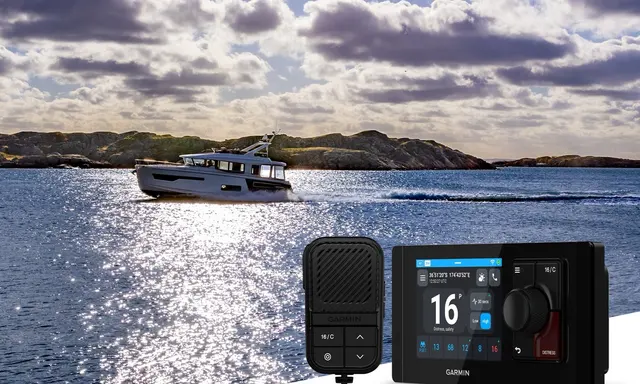
Garmin has introduced two new JL Audio marine head units aimed at owners who want a more integrated entertainment system without giving up the durability and control expected from dedicated marine equipment. The A60 uses a visible helm-mounted display, while the A60-H is a hideaway version intended for installations where the main interface is provided elsewhere.
Both units support four separate audio zones and use Garmin’s marine audio software environment, including Digital Signal Processing and Easy Tune through the redesigned Garmin Audio app. Control can also be extended around the yacht through compatible remotes, smart devices and selected Garmin quatix watches.
Four-zone control suits larger onboard layouts
A yacht can have very different listening requirements in the saloon, cockpit, flybridge and foredeck, so a single-volume audio system quickly becomes restrictive as boat size increases. The A60 architecture supports four independently controlled zones, allowing owners to adjust sound for separate living areas rather than treating the entire boat as one room.
That is particularly relevant to yachts in the upper end of the sub-24-metre market, where several exterior entertaining spaces may be in use at the same time. Independent zones also make it easier to keep interior sound moderate while running louder music in an open cockpit or beach-club area.
DSP and Easy Tune move setup into software
Garmin says the A60 family includes built-in Digital Signal Processing to optimise the signal delivered to speakers and subwoofers. DSP can also help protect system components by managing the power and frequency content reaching them, which matters in marine installations where equipment is exposed to long periods of high-volume use.
Easy Tune works through the Garmin Audio app to simplify system configuration rather than relying entirely on manual amplifier adjustments. The effectiveness will still depend on speaker choice, placement and enclosure design, but a software-led setup can make it easier for installers to produce repeatable results across different yacht models.
Bluetooth LE and NMEA 2000 expand control options
The head units support Bluetooth LE audio streaming from compatible devices and can also connect to a yacht’s NMEA 2000 network. Garmin says this allows integrated audio control from compatible multifunction displays and from the JL Audio NRX-300 wired remote, reducing the need to return to a single stereo panel every time a crew member wants to change a source or volume.
The system also supports Speed vs. Volume adjustment, which can raise output as background noise increases with boat speed. That may be useful on open motor yachts where wind and engine noise change dramatically between displacement cruising and faster planing speeds.
The visible A60 gets a modern colour display
The standard A60 uses a 2.95-inch high-resolution colour screen with a quoted resolution of 640 by 360 pixels and a sunlight-readable design. Garmin is clearly targeting contemporary helm styling, where a traditional small monochrome stereo can look dated alongside large glass multifunction displays and digital switching panels.
The A60-H takes the opposite approach by hiding the head unit and relying on networked or remote interfaces. That gives designers more freedom in minimalist interiors and exterior helms where reducing the number of visible controls can be as important as adding another dedicated display.
A built-in DAB tuner adds another source option
Garmin includes Digital Audio Broadcasting support in the A60 platform for regions where DAB services are available. Combined with Bluetooth streaming and network control, the tuner gives owners several ways to provide entertainment without depending on a single phone or internet connection.
Marine audio systems increasingly sit alongside Wi-Fi, satellite connectivity and app-based media services, but broadcast radio still has value when mobile coverage is poor or a yacht is moving between cruising areas. The most useful installations are therefore likely to combine local sources with streamed media rather than assuming constant connectivity.
Audio is becoming another integrated yacht system
The significance of the A60 family is not simply the number of speakers it can drive, but the way control is distributed through the boat. Modern production yachts increasingly use common data networks and touch interfaces for navigation, lighting, switching and entertainment, so audio equipment is being designed to participate in that same connected environment.
For owners, the practical benefit is convenience rather than technology for its own sake. A well-designed installation should make it simple to select a source, manage different zones and control volume from the places where people actually spend time, while keeping the underlying electronics protected and serviceable.