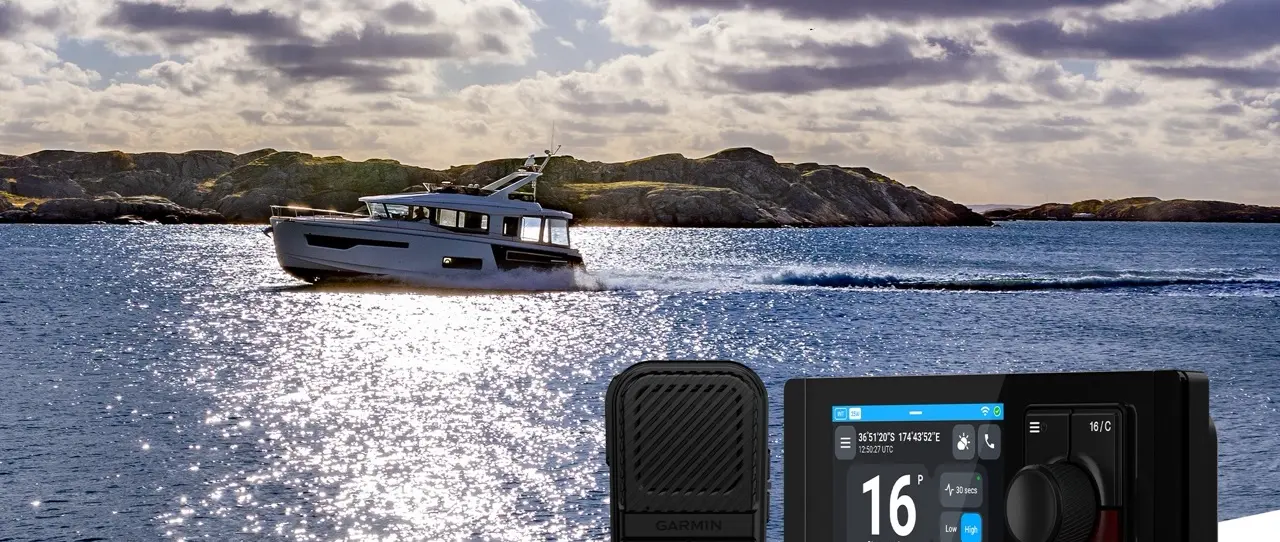
Garmin has introduced the Signal VHF 400 and VHF 220 as compact fixed-mount marine radios built around a 3.5-inch colour touchscreen and deeper integration with modern yacht networks. The premium VHF 400 adds an integrated Class B AIS transponder, while the VHF 220 provides AIS receive capability.
Both models combine conventional VHF and DSC communication with automated squelch, adaptive noise cancellation and networked control. Garmin is also offering the RM 100 remote station for a second helm or flybridge, allowing owners to extend radio operation without installing another independent VHF system.
The VHF 400 combines radio and AIS
The Signal VHF 400 can transmit and receive VHF, DSC and AIS through a single VHF antenna when installed with the required components. Its Class B AIS transponder broadcasts vessel identity, position, course and speed to nearby AIS-equipped traffic, adding an important layer of situational awareness.
The VHF 220 is a simpler option because it receives AIS data rather than transmitting it. Owners should choose between the two based on the yacht’s existing AIS equipment, operating area and whether duplicating a separate transponder would add useful redundancy or unnecessary complexity.
Noise management is designed for real helms
Garmin uses automated squelch and adaptive noise cancellation to reduce engine, wind and wave noise during voice communication. The included fist microphone also contains a loud built-in speaker and its own background-noise processing, helping crews hear calls away from the main radio chassis.
Those features matter on open motor yachts where ambient noise can make otherwise powerful radios difficult to use. Clear audio is particularly important during harbour operations, safety calls and situations where a skipper is managing several tasks at once.
Playback and watch modes reduce missed calls
The radios can automatically record up to three minutes of received audio and monitor multiple channels simultaneously. Playback allows a skipper to review a call that was partly masked by noise or distraction rather than asking another station to repeat the entire transmission.
Advanced watch functions can monitor as many as six channels for activity, although crews still need disciplined radio procedures. Technology can make information easier to recover, but it cannot replace correct channel selection or a proper listening watch when conditions require one.
Garmin networks the radio with the rest of the helm
Signal VHF integrates through NMEA 2000, Garmin Marine Network and BlueNet, while the ActiveCaptain app can handle configuration and software updates. The VHF 400 is listed at $1,499.99, the VHF 220 at $999.99 and the RM 100 remote station at $699.99.
For modern production yachts, that level of integration can reduce duplicated GPS, AIS and control interfaces. The benefit is strongest when the network is documented and serviceable, because highly connected helms need clear troubleshooting paths if one device or data source fails.