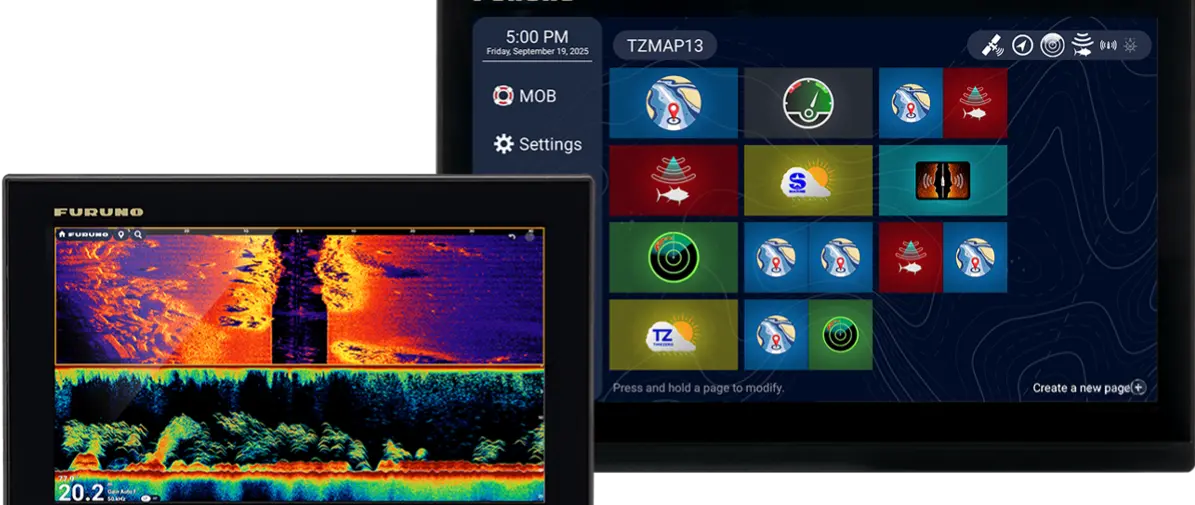
Furuno has expanded its multifunction-display range with the TZMAP9 and TZMAP13, two standalone units designed for owners who want modern charting and fish-finding capability without building a larger networked helm. The displays bring Furuno’s TZ MAPS cartography to 9-inch and 13-inch formats and include built-in TruEcho CHIRP fish-finder processing.
The concept is deliberately self-contained, reducing the amount of external hardware required for basic navigation and sonar functions. That makes the range relevant to smaller luxury yachts, chase boats and refits where console space is limited but owners still want current cartography and a modern touch interface.
Two screen sizes cover compact helm layouts
The TZMAP9 uses a nine-inch display while the TZMAP13 increases screen area to 13 inches for helms that can accommodate a larger panel. Both are intended to provide the same core navigation environment, allowing builders or owners to choose primarily around available space and viewing distance.
A larger screen can make split views and chart detail easier to read, but it also consumes more valuable dashboard area. On refits, the existing cutout and surrounding instruments often determine which size is practical before feature differences become relevant.
TZ MAPS brings Furuno cartography onboard
The new displays use Furuno’s TZ MAPS cartography, giving users access to the same mapping environment associated with the company’s wider TimeZero ecosystem. Modern digital charts can combine vector data, depth information and route-planning tools in ways that are easier to update than traditional chartplotter platforms.
Owners should still treat electronic cartography as one navigation source rather than a substitute for prudent seamanship. Survey age, local notices and position accuracy remain important regardless of how detailed the display appears.
TruEcho CHIRP is built into the unit
Furuno integrates a TruEcho CHIRP fish finder directly into the TZMAP platform, allowing owners to add compatible transducers without installing a separate sounder module for ordinary use. That can reduce cabling and simplify a helm where space and power consumption are both limited.
Although sonar is often associated with fishing, depth and seabed information can also be useful during coastal cruising and anchoring. The exact performance will depend heavily on transducer selection and installation quality, especially on faster boats where aerated water can interfere with the signal.
Standalone architecture keeps complexity down
Furuno is positioning TZMAP as an all-in-one solution rather than the centre of a large distributed network. That can appeal to owners who value reliability and straightforward troubleshooting over the ability to integrate every sensor and display aboard.
For the 12-to-24-metre market, there remains room for both approaches. Large yachts may justify multiple redundant networked displays, while secondary helms, tenders and simpler cruisers can benefit from a powerful standalone unit with fewer dependencies.