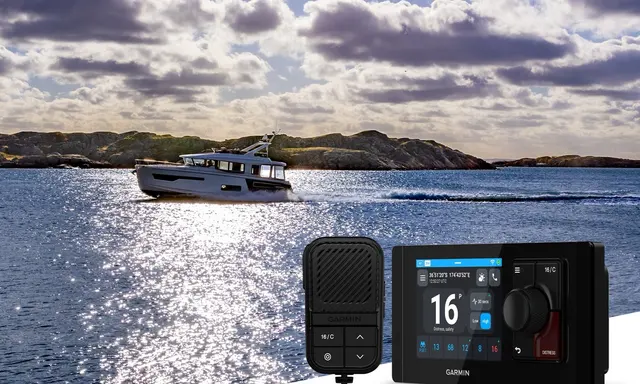
Garmin has introduced the GMI 40 as a new compact instrument display for sailing yachts, cruisers and other boats that need clear access to live navigation and vessel data without dedicating a full multifunction display to the task. The unit uses a 4.3-inch high-resolution colour LCD touchscreen with edge-to-edge glass and a design intended to match Garmin’s current GPSMAP helm displays.
The GMI 40 is built around networked data rather than a fixed set of internal sensors. It can receive information over NMEA 2000 and Garmin BlueNet, while wireless support extends the display to compatible gWind sensors, remote controls and selected quatix marine smartwatches.
A small display can still carry a broad data set
Dedicated marine instruments remain useful even on yachts equipped with large chartplotters because crews often want depth, speed, wind or heading visible continuously. A separate display can keep those values in sight while the main screen is used for charting, radar or camera feeds, especially at a busy helm.
Garmin’s approach with the GMI 40 is to keep the unit physically compact while allowing the underlying network to decide what information is available. That makes the display relevant to both sailing and motor yachts because it is not limited to a single type of sensor or a predefined instrument role.
NMEA 2000 and BlueNet handle onboard integration
The GMI 40 can connect to compatible onboard equipment through NMEA 2000, the widely used marine data network found on many production yachts. Garmin also includes BlueNet connectivity, allowing the instrument to sit within the company’s newer high-speed marine networking environment where appropriate.
Wireless connections add another layer for compatible gWind sensors, Garmin marine remotes and quatix smartwatches. The point is not that every installation needs all of these connections, but that an owner can build the instrument into an existing electronics package without treating it as an isolated display.
Garmin has considered older GMI 20 installations
Refit practicality is a recurring issue with marine electronics because changing a display can leave an awkward opening in an expensive helm panel. Garmin says owners replacing a GMI 20 can use an adapter plate that allows the new GMI 40 to fit the existing cutout rather than requiring a complete redesign of the console.
That detail is modest compared with processor or screen specifications, but it can materially change the cost and disruption of an upgrade. On a finished yacht, avoiding new joinery, composite work or panel fabrication often matters more to the owner than a small difference in the purchase price of the instrument itself.
Wind and underwater-data bundles broaden the package
Garmin offers the GMI 40 as a standalone instrument or in bundles with additional sensors. Wind packages can include wired or wireless gWind transducers, while below-water options include the DST820 smart transducer or combinations of GDT 43 depth-and-temperature and GST 43 speed-and-temperature sensors.
For sailing yachts, accurate wind information is central to sail trim and autopilot behaviour, while motor-yacht owners may prioritise depth, water temperature and speed. The same display can therefore serve different roles depending on which sensors and network data are already present aboard the yacht.
Software updates use the ActiveCaptain ecosystem
Garmin says compatible smartphones running its ActiveCaptain app can be used to keep GMI 40 software up to date. That reflects a wider trend in marine electronics toward treating displays as software-managed devices rather than equipment that remains unchanged for its entire installed life.
Owners still need to manage updates carefully on a working navigation network, particularly before an extended passage. The practical advantage is that fixes and feature improvements can reach the instrument without requiring a dealer visit or manual update process for every routine software release.
The new instrument is available immediately
Garmin lists the GMI 40 at a suggested retail price of $599.99, with sensor bundles ranging from $1,099.99 to $1,899.99. Final installed cost will vary with cabling, network expansion and transducer work, particularly if a yacht is being upgraded from older non-networked instruments.
For the 12-to-24-metre market, the GMI 40 is less about adding another screen for its own sake and more about giving designers and owners a compact place for persistent data. Its value will be highest where the helm already contains a rich NMEA 2000 network and space is at a premium.