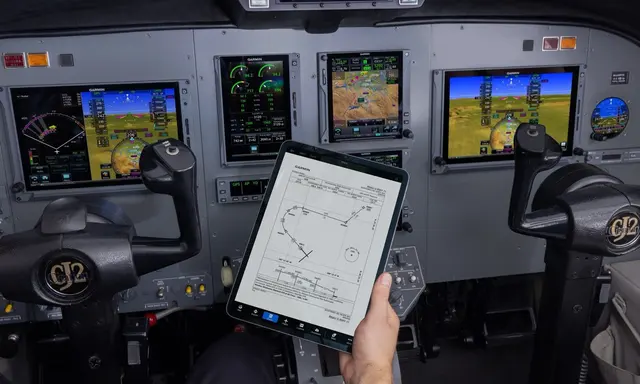
A safety technology passes a notable adoption threshold
Garmin says more than 2,500 aircraft are now equipped with its emergency Autoland technology, an adoption milestone reached a little over six years after the first certification. Announced on 14 October 2026, the figure spans a range of personal aircraft and business-aviation platforms. For private owners and passengers, the significance is not a promise that normal flying has become autonomous, but the growing availability of a certified system designed for a rare and potentially serious emergency.
The announcement comes as safety technology increasingly influences aircraft purchase decisions alongside range, cabin comfort and operating cost. A sophisticated flight deck can be attractive to a pilot, but Autoland addresses a very different question for the people travelling behind the cockpit: what happens if a pilot becomes incapable of flying? Garmin's system is built for that contingency, and its expanding installed base shows that several manufacturers and retrofit programmes have brought the capability into service.
What Autoland is intended to do
Autoland is an emergency system for circumstances such as pilot incapacitation. On an appropriately equipped aircraft, a passenger may initiate it using a dedicated control, and Garmin says the system can also activate automatically when it detects that pilot intervention is absent. It then plans a route to a suitable airport, manages the approach and landing, and communicates relevant information to air traffic control. The intention is to reduce dependence on an untrained passenger suddenly having to operate the aircraft.
This description must be kept within the bounds of the approved system. It does not mean every aircraft can take off, conduct an ordinary business journey and land itself without a pilot. Autoland is certified for specific aircraft and configurations, with defined operating conditions and procedures. Buyers should understand how activation works, what the passengers are instructed to do, and how crews train for the remote possibility that the equipment is needed.
From the first Piper approval to a wider fleet
Garmin identifies the Piper M600 SLS as the first certified application in May 2020. The technology has since spread across more than fifteen aircraft models, according to the manufacturer, and now reaches piston singles, high-performance turboprops and certain business jets. The expansion matters because those categories serve different missions: an owner-pilot family aircraft is not operated in the same way as a professionally crewed jet.
The scope of the programme can be easy to overstate if model families and individual configurations are treated as interchangeable. Garmin's published examples include selected Cirrus, Piper, Daher TBM and King Air aircraft, as well as the HondaJet Elite II and Embraer Phenom 300EV. A model name in a general list is not proof that any particular aircraft on the market contains the relevant hardware and approved software. The serial number and installed equipment must be checked.
Business jets move into the Autoland story
One of the developments highlighted in Garmin's announcement is the arrival of certifications for twin-engine jets. The HondaJet Elite II and Embraer Phenom 300EV are cited as examples, while the Pilatus PC-12 PRO and Epic E1000 AX also figure among approvals gained during 2026. The manufacturer says four additional aircraft models received certification this year. Such changes are meaningful because the system has moved beyond the relatively narrow category in which it first appeared.
For a jet owner, additional emergency capability may become part of discussions with a flight department, broker or insurer, but the purchasing decision should remain grounded in the aircraft's approved specification. Crew complement, mission routes, certification requirements and professional training are not removed by an emergency landing feature. Private aviation is safest when different layers of protection work together, rather than when one feature is expected to substitute for operational judgement.
A retrofit path extends the idea beyond new deliveries
Garmin reports that nearly 250 of the Autoland-equipped aircraft were retrofitted after their initial delivery. Some were built with a suitable architecture before the capability was enabled, while others have received more extensive avionics work. The retrofit element is important in a market where capable business aircraft can remain in service for decades. It suggests that safety options are not always confined to buying the latest airframe from the factory.
Retrofit feasibility depends on the aircraft, approved technical package and installation provider. An owner considering the investment should request a detailed survey of existing avionics, wiring, displays, autopilot systems and certification status, followed by a clear quotation for training and downtime. Even where a manufacturer has announced broader availability, an eligible aircraft may require a specific upgrade combination. A confident purchase decision rests on a documented configuration, not a general marketing promise.
The human side of an emergency system
Passengers may never need to touch an Autoland control, but clear briefing matters precisely because the use case is unfamiliar. The simplest instruction can be extremely valuable when stress is high: where the dedicated button is, when it should be used and how to follow system messages after activation. Crews should avoid overwhelming guests with technical detail, while making sure the people on board understand the purpose of the emergency provision.
Pilots and aircraft managers have a different responsibility. They must know the approved procedures, the system's limits and any differences between aircraft in a managed fleet. Maintenance records need to reflect software configuration and any related service requirements. If a charter or private owner group uses more than one aircraft type, a shared training philosophy can help, but aircraft-specific briefing remains necessary whenever the equipment differs.
What the 2,500 figure can and cannot establish
The installed-base figure is a manufacturer-reported count of equipped aircraft. It is not a measurement of emergencies prevented, successful activations or the probability that a passenger will ever need the system. Nor does it automatically prove that every private-aircraft operator should retrofit at once. The relevant assessment depends on the mission, the aircraft's existing capability, the expected service life and the owner's approach to safety investment.
What the number does illustrate is that emergency automated landing has progressed from a single certified application into a broader production and retrofit ecosystem. Operators increasingly have real aircraft installations and approved documentation to examine instead of relying solely on concept demonstrations. A technically mature conversation therefore asks about exact approval, maintenance implications and training, rather than simply whether the equipment sounds reassuring.
Further certification is on the horizon
Garmin says additional work is planned for 2027, including expected applications on certain Citation Gen3 aircraft and the Beechcraft Denali. Those programmes are forward-looking statements, not evidence that every proposed installation has already received approval. Certification schedules can shift, and owners should be particularly cautious about representing planned functions as fitted capabilities when evaluating an aircraft or planning a charter itinerary.
For luxury travellers, this is a useful distinction between headline innovation and delivered protection. An aircraft may be marketed with a future safety pathway, but the available equipment today determines how it can be operated now. A buyer who values the capability should ask for the aircraft's type-specific manuals, service records and confirmation from the authorised maintenance organisation. Clarity at the contracting stage prevents disappointment after delivery.
An evolving standard of private-aviation confidence
The luxury of private aviation is often described in terms of flexibility and personal service, yet a thoughtful ownership programme also invests in engineering and safety systems that passengers rarely notice. Autoland belongs in that quieter category. When properly certified and installed, it provides an additional option for a scenario in which the pilot can no longer complete the flight. It complements rather than displaces the training, judgement and professionalism of the flight crew.
Garmin's October milestone is therefore significant without needing exaggeration. More than 2,500 reported installations and a growing number of approved models indicate a technology gaining a broader place in aviation. The best response for owners is not to chase a single number, but to ask informed questions about the aircraft they actually use. A strong flight department turns new capability into reliable procedures and maintains a clear separation between genuine assurance and promotional claims.