Raymarine has divided its Cannes Yachting Festival display across the show’s motor-yacht and sailing areas, using the event to demonstrate a broad electronics portfolio rather than a single product launch. At Vieux Port the company is highlighting its latest Axiom displays, Maretron vessel-monitoring products and a new commercial ECDIS offering for larger yachts.
At Porto Canto, where the show concentrates more heavily on sailing and smaller motor boats, Raymarine is showing Alpha Performance instruments and RSW SmartWind technology. The split provides a useful picture of how modern yacht electronics are diverging into specialised applications while remaining connected through common onboard networks.
Axiom remains central to the integrated helm
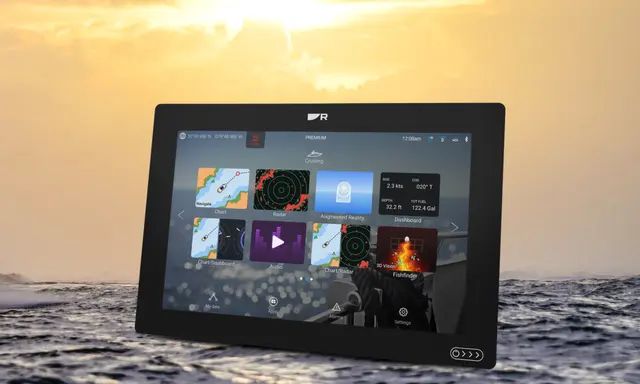
Raymarine’s Axiom multifunction displays continue to act as the visible centre of many of the company’s yacht installations. A modern MFD can combine charting, radar, sonar, cameras, autopilot control and vessel data, so improvements to the display platform influence much more than navigation alone.
For builders, the attraction of a common display environment is that several systems can be presented through a consistent interface rather than adding a separate screen for each function. Owners still need redundancy and sensible separation of critical systems, but a well-designed integrated helm can reduce clutter and simplify everyday operation.
Maretron extends the view into vessel monitoring
Raymarine is also presenting Maretron products at Cannes, reflecting the growing importance of detailed onboard monitoring. Tank levels, electrical status, machinery data and alarms can all feed into a networked vessel-management environment, giving owners and crew a clearer picture of systems that were once checked through scattered analogue gauges.
That is especially relevant to larger production yachts, where the number of pumps, batteries, tanks and technical subsystems can increase rapidly. Central monitoring does not replace physical inspection, but it can help crews identify unusual trends earlier and bring key information to the helm or other control stations.
Commercial ECDIS technology reaches the yacht sector
Raymarine Commercial is showing a new ECDIS offering for the superyacht sector at Vieux Port. Although ECDIS originates in regulated commercial navigation, the technology is increasingly relevant to professionally operated large yachts that need robust route planning, chart management and bridge workflows.
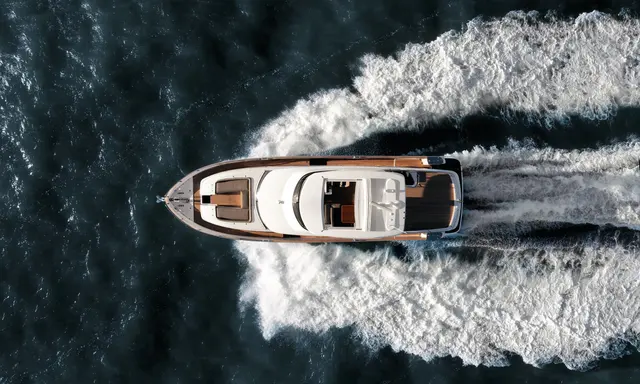
For sub-24-metre private yachts, a full commercial bridge may be unnecessary, but the direction still matters because features developed for demanding professional applications often migrate into smaller systems. Reliability, network resilience and clearer management of navigation data can benefit recreational owners even when formal carriage requirements do not apply.
Alpha Performance targets sailing crews
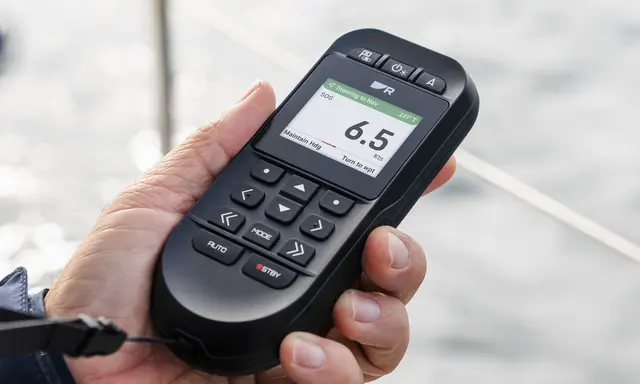
At Porto Canto, Raymarine is placing more emphasis on its Alpha Performance displays, which are designed to present sailing data in a clear format where crew can read it quickly from different positions. Performance sailing depends on wind, speed, heading and tactical information being visible without forcing a helmsman or trimmer to interpret a crowded chartplotter screen.
Dedicated instruments therefore remain relevant even in highly integrated systems. The useful distinction is not between old-fashioned instruments and modern displays, but between information that needs constant, glanceable visibility and information that is better handled on a larger multifunction screen.
RSW SmartWind focuses on better wind data
Raymarine is also demonstrating RSW SmartWind technology for the sailing market. Accurate and stable wind information influences sail trim, performance analysis and autopilot behaviour, so masthead sensing remains one of the most consequential parts of a sailing-yacht electronics package despite its relatively small physical size.
Better sensors only deliver their full value when calibration and network integration are correct. A production yacht leaving the yard with carefully commissioned wind instruments can provide much more trustworthy data than an installation where offsets, mast effects or network settings have not been properly checked.
Cannes shows how broad the electronics stack has become
Raymarine’s 2026 display spans navigation, monitoring, sailing instrumentation and professional bridge technology, illustrating how difficult it is to think of marine electronics as a single product category. The helm has become the meeting point for navigation, machinery awareness, communications and performance data across both motor and sailing yachts.
For owners, that breadth makes system planning more important than choosing an individual screen. The best installation is usually the one designed as a complete network with clear priorities for redundancy, usability, software support and future expansion, rather than a collection of impressive devices added one at a time.